When the Beetle added another


In 1970, the VW Beetle was technically completely outdated. There were hardly any rear-engined cars left, and those with air cooling were a minority anyway. Of course, the Porsche 911 had a similar design, but the Opel Kadett or Ford Escort had the standard drive (water-cooled four-cylinder at the front, rear-wheel drive), while the new generation of mid-range cars such as the Renault 16, Audi 80 or VW K70 came with a front engine and front-wheel drive.
And it was precisely at this moment that the Beetle was given a new lease of life with a fresh cell treatment.
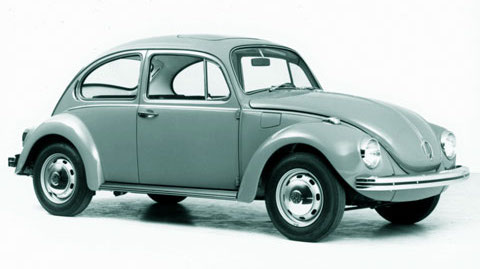
Auto Motor und Sport magazine took the first opportunity to test the new kid on the block, which featured a freshly designed front axle and a modified rear axle.
The conclusion?
"Anyone who thought that the Beetle was finished after decades of refinement was once again wrong. The changes of 1970 are the most extensive for a long time, and with them the Volkswagen presents itself stronger, safer, more spacious, better than ever. Even its image - fueled by the movie 'Love Bug' and the funny buggy wave - is more youthful and likeable than ever before, and the factory is clever enough to adapt it to this development with fresh pop colors. Whether you admire or revile the Volkswagen factory's stamina with this model, one thing has to be said realistically: This car does not need a successor at the moment," Manfred Jantke noted in conclusion to the test report.
For the sake of completeness, here are the technical and driving performance figures for the 1302 S:
Air-cooled four-cylinder boxer engine with a displacement of 1584 cm3 and 50 hp at 4000 rpm; kerb weight 870 kg, external dimensions 4.08 x 1.585 x 1.5 meters.
Driving performance: 0 to 100 km/h in 19.5 seconds, top speed 134 km/h
Price at the time: DM 5945
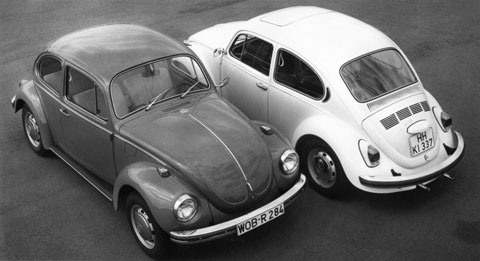
The 1302 was only available from 1970 to 1972, when it was replaced by the 1303 with a curved windshield.