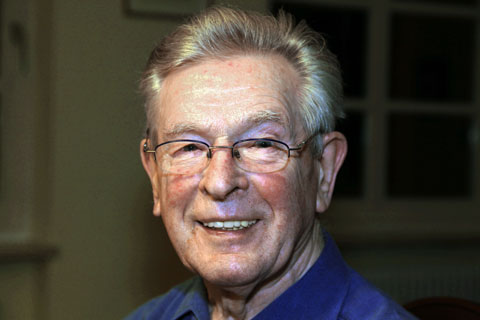
Gerhard Schröder passed away on January 7, 2018. As a designer, the namesake of the former German Chancellor was not a media-famous celebrity in the automotive world. But his work was all the more significant.
After the Second World War, Gerhard Schröder, born on March 21, 1925 in Markoldendorf in southern Lower Saxony, attended the highly regarded Hamburg School of Car Construction. During his studies, he was already working intensively on improving folding and folding mechanisms for convertible tops.
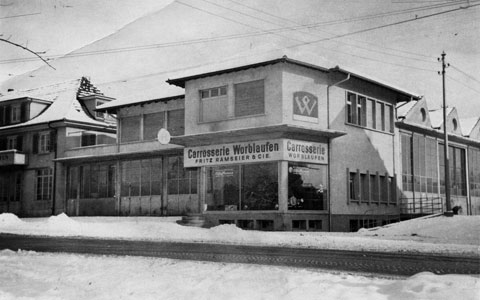
![Carrosserie Worblaufen Ramseier (© Archiv Gerhard Schröder)]()
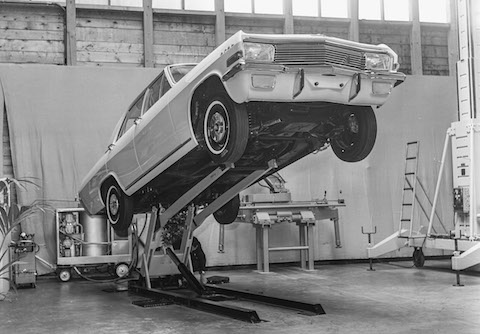
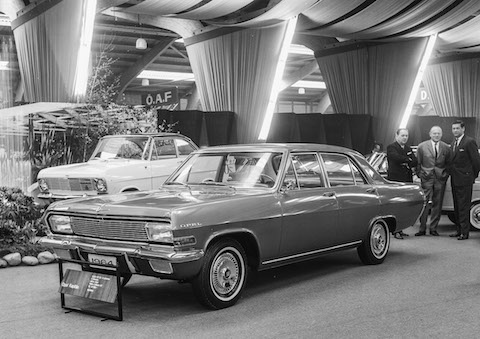
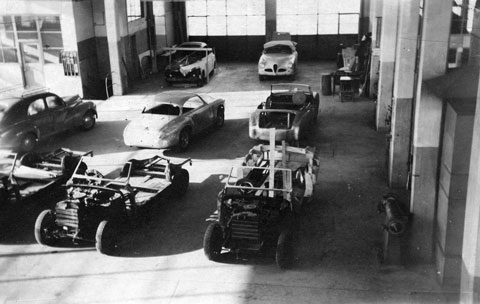
In April 1950, he joined the company "Carrosserie Worblaufen, F. Ramseier & Co" near Bern. The famous Swiss specialist for open-top bodies is the ideal place for him to mature into a sought-after expert in this field.
![In den Räumen der Carrosserie Worblaufen Ramseier (© Archiv Gerhard Schröder)]()
In January 1952, Gerhard Schröder moved to the coachbuilder Karl Deutsch in Cologne-Braunsfeld, where he worked on various soft top designs for Ford convertibles.
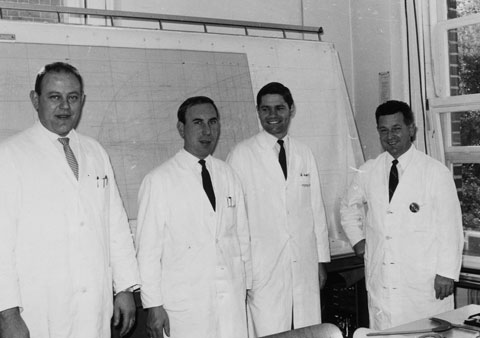
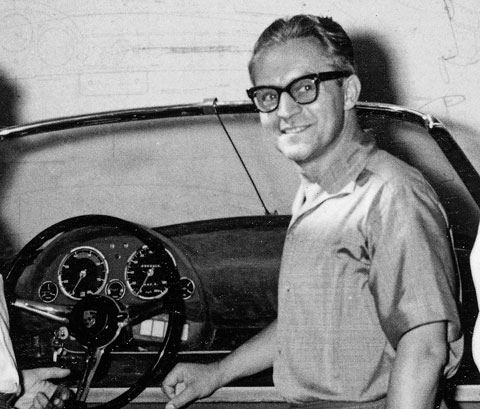
Just six months later, the next station followed, and with it another important step in his career: Gerhard Schröder moved to Karmann in Osnabrück, where he initially developed the large-scale production version of the soft top linkage for the Volkswagen Cabriolet. With the start of series production of the VW Karmann-Ghia, his next major task begins: the realization of an open version of the elegant Volkswagen coupé. It goes into production in the fall of 1957 with the VW Karmann-Ghia Cabriolet. However, at this time Gerhard Schröder was already working for the company to which he would remain loyal until his retirement. (Schröder on the right in the picture)
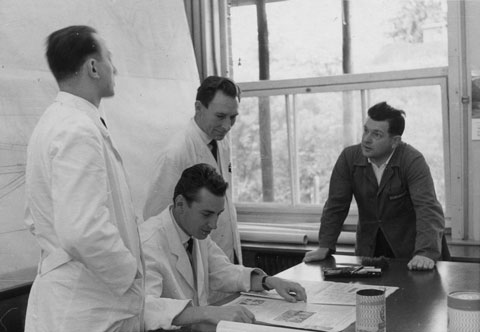
![Bei Porsche in den Sechzigerjahren - Kolb, Günter Kübler, August Wilhelm Gösse, Schröder (rechts) (© Archiv Gerhard Schröder)]()
It is the Dr. Ing. h.c. F. Porsche KG in Stuttgart-Zuffenhausen. Here, the body designer passed through various stations, and the development of folding tops was joined by other activities, increasingly in positions of responsibility.
![Bei Porsche - Lothacker, Srock, Maag, Schröder (© Archiv Gerhard Schröder)]()
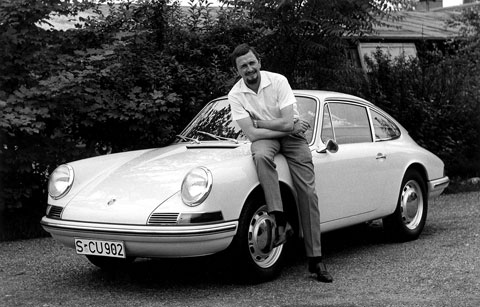
As it would be several years before Porsche opened its own professional design department, Gerhard Schröder's tasks also included designing and creating entire bodies. In the early 1960s, together with model maker Heinrich Klie, he created the shape of the Type 901, which, as the Porsche 911, became the most famous sports car in the world - a work for which Ferdinand Alexander "Butzi" Porsche took credit as head of the styling department, officially known as the "Model Department".
![Porsche 901 mit Butzi Porsche im Jahr 1963 (© Werk)]()
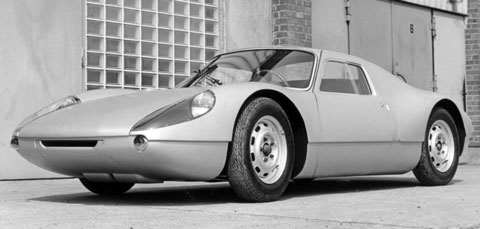
The Klie/Schröder duo also played a key role in the genesis of the Porsche Carrera GTS, which was known internally as the Type 904; the former once again as a designer, the latter with the implementation of the plastic body - a first for Porsche.
![Heinrich Klie, genannt "Konditor" (© Archiv Gerhard Schröder)]()
(Picture: Heinrich Klie)
Thanks to the success of the 904, Gerhard Schröder became head of a working group responsible for the body design and construction of Porsche racing sports cars.
![Porsche 904 GTS von 1963 (© Werk)]()
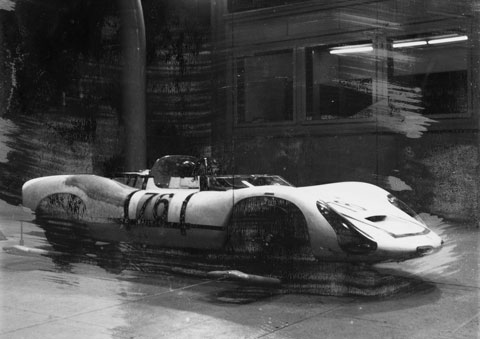
This work resulted in the 910, 907, 908 and 917, which made Porsche the most successful brand in endurance racing.
![Porsche 910 Spyder - Vorbereitung Aerodynamikversich (© Privatarchiv Gerhard Schröder)]()
Eugen Kolb (81), who created the silhouettes of these legendary cars under Gerhard Schröder, still praises his former boss today as a team player among his superiors who always gave his employees a free hand and had no problem delegating responsibilities.
In the early 1970s, Gerhard Schröder moved to the body-in-white department and later to the research department. He took early retirement in the late summer of 1984. Porsche's important designer, who was hardly known outside the sports car manufacturer, mainly thanks to his modesty, has now died in Nuremberg at the age of 92.
But the work of this lovable man will remain unforgotten. With the body shape of every classic Porsche 911 Coupé that drives past us - and with every Targa roof that disappears into the trunk when folded: This idea, too, born in 1965, came from the creative mind of Gerhard Schröder.