It's easy to forget how photos used to be taken before the digital camera was invented. Not so long ago, 30 years ago, ambitious amateurs took photos with(analog) 35 mm or medium format cameras, using color, slide or, as in the case of the Alfasud Ti photo above, black and white films of different sensitivities. Once the pictures were in the box - in this case the "box" was a Nikon FM - and the Ilford or Kodak film, which comprised 24 or 36 exposures, was ready, it could be removed from the camera and developed.
 To do this, the film was removed from the metal capsule in the dark - the capsule could be opened - and wound onto a spiral and placed in a Jobo developing box. Following meticulous instructions, a developer liquid was first added and the can was carefully moved. After the specified time had elapsed, the developer was removed, rinsed and then fixed, then rinsed again and the film, which was a good one meter long if no light had been added, nothing had stuck and no other mishaps had occurred, was fully developed and could be hung up to dry.
This meant that after around 30-40 minutes you had one or 36 negatives.
When the film was dry, you could start making paper prints. To do this, the negative was placed in the enlarger, which projected the image onto the table. Common devices came from Durst or Jobo, but in the example shown here it was an inexpensive Opemus-4.
The detail and sharpness were carefully adjusted and then a piece of photographic paper could be placed under the enlarger in semi-darkness, with only a reddish-orange bulb permitted as light. This was now exposed for a few seconds and then passed through a series of baths - developer, stop bath, fixer.
The most exciting part was when the image appeared and concretized in the developer bath. The result could still be influenced by longer or shorter baths in the developer tank. The image could also be adjusted by using different gradations (degrees of hardness) for the paper, by dodging and post-exposure, and of course by extending/shortening the exposure time.
It took a good 5 to 15 minutes to create a beautiful black and white enlargement, which was then in principle also unique.
Perhaps a few days had passed since the original photo was taken, perhaps even a few weeks. Of course, you could have all the work done by a professional lab, but then all the specific changes to the result were not possible. And the development experience (see above) also failed to materialize.
Well-processed enlargements last for decades, perhaps even centuries, if stored carefully. Whether today's digital images can still be "read" in 50 years' time, however, remains to be seen.
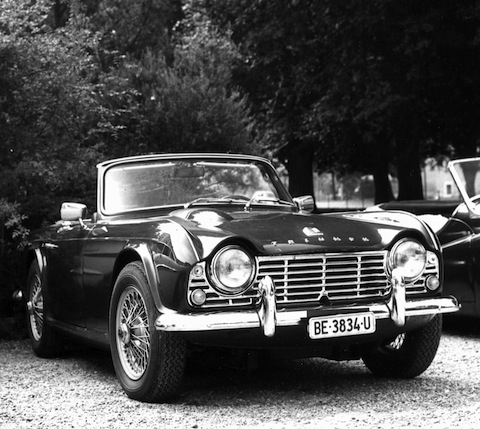
![Triumph TR 4 von ca. 1963, aufgenommen im Jahr 1981]()


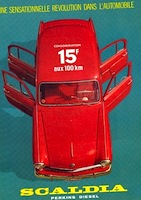 In January 1963, a press release made the rounds stating that the Belgian company Sobimpex was installing Perkins 1.6-liter engines in the Russian Moskovitch and thus producing the world's cheapest diesel passenger car "Scaldia Moskovitch". The press release also stated that some of these vehicles had already been tested as cabs in Brussels. The findings have been incorporated into the "series version", of which 1,200 units are now to be produced per year. The car was also shown at the Brussels Motor Show in January 1963. Sales brochures were printed, but the expected success did not materialize.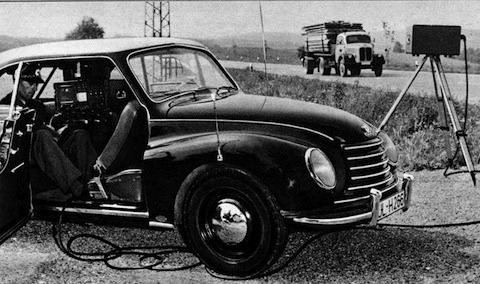
 37% of German drivers who took part in an opinion poll published last week by the magazine AMS have been caught by speed cameras in the last 12 months. Of these, 59% were caught once, 28% twice, 9% three times and 3% even more often.