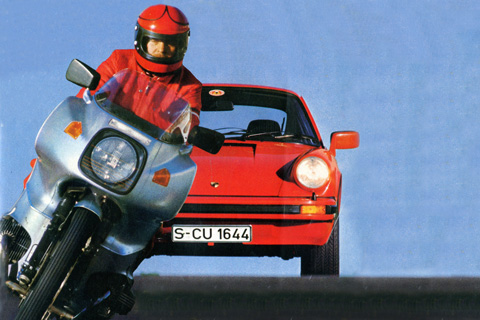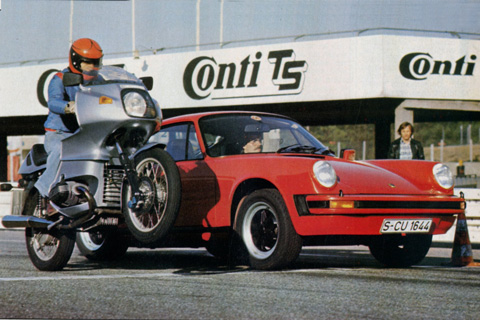
It's a fairly old question that was already hotly debated at regulars' tables and among experts in the 1970s: Is a motorcycle faster than a sports car?
A good 40 years ago, the magazine "Sport Auto " took out a stopwatch and pitted one of the fastest motorcycles of the time against a sports car.
Tracking ability, wagging, slalom, handling and times on the small Hockenheim circuit were compared, as well as braking deceleration.
And although the BMW R 100 RS (with two-cylinder boxer engine) with 70 hp developed only a third of the power of the Porsche 911 Carrera 3 Liter with 200 hp, it was ahead in acceleration up to 180 km/h. The motorcycle took 4.6 seconds to reach 100 km/h, while the Porsche needed 6.3 seconds. Up to 160 km/h, it was 12.6 seconds for the two-wheeler and 16.2 seconds for the rear-wheel-drive Porsche. However, the top speed then went in favor of the car, 235 km/h versus 200 km/h. The motorcycle was also faster when weaving, and the same was true for the slalom. However, the tide turned on the handling course and on the small circuit of the Hockenheimring, where the Porsche was able to distance itself from the BMW RS to some extent, by around 2.2 seconds on the circuit.
The braking test was exciting, which the Porsche initially seemed to win with 8.0 m/s2, mainly because the bike started to lurch badly. Interestingly, however, when concentrating only on the front brake, the bike increased to 8.85 m/s2. On the third attempt, again with front and rear brakes, the rider was thrown off the bike. This shows that a motorcycle may be faster and better than a car in many disciplines, but it is not easy to ride.
In addition to the pure performance comparisons, the difference in price and weight should also be noted: the BMW R 100 RS cost DM 11,210 in 1977, while the Porsche cost DM 46,350. The weight comparison was 230 kg versus 1120 kg.
Since then, the battle between motorcycles and cars has continued, and today it is increasingly being fought on YouTube, but car magazines are also taking up the topic again and again, such as " Auto Bild" in 2017, exactly 40 years after the test summarized above.
Once again, it was a BMW motorcycle and a Porsche sports car. However, customers and manufacturers had become more demanding in the meantime. A BMW S 1000 RR with 199 hp was pitted against a Porsche 918 Spyder with 887 hp. The DM 11,210 of 1977 had become EUR 17,400 for the motorcycle, while the price of the car had climbed from DM 46,350 to an astronomical EUR 768,026. So the Porsche no longer cost four times as much as the motorcycle, as it did 40 years ago, but 44 times as much. And it not only had four driven wheels, but also a dual-clutch gearbox, electric motors and various electronic aids on board.
As a result, it got off the starting blocks better and reached 100 km/h in just 2.6 seconds, while the BMW took 3 seconds (four tenths more). The 918 needed a meagre 4.9 seconds to reach 160 km/h, while the RR reduced the gap slightly and reached 160 km/h in 5.2 seconds. By 200 km/h, the tide had turned and the bike needed one tenth less to accelerate to this speed from a standstill. And the bike then maintained its lead up to 280 km/h, only to have to capitulate at 300 km/h because the gear ratio was too short. The two-wheeler and four-wheeler completed the standing kilometer in the same time of 17.99 seconds, compared to the 25.3 seconds (BMW R 100 RS) and 26.4 seconds (Porsche Carrera) of 40 years earlier.
But even in the modern era, the motorcycle was the much more difficult machine to drive, so a professional driver was put in the saddle and she also had a lot to do to keep the two-wheeler on the ground.
So the car may be able to make better use of its advantages today, but in terms of performance per euro, the motorcycle will probably always be ahead, perhaps even more so today than back then, especially as the increase in weight of the two-wheeler was marginal at best, whereas even hyper sports cars today can weigh over 1.5 tons.