Mom, mom, look, dad has flattened our car!


The tuning fair in Essen is something very special for classic car enthusiasts. Normally, people insist on originality, especially when it comes to historic cars. Everything, even the smallest detail, should be from its time, preferably without new parts, right down to the paintwork and leather.
Then you are suddenly confronted with things that make you wonder what the point is.

The absolute extreme example at the current Essen Motor Show is a black Mercedes-Benz 190 SL, a true classic, beautifully shaped and perfect down to the last detail and now it is lying there, flat on the floor. Far removed from its originality, it looks like a carpet on top of a carpet. With the extreme negative camber at the rear axle, which takes some getting used to, it no longer looks aesthetically pleasing. One can only hope that all the original parts are still available to make a rebuild possible. Whether you like it or not, it has to be said that the quality of workmanship of the tuning objects cannot be criticized in any way. Even on the 190 SL, all the gaps fit better than on the original.
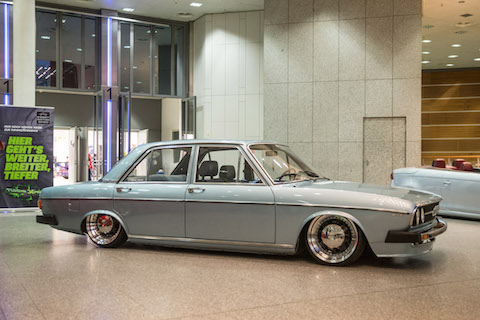
Another vehicle that looks much better in its original condition than in such a baggy state is the Audi 100 LS. What is somehow acceptable for the Americans is somehow out of place for the Europeans. It is said in the scene that the trim position close to the ground is supposed to ensure improved aerodynamics and, in turn, lower fuel consumption. In addition, the shortened suspension travel should ensure optimized handling in extreme situations.
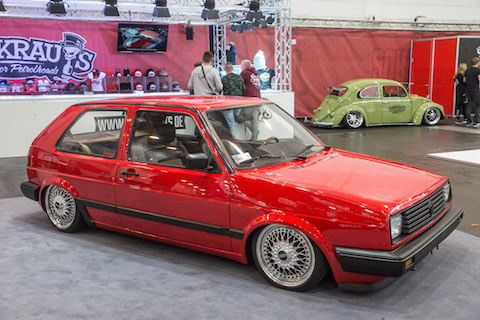
Tuning comes from racing, where road cars were helped to achieve faster lap times with more powerful engines and improved suspensions. Everything that was changed was ultimately intended to improve times. However, the resulting look also appealed to non-racing drivers and so various derivatives from the race track were brought back to the road.
As early as 1953, the company "Kamei" presented the first front spoiler, at that time still called a "depth control", for the VW Beetle in order to get more downforce on the front axle of the extremely rear-heavy vehicle from 100 km/h upwards.
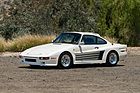
The big tuning boom then began in the seventies. At that time, there were also many extreme conversions, such as the Gemballa on the Porsche or the Ferrari. This marked the beginning of the "show tuning" era. It was no longer the improved driving dynamics that were in demand, but rather the eye-catching appearance. The so-called "GRP bombers" became increasingly popular and even made it onto the big screen in the movie "Manta, Manta".
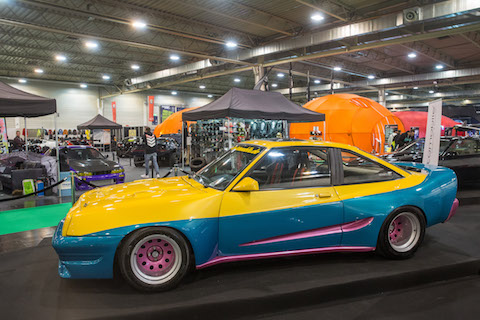
From the end of the nineties, the trend returned to much more discreet conversions. Mostly also to pure factory conversions such as AMG from Mercedes, M-Edition from BMW, or Abt from Audi.
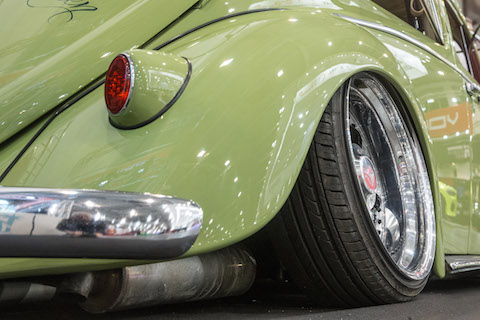
Not so at the tuning fair, where the hobby scene of tuning meets and presents absolutely perfect conversions beyond good and evil. It is really rare to see a car of this type on the road, but with today's legal framework it is extremely difficult, or even impossible, to get a license for such a tuned vehicle.
Therefore, one wonders why so much money is spent on such a refinement of a car that can never fulfill a purpose. The presentation at the Essen Motor Show (30.11. - 8.12.2019) is ultimately only of very short duration.