Finally a racing movie again and a really good story to boot. A movie with a running time of around 150 minutes and lots of action. But does it really deliver what the title promises?
Perhaps, as a racing photographer for many years, I am simply not qualified to judge it, as I am far too biased towards reality. The whole story seems massively overstretched to me, but that doesn't do the movie any harm, quite the opposite. It also makes it really entertaining, the time flies by. The acting performance of the two main actors (Christian Bale and Matt Damon) is absolutely first class, especially Christian Bale as Ken Miles with his cheeky openness is a great audience favorite. All the scenes with the historic start-finish straight and the extremely realistic pit building, which no longer exists, are extremely impressive.
But why does the hours of good build-up have to be ruined in a short space of time at the end? Instead of reasonably good racing scenes with unusual camera angles, we end up with a production in the style of a Michel Valliant comic. What fits in a comic is far from being film-ready. It's one thing to be constantly shifting up with only four gears available, but it's quite another to be able to fly over the embankment with the car completely unscathed.
At the latest, however, the prolonged eye contact when driving side by side at well over 200 km/h really takes you completely out of touch with reality. Or maybe that's what Vettel and Leclerc tried to do last Sunday? A race to catch up, in which all the opponents look like "learner drivers", may be funny in "A Great Beetle", but unfortunately this is completely out of place here. If you could at least make up a lot of time and ground consistently over several laps, that would be okay. But catching up and overtaking within a single lap is somehow not possible. Seen in this light, a Lewis Hamilton would have overtaken Pierre Gasly and Max Verstappen in Interlagos with 1500 rpm more on the last 800 meters and, to be on the safe side, would have made up for his already impending five-second penalty.
The finish would also have made a much better impression if it had been toned down and rendered more realistically. As always, a huge amount of effort was put into the driving scenes. But if they had been made just a little more real, the movie would have been much better. In my opinion, such a great racing car shot from cheeky perspectives and with the right sound to go with it wouldn't need such exaggerated gags ...
But everything is different in Hollywood, as Niki Lauda laughingly told me at the film premiere of "Rush" that he deleted the scene in the script where his actor (Daniel Brühl) was supposed to insert the ignition key into the ignition lock of the Formula 1 car and start the engine. Unfortunately, this is exactly how many of the racing scenes from "Le Mans 66" came across to me.
As a conclusion to a good racing film, Steve McQueen's "Le Mans" clearly remains untouched for me, far ahead of all other films made to date.
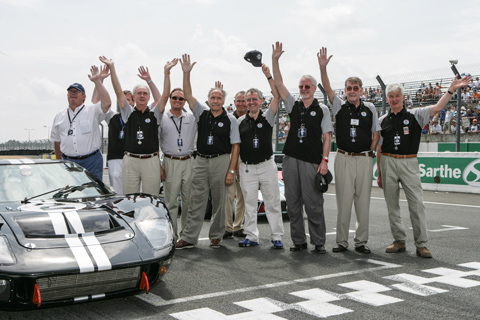
![Die Crew von 1966, aufgenommen in Le Mans 2006 (© Daniel Reinhard)]()
Visible in the picture: Ian Slater (Ford of Europe), Phil Henny (Shelby America), Alan Mann (Alan Mann Racing), Harry Calton (Ford Chief Press Officer 1966), John Whitmore (Driver Ford GT 40 Car No. 8), Lee Holman (Holman Moody) and Brian Lewis (Ford Advanced Vehicles / Alan Mann Racing).
The picture above shows the three 1966 Ford GT40s crossing the finish line in 2006.