Classic car drivers adapt their behavior to the summer heat (question of the week)

Hot summer days with temperatures above thirty degrees are becoming increasingly common in our latitudes too. While modern cars are equipped with powerful air conditioning systems (for the crew) and robust cooling circuits (for the engine), older cars heat up more, struggle more with the temperatures in the engine compartment and can lead to overheated occupants. With a " question of the week" , we therefore wanted to find out whether classic car owners change their behavior because of the summer heat.
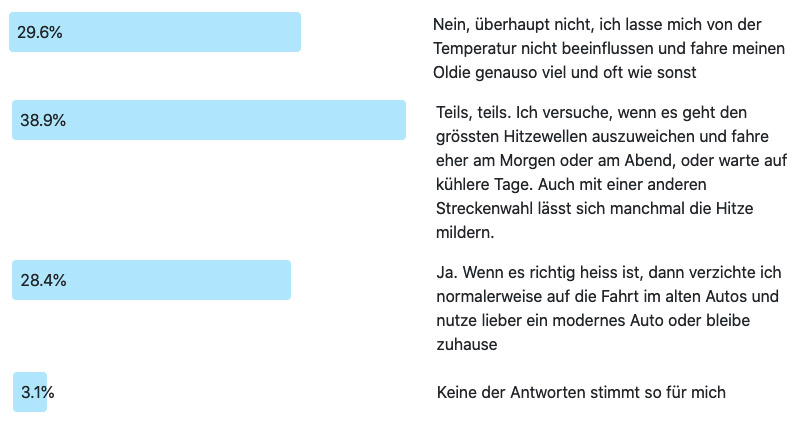
In fact, around two thirds (67.3%) of drivers of old cars adapt to the conditions. A good half of them do so situationally, trying to avoid the worst heat waves or taking a different route. 28.4% (absolute), i.e. slightly less than half of these classic car owners, prefer not to drive their old car, prefer a modern car or stay at home.
Slightly less than a third of all 324 respondents, 29.6% to be precise, see no reason to adapt and use their old car just as much and as often as usual.
One reader also pointed out that there are, after all, auxiliary radiators and the option of keeping the oil level at the upper limit, or installing an oil cooler so that the classic car can cope with higher temperatures. "In our case, the driver is the first to break down in the heat, never the classic car!" said the reader in his letter. However, this driver-side problem in particular was addressed in our question of the week just as much as the technical problem.
For the sake of good order, it should be added that 3.1% were unable to "tick" any of the answers given.
Here is the graphical representation of the result:
We have already posed the next "Question of the Week" . Now we would like to ask our readers to predict which of the six vehicle types given will be the most common on our roads in 2050.
Of course, you can still read all the answers to the more than 200 questions of the week so far .