A battery that visually matches the old car is a bonus (question of the week)


If you open the hood of an old car, you are often startled by a colorful/modern battery in the well-kept and authentically restored engine compartment, which doesn't really fit in with the rest. But today's batteries just look different from the ones that were installed decades ago, which usually had a black rubber housing and refill openings for the fluid level.
In a question of the week, we asked Zwischenas readers what they think of batteries and whether functionality is more important than looks, or vice versa. 311 answers show that there is no uniform opinion here.
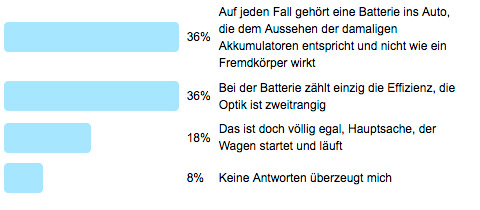
A good third (36 percent) thought that a battery that matched the appearance of the batteries of the time and did not look like a foreign object definitely belonged in the car.
However, an equal second third (again 36 percent) were of the opinion that only efficiency and not appearance was important.
A further 18 percent said that they didn't care at all as long as the car ran and started, while eight percent couldn't come up with an answer.
However, one reader explained to us that the issue is much more complex and that it's not just about looks:
" Of course you shouldn't install a white, blue or red battery, that would be a bit unsightly. It should at least be black. But the problem arises for another reason:
Modern lead batteries have a much lower internal resistance than those of earlier years. The old mechanical regulators and the alternators of the time have a hard time with this. Added to this is the modern stop-and-go traffic, because the battery is hardly charged below 1500 rpm.
With modern maintenance-free batteries, the regulator voltage must be maintained much more precisely. This is only possible with electronic temperature-compensated regulators. According to the Lucas data sheet, a mechanical three-element regulator has a control voltage of 12 to 16.4 volts, depending on the load and temperature. An electronic regulator, on the other hand, delivers between 14.2 and 14.4 volts under the same conditions. For this reason, batteries used to have plugs for topping up with distilled water, as this was simply necessary under the conditions of the time. Modern batteries in combination with mechanical regulators only work if the regulator is set to a maximum of 14.4 volts and the battery is recharged at home with the charger after every ride. Otherwise the battery may only have a short service life.
It seems important to me that these facts should be taken into account when deciding which battery to install. Because it's not just about looks."
So, as always, everything is a little more complicated, but at least the industry is increasingly offering solutions that are visually and technically compatible with classic cars.
Here are the results of the survey in graphic form:
And of course we have already asked a new question of the week . This time we want to know which criterion weighs most heavily when buying a classic car?
And of course you can still look up the results of all the previous questions of the week .