Driving like 120 years ago


Around 120 years ago, people in Paris were amazed when Louis Renault managed to drive up to Montmartre in his own design without stopping. Napoleon had failed on horseback decades earlier on the steepest road to the highest point in Paris, but Renault's little car overcame the incline and its builder won a bet.
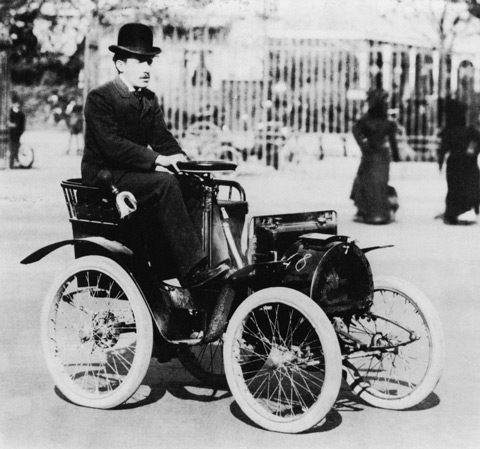
He was also able to take orders for his car, even though he had designed it for his own use and built it in his shed at home.

Although it was built 120 years ago, both the car and the way it was driven were not fundamentally different from what is the norm today. The engine was started with a crank handle assigned to the driver, so to speak.

Because the front-mounted engine was not large at 198 cm3, the effort required to start the single-cylinder engine immediately was limited.

The Renault, which was later called the Type A, was the first car to have a three-speed gearbox with a direct gear and power transmission to the rear wheels via a cardan shaft.

Gears were shifted using a rotary lever in the middle of the car, while another lever was used to engage reverse gear.
Braking was manual, with a pull on the lever on the outside right acting on the rear brakes. The accelerator was also operated manually via the handlebar, which acted directly on the front wheels.

As the two-seater car with an output of around 1 hp and sprung rigid axles at the front and rear only reached leisurely speeds, there was not too much hustle and bustle when operating it, but shifting gears several times up to 20 or 25 km/h was quite something. Nevertheless, the selectable gear ratio allowed Louis Renault to climb the hill of Montmartre, which marked the beginning of a now 120-year-old carmaking tradition. Many of the French carmaker's subsequent designs were just as revolutionary as the Type A, albeit in a different sense.