Let's start with a quick minute's thought: Can you think of a battery-powered and fun-to-drive two-seater that you can get your hands on for less than 40,000 euros or Swiss francs? And which is also suitable for everyday transportation tasks?
Neither do we. But why is there such a gap in the constantly expanding range of electric models offered by car manufacturers? One obvious reason could be that the latter first want to ensure the "basic supply" of their customers in the coming years of change and therefore prioritize the (further) development of more practical everyday cars à la VW ID.3, BMW i3 or Škoda Enyaq iV. Electric vans, SUVs and commercial vehicles are also gradually replacing their combustion engine cousins.
Electric sports cars, on the other hand, are currently mostly not "classic" sports cars, but exotic hypercars with well over 1000 hp and correspondingly exorbitantly high prices, apart from German products. However, it is obvious that it is not only the wealthy who enjoy driving pleasure. Nevertheless, car-loving average earners have not yet been offered an adequate electric sports car.
However, models such as the Renault Zoe, the Hyundai Kona electric and, above all, the Tesla Model 3 have impressively demonstrated how much Mr. and Mrs. Mittelstand like to use battery-powered cars. In my at most semi-qualified opinion, their technology should also be able to be installed in a compact two-seater, although this would have to sacrifice certain amenities in favor of a more sports car-like power-to-weight ratio.
With a weight of approx. 1200 kilograms, appealing driving performance would be achievable, although the bare car quartet figures should not be the main focus. The 289 kilowatts of the basic Model 3 would probably be too much of a good thing, even a coupé or roadster with less power and rear-wheel drive could certainly make its occupants grin. A low center of gravity thanks to the battery mounted flat in the chassis would also be beneficial for lateral dynamics.
A clear indication of the popularity of budget-friendly fun drivers is the fact that the 2022 annual production of the Toyota GR86 was sold out within a few days. Its prices started at just under 34,000 euros, for which the lucky last-minute buyers received a light, agile and, above all, refreshingly pure coupé. Like its sister model, the Subaru BRZ, the GR86 is powered by a four-cylinder boxer engine without turbocharging and despite "only" a good 230 hp, it can achieve adventurous drift angles.
Just as anachronistic as the lack of forced ventilation is the standard manual six-speed gearbox. With such promising ingredients, it is hardly surprising that many people's mouths were watering, but unfortunately these traditionally fun-to-drive factors also diminish the hope of an electric people's sports car.
The appeal of the new Toyota GR86, but especially that of many classic cars, lies in the tangible mechanics of a conventional automobile and the interaction with it. The drive in the Fiat Nuova 500 revealed to the author of these lines that the involvement of all the senses is the main reason for our fascination with historic vehicles. While in a classic car you always know what the road surface is like and can feel whether the last gear change was clean or not, the ride in a modern automatic car feels almost sterile (in both senses of the word).
This ultimately relatively subjective experience has been written about many times here and elsewhere. In this blog post, it unfortunately serves as an argument as to why electric sports cars with moderate performance values and purchase prices will probably play a much smaller role than their petrol-guzzling ancestors. It goes without saying that the electric drive does not require a gearbox, which means that a very characteristic element of sports cars is eliminated from the outset. Hardly anyone would want to drive a Fiat 850 Coupé, Caterham Seven or Mazda MX-5 without sorting the gears themselves.
Of course, it is technologically possible to simulate a combustion engine with a short-ratio gearbox in an electric car and make the driver appear to be more involved in the action by means of a crisp gearshift. However, additional equipment on board increases the weight and thus also reduces the range, whereby even the best simulation cannot possibly leave exactly the same impression as a ride in an unadulterated "original" such as the Triumph Spitfire.
Simulating the sound of a combustion engine also poses serious problems for any car manufacturer. However, automotive traditionalists sometimes shake their heads at the modified engine sound of modern premium vehicles, and a purely electrically powered car would have to be given significantly more background music. This raises the question of whether potential customers would prefer synthetic imitations of classical symphonies to the unattractive, but at least honest e-humming.
Another point that speaks against a coming flood of affordable battery-powered sports cars is the growing awareness of the finite nature of resources on planet Earth. Even the production of an electric car devours countless tons of raw materials and if this same car is then only used sporadically as a leisure vehicle, it is at least partially justified to question its cost-benefit ratio.
It is possible that breathtaking acceleration and top speeds beyond good and evil are simply the only, or at least the best, means by which the electric drive in a car can boost our dopamine and adrenaline levels. But who knows, perhaps car manufacturers will soon launch plug-in sports cars that a broader section of the population can afford once the more everyday electric models have been established.
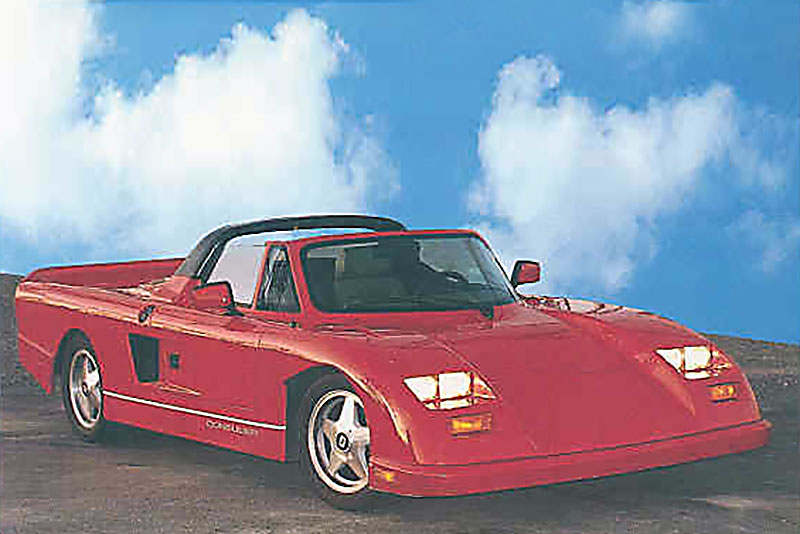
In the mid-nineties, the two US e-sports cars Renaissance Tropica and Electricar GTP ( pictured above) failed mainly due to the state of the technology at the time. If these interesting concepts had been realized almost three decades later, this blog post would probably have been about a different topic.
If you have now begun to ponder the future of the sports car, you are of course welcome to share your thoughts and theories with other readers in the comments below. We are curious...