Only overpowered front-wheel drive vehicles need all-wheel drive

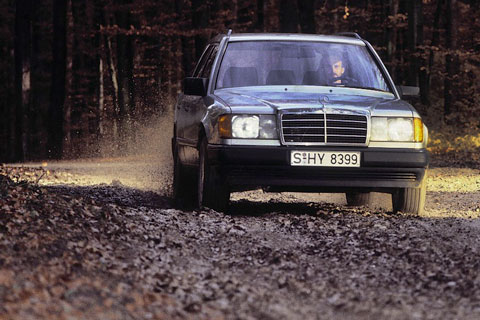
Today, it is hard to imagine a head of development at a major car brand saying that all-wheel drive is only a necessary evil for overpowered front-wheel drive vehicles. In fact, Friedrich van Winsen, responsible for passenger car development at Daimler-Benz, said something like this at the beginning of the 1980s. Mercedes already had cars with all-wheel drive at the time, but these were veritable off-road vehicles with rigid axles at the front and rear or commercial vehicles.
This changed quite quickly in the 1980s with the Audi Quattro and its descendants, and today four-wheel drive cars can be found with practically every manufacturer and in almost every model series.
The fact that there was less demand for four-wheel drive in the fifties and sixties was certainly also due to the fact that there was significantly less power available, which was usually sent to the rear wheels. With the GTI and the like, however, front-wheel drive cars became faster and faster. For a long time, it was thought that 200 hp was the end of the line for front-wheel drive, but even this limit was eventually pulverized thanks to better limited slip differentials and electronic aids.
What could never be completely eliminated, however, were some of the disadvantages that all-wheel drive already had in the 1980s. It made the cars heavier and thirstier. And this is still the case today. But the safety benefits compensate for this aspect for most buyers and all-wheel drive is part and parcel of SUVs, the most popular vehicle category today.
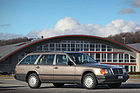
We have just reported in detail on the Mercedes-Benz 4Matic all-wheel drive system, which was presented at the IAA in Frankfurt in September 1985, in connection with the Mercedes-Benz 300 TE 4Matic .