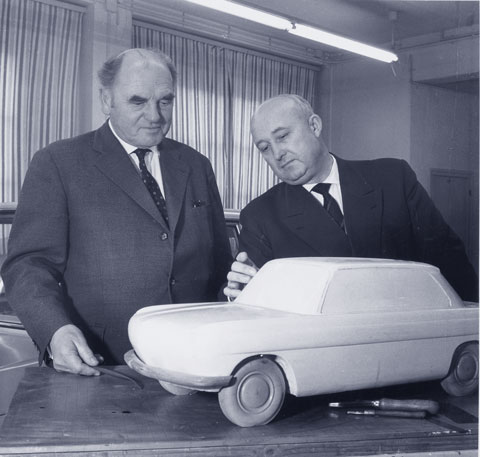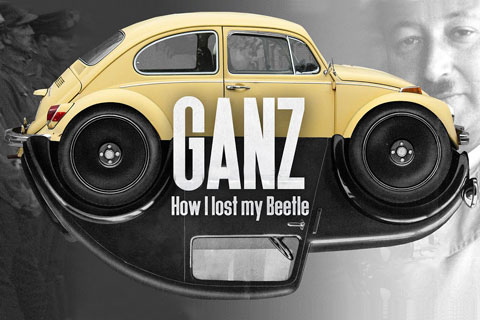
The claim is huge: Josef Ganz, not Ferdinand Porsche, is the father of the VW Beetle. On Saturday, September 12, 2020, the documentary by journalist Paul Schilperoord and director Suzanne Raes "GANZ: How I Lost The Beetle" was shown at the Swiss Museum of Transport in Lucerne. It is an emotional cinematic reappraisal of Josef Ganz's life based on his estate, which Paul Schilperoord has analyzed. (2)
His book has been published in several languages. Both SRF and Blick reported on the film in advance. (3)
The fate of Josef Ganz is shocking. Even as a Swiss citizen, we are ashamed of the way he was treated in our country. Something like this must never happen again, said many people who saw the movie. The fact that Jews are once again increasingly becoming victims of bullying and violence should not leave us cold.
Nevertheless, it is fair to ask whether the claim to Josef Ganz's authorship of the VW Beetle is correct in the way it is presented. The film goes much further than the book. In the film, Josef Ganz says sentences such as "... Porsche built the Beetle in a way I couldn't have done better ..." or "... a million Beetles and I'm not invited to the party ...". The texts are not written by Josef Ganz, but by the authors and are spoken by a narrator. They are part of a dramaturgical exaggeration, as the director explained after the film in Lucerne.
But they intonate what Josef Ganz himself wrote: "I created the Volkswagen. I coined the name and created a car with rear engine, backbone platform chassis and swing axle suspension at a time when Dr. Ferdinand Porsche, as technical director of Mercedes-Benz, was scrapping all that company's rear-engined prototypes because he thought the system impractical" [Ich schufte den Volkswagen. I coined the term and created a car with a rear engine, central tubular chassis and swing axle at a time when Dr. Ferdinand Porsche, as technical director of Mercedes-Benz, was scrapping all that company's rear-engined prototypes because he thought the system impractical]. (4)
One instinctively wants to enter into a technical debate. With their large wheels fitted with thin tires and their wooden frame supporting the bodywork, Ganz's designs appear to be exponents of an older generation of cars alongside a VW Beetle with its all-steel body, despite all the similarities in appearance. The all-steel body technology developed by the Budd Company in Philadelphia was the key to the mass production of the automobile in general and for the VW Beetle in particular after the Second World War. (5)
But the decision on this development was made long after Josef Ganz had to flee Germany after massive threats to life and limb.
In his book, Paul Schilperoord summarized the claim as follows: "He had developed the basic design, propagating the concept of an affordable Volkswagen for years ...." (6)
The question is whether the formulation of a basic technical concept is sufficient to establish authorship of a particular car model. In the book about his years at FIAT, Dante Giacosa described how, when designing the Fiat 600, he had the choice between a front-engined, front-wheel drive or rear-engined, rear-wheel drive model, given the weight and space constraints imposed on him. He opted for the rear engine for cost reasons. The combination of drive and steering is technically demanding and was too expensive for him at the time. (7)
If you have opted for a rear engine, then you almost inevitably need a swing axle variant at the rear. To ensure access to the engine, a hatch would have to be provided in the rear to create as much interior space as possible. In addition, the rear wall behind the engine will be pulled at an angle from the roof to the floor, creating a kind of streamlined shape at the same time. These are logical connections at a very high level of abstraction. The decisive factor is the execution.
It is noticeable that Josef Ganz did not place the engine behind his designs, but in front of the rear axle. Strictly speaking, he did not design rear-engined cars, but mid-engined cars. In his patent (DE 587409 dated May 8, 1932: Drive block for motor vehicles), he describes the advantages of this arrangement in terms of driving dynamics. His patented swing axle (CH 170286 dated June 30, 1934: Pendulum swing axle on motor vehicles) had two parallel, transverse leaf springs.
The VW Beetle had a rear engine, i.e. an engine behind the rear axle in Josef Ganz's formulation, and had torsion bar springs. But are these technical differences enough to negate Josef Ganz's authorship of the VW Beetle concept? Important in this context are the comments made by editor-in-chief Josef Ganz in his magazine "Motor-Kritik" on Ferdinand Porsche's prototype for Zündapp in 1932 and on the Mercedes-Benz 130H (W23) at the end of 1933. Both cars are four-seaters with rear engines and fit well with the VW Beetle in terms of concept. "However, the Zündapp Type 12 was not a Volkswagen, but a mid-range car ..." summarizes Paul Schilperoord. (8)
And: "The MB 130H is not really a real car with a rear engine. Rather, it is a car with an outboard engine". The engine is positioned far back, which resulted in undesirable lurching on the road". (9)
This makes it clear: Josef Ganz understood the Volkswagen product to be a small car with a mid-engine, two seats (a bench seat) and a small engine. His Standard Superior had 12 hp in 1933. With an unladen weight of 490 kilograms, that was 40 kilograms per horsepower. This enabled it to reach a top speed of 70 kilometers per hour. (10)
It primarily had to be cheap. It is perhaps characteristic of Josef Ganz that he criticized Wilhelm Gutbrod for demanding a closed body, a more powerful two-cylinder engine and an electric starter. These were all things that would increase the weight and price. (11)
Ferdinand Porsche disagreed with this definition of a Volkswagen as early as 1931: "First and foremost, a distinction must be made between a driving machine, which I imagine to have a maximum load capacity of two people, and a people's car, which in my opinion must have four relatively comfortable seats. ... The people's car, on the other hand, I can imagine as a robust, not too small car with a weight of about 600-650 kg depending on the bodywork and a cylinder capacity of about 1500 cubic centimeters as quite powerful." (12)
Based on these ideas, he developed the prototypes for Zündapp (Type 12) and NSU (Type 32) in 1932/1933. (13)
In his 1934 exposé, he doubled down: "I have studied the question of the Volkswagen in detail ... I do not understand a Volkswagen to be a small car which, by artificially reducing its dimensions, power, weight, etc., continues the tradition of previous products in this field in the stork's beak manner. Such a car can be cheap in terms of purchase price, but never from the point of view of a healthy economy, since its utility value is extremely low due to the reduction in driving comfort and service life." (14)
His Volkswagen in the form of the VW Beetle had a rear engine, four seats (two rows of seats) and 25 hp (Type 1 from 1948). With an unladen weight of 720 kilograms, that was around 30 kilograms per horsepower or about 25 percent less than the standard Superior. Its top speed was 105 kilometers per hour. (15)
Conclusion: The VW Beetle and the Standard Superior are two different types of Volkswagen, firstly in terms of the targeted customer segment and secondly in terms of design. Ferdinand Porsche is the biological father of the VW Beetle. Josef Ganz can be seen as an important exponent of small cars. However, the two could well be brothers, to stay in the picture.
But it would be wrong to see the period between 1928 and 1934 in the German automotive industry as dominated by a showdown between Josef Ganz and Ferdinand Porsche. The idea of a people's automobile had been discussed in Germany since 1904. (16) Griffith Borgeson, Karl Ludvigsen and Paul Simsa have described from a neutral perspective the emergence of a rear-engined middle-class car in Germany in the 1930s. (17)
The largest car manufacturer in Germany until the beginning of the Second World War was by far the General Motors subsidiary Opel. It was the pioneer of series production and the self-supporting body and dominated the mid-range car segment. It relied on the conventional design, i.e. front engine with rear-wheel drive. It applied what Ferdinand Porsche called the stork's beak principle: a (more or less) true-to-scale downsizing of larger models. Based on preliminary work by Edmund Rumpler, Paul Jaray, Béla Barényi, John Tjaarda van Sterkenburg and others, Josef Müller and Hans Nibel realized the Mercedes-Benz 130, which was produced from 1934 to 1936, and Ferdinand Porsche the VW Beetle in 1937, which, however, was no longer delivered to private individuals before the war. Both had a rear engine and four seats (two rows of seats). At the same time, Adler, the Czech Tatra under Hans Ledwinka and other mid-range cars of conventional design were launched on the market. DKW successfully opted for front-wheel drive and established itself as the second force in the production statistics(18).
BMW dominated the small car segment with front-engine/rear-wheel drive cars. The mid-engined cars inspired by Josef Ganz did not achieve sensational sales figures and quickly disappeared from the market statistics. At the same time, it should not be overlooked that small cars have almost always made only a small contribution to the motorization of broad sections of the population compared to the middle class in the history of the automobile.
Paul Simsa noted: "The forum for discussions on popular motorization with progressive designs was the magazine "Motor-Kritik" under the engineer Josef Ganz from 1928 onwards". (19)
This effectively resulted in the VW Beetle as the only successful model in Germany. The fact that this car became a market success after the Second World War is largely thanks to former Opel employee Heinrich Nordhoff. He turned Ferdinand Porsche's pre-war design into a product that was in great demand during the period of the economic miracle. The key to this was a consistent increase in productivity in production and a continuous improvement in quality. The first allowed him to keep the price low and the second to ensure low operating costs for buyers. This was complemented by measures such as the establishment of a close-knit service network, the system with exchange parts and permanent product improvements. He created a marketing mix that was highly recognized worldwide. Last but not least, the VW Beetle is still one of the best-selling cars in automotive history.
It is not surprising that Josef Ganz clung to the VW Beetle in 1965: "Apart from the position of the engine behind the axle made necessary because of the need for more space and the trailing arm torsion bars on the suspension, the Volkswagen of today principally is little different to the one I proposed in 1928. They haven't even changed the name!" (20)
[Translation: Apart from the position of the engine behind the rear axle as a result of the greater space requirement and the wheel suspensions with crank arms and torsion bars, the Volkswagen of today principally is little different to the one I proposed in 1928. They haven't even changed the name].
But in order to be able to take this position, he had to hastily erase the boundary lines that he had drawn in thick pencil as editor-in-chief of "Motor-Kritik". Nevertheless, he wanted to hold on to the Volkswagen as a small car. The contradictions are obvious. The market success of the VW Beetle was based on a different product and therefore technology concept than Josef Ganz had proposed in the early 1930s.
This is not a rejection of the documentaries about Josef Ganz. His story is worth continuing to be told and not falling into oblivion. It is undisputed that he fueled the discussion about the Volkswagen and possible technical solutions for its realization with verve. Heinrich Nordhoff also expressed this with a wonderful gesture when he offered him financial support (unfortunately too late). It is acceptable that dramaturgical exaggerations are also part of a cinematic production. I, on the other hand, was interested in a correct assessment of Josef Ganz's achievements from an automotive history perspective.
Footnotes
(1) I would like to thank the exponents of the Swiss Car Register in Safenwil for listening to my theories and using their extensive knowledge to point out errors. In a short report, I only wanted to point out that pure technology comparisons without considering the underlying product concepts are sterile. I worked out the conclusions and the abbreviations on my own and the responsibility for this lies entirely with me.
(2) The original was published in Dutch in 2009. It was followed by a German edition (Schilperoord, 2011) and an English edition (Schilperoord, 2012). The following is a quote from the German edition.
(3) "Josef Ganz: The unknown VW Beetle inventor": Video.
Blick: "The forgotten VW Beetle inventor - What Josef Ganz broke"
(4) (Ganz, 20/1965)6, p. 7)
(5) See on the importance of the all-steel body for large-scale series production (Nieuwenhuis & Wells, 16(2007)2).
(6) (Schilperoord, 2011, p. 8)
(7) (Giacosa, 1988, p. 153)
(8) (Schilperoord, 2011, p. 125). The original was taken from Motor-Kritik 12(1932)18. In Motor-Kritik 13(1933)4, Walter Ostwald wrote a different assessment: (Schilperoord, 2011, p. 136), which is not used here.
(9) (Schilperoord, 2011, p. 197). The quote comes from Motor-Kritik 14(1934)1. Karl Ludvigsen also refers to this criticism of the Mercedes-Benz 130: (Ludvigsen, 45(2005)2, p. 62).
(10) The data was taken from (Wikipedia, no date). In 1934, a slightly larger version with more power and alternatively a trunk or small seat in the rear of the car followed.
(11) (Schilperoord, 2011, p. 122)
(12) (Porsche, 32(1931)6 (February 7, 1931))
(13) The last paragraph of the short article quoted is interesting: "For reasons of equity and form, I would welcome it if such a vehicle with front-wheel drive could be created on the condition that this type of construction would be able to prove that it could drive on a wet road with its own power on a road with more than 20 percent gradient". It would be interesting to know what experiences led Ferdinand Porsche to design the Zündapp Type 12 with a rear engine in the same year.
(14) (Etzold, 1995, p. 33)
(15) The data was taken from (Boschen, 1986, p. 181).
(16) (Gudjons, 1988)
(17) (Borgeson, 18(1980)4), (Ludvigsen, 45(2005)2), (Simsa, 2004). The comprehensive standard work on the subject is by Karl Ludvigsen: Battle for the Beetle (Ludvigsen, 2000). Interestingly, Paul Schilperoord does not refer to it for his book.
(18) (Simsa, 2004, p. 25). The Tatra 97 is not referred to here because it plays no role in the "Beetle debate" with Josef Ganz.
(19) (Simsa, 2004, p. 81)
(20) (Ganz, 20/1965)6, p. 10)
Bibliography
- Borgeson, G. (18(1980)4). In the Name of the People: Origins of the VW Beetle. Automobile Quarterly, pp. 340-361.
- Boschen, L. (1986). The big book of Volkswagen models: All vehicles from 1934 to the present (2nd ed.). Stuttgart: Motorbuch.
- Etzold, R. (1995). The Beetle: A Documentation Volume II (6th ed.). Zug Stuttgart: Verlag Alfred Bucheli and Motorbuch Verlag.
- Ganz, J. (20/1965)6). How I Invented The Volkswagen. Australian Motor Sports and Automobile, 6-10.
- Giacosa, D. (1988). Progetti alla Fiat: Prima del computer. Milano: Automobilia.
- Gudjons, A. (1988). Die Entwicklung des Volksautomobils von 1904 bis 1945 unter besonderer Berücksichtigung des Volkswagens. Dissertation: University of Hanover.
- Ludvigsen, K. (2000). Battle for the Beetle. Cambridge, MA: Bentley.
- Ludvigsen, K. (45(2005)2). Origins of the People's Car. Automobile Quarterly, pp. 52-71.
- Nieuwenhuis, P., & Wells, P. (16(2007)2). The all-steel body as a cornerstone to the foundations of the mass production car industry. Industrial and Corporate Change, pp. 183-211.
- Porsche, F. (32(1931)6 (February 7, 1931)). The designer's opinion on the driving machine: contribution by Ferdinand Porsche. Allgemeine Automobil-Zeitung, 10.
- Schilperoord, P. (2011). The true story of the VW Beetle: How the Nazis stole the VW patents from Josef Ganz. Frauenfeld Stuttgart Vienna: Verlag Huber.
- Schilperoord, P. (2012). Josef Ganz: The Jewish Engineer behind Hitler's Volkswagen. New York, NY: RVP Publishers.
- Simsa, P. (2004). Hitler, Beetle, deception of the people: How Ferdinand Porsche fascinated the "Führer". Wallmoden: Bodensteiner Verlag.
- Wikipedia. (no date). Standard Superior. Retrieved on 24.09.2020