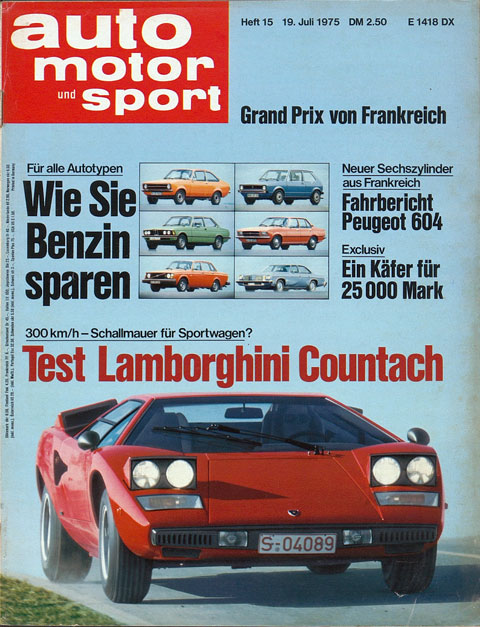
When the 300 km/h sound barrier was almost broken with the Lamborghini Countach


Ferruccio Lamborghinihad done it again. He had already presented the most sensational sports car in the mid-sixties with the Miura, and the Countach caused almost more excitement in the mid-seventies. And it was announced with a top speed that was usually only available as a (barely achievable) figure on a few speedometers on this side of the racetrack: 315 km/h.
Marcello Gandini had given the Countach a body that looked like no other sports car. A length of 4.14 meters, a width of 1.89 meters and a height of 1.07 meters resulted in proportions that made the car appear fast even when stationary.
The magazine Auto Motor und Sport receivedan early Countach LP 400 for a road test in mid-1975 and wanted to know whether the 300 km/h could now be achieved.
The Countach wasn't quite as fast as expected, however, and at 288 km/h its power diminished. But this was also a record, as the competition of the time had to lay down their weapons much earlier.
After all, the 3929 cm3 V12 engine with four overhead camshafts and six Weber twin carburetors had to contend with a fighting weight of 1375 kg (full tank). However, 375 hp at 8000 rpm ensured jet-like acceleration. It took 5.4 seconds to reach 100 km/h and 18.7 seconds to reach 200 km/h. By then, the interior noise level was already at 95 dBa.
"The way the Countach presents itself today, it is certain to be the absolute leader among top-class sports cars. Currently its most serious rival for this demanding position is the Ferrari BB, which not only has its northern Italian home in common with the Countach, but also a whole range of technical features," concluded Helmut Eicker in his test report in AMS 15/1975 , which is certainly worth reading again.
Incidentally, the Countach cost DM 99,800 at the time, but air conditioning (DM 1350), cassette radio (1400) and leather luggage set (three-piece, DM 1500) had to be paid for separately. Converted, that would have been just over 100,000 euros at the time (without inflation adjustment). Today, good examples of the first series nibble at the million mark ...