Classic cars, quo vadis?


What does the future hold for classic cars? What will the 'next generation' do or not do with our beloved automobile? The 21st theme evening at the Emil Frey Classics Center in Safenwil, led by Christian Jenni and Urs P. Ramseier and introduced by Stephan Vögeli, the host, explored these questions.
It's not so easy to make predictions, especially when they concern the future. So the speakers - Urs. Ramseier, Lorenz Frey-Hilti, Ercole and Paolo Spada, Anton Piëch - often looked to the past for signs of the future.
But even so, it quickly became clear that the "fire" - our passion, our enthusiasm for old cars - simply had to be passed on. You have to get the new generation excited about classic cars. However, you have to be careful. Gustav Mahler was quoted several times with his bon mot "Tradition is the passing on of fire and not the worship of ashes".

But how can we pass on the fire if the next generation is not even interested in our beloved individual mobility? Some interesting study results have shown that today's urban, young people no longer want to spend money on their own car. The smartphone generation would rather go on vacation or spend their money on clothes. What's more, beautiful classic cars are becoming more and more expensive or, if they are cheaper, are so complex and expensive to maintain that young people can no longer afford to keep them.
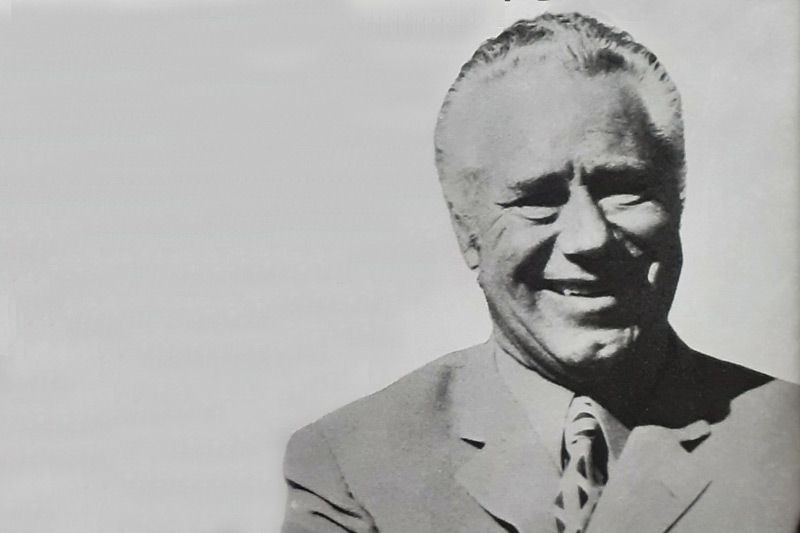
We can already see at many events today that the next generation will still enjoy driving classic cars. And Ercole and Paolo Spada, whose presentation alone would have been worth a whole evening, showed that the love of form and function can also be passed on to our descendants.
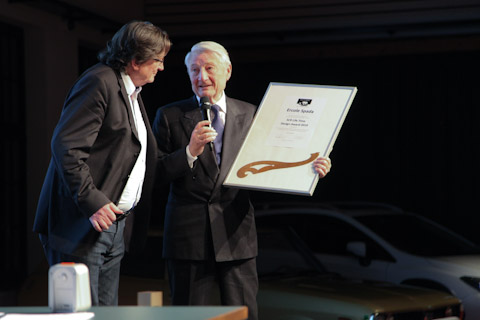
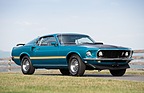
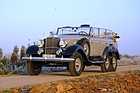
After all, Ercole Spada, who was also presented with a lifetime achievement award last night, was the creator of the Aston Martin DB4 GT Zagato and the Alfa Romeo Giulia TZ (there was a copy of both in Safenwil, see picture above) and it was exciting to hear how high-speed drives were carried out on the highway from Milan to Bergamo to test the efficiency of sheet metal modifications to the bodywork in the absence of a wind tunnel. This resulted in unforgettable cars, such as the sports versions of the Lancia Flavia and Fulvia or the Alfa Romeo Junior Zagato. Many of these designs were characterized by an element that set Spada apart from the rest of the designers: the cut-off rear end, also known as the "coda tronca".

This stylistic element can also be seen in the work of his son Paolo Spada, as well as other curves and shapes that his father had already characterized. In the Spadas' case, the fire was passed on to the next generation, as it was for the Ramseiers (Carrosserie Worblaufen) and Urs Paul Ramseier, and for the Freys with Lorenz Frey-Hilti.

But is it enough if individual descendants continue to cultivate their love of the automobile and remain loyal to the historic vehicle? What will happen to the 100,000 or so classic cars in Switzerland or the 500,000 or so classic cars in Germany if the young people of tomorrow are more interested in smartphones, 3D virtuality and gaming, i.e. private individual transportation on four (or two) wheels?
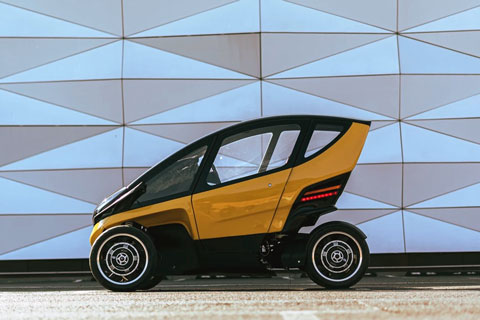
It was much more difficult to elicit answers from the votes. The last speaker, Anton Piêch, a descendant of a very successful car manufacturing dynasty, came closest to answering these questions. His thesis that the sports car will survive, and with it the love of car tradition, aroused optimism. On the one hand, the future will see the fulfillment of basic mobility needs. Safe, self-driving means of transportation will take people where they want to go cheaply and efficiently. However, people will not want to own these moving cubes. On the other hand, there will always be a luxury segment in which ownership is important, in which the connoisseurs cavort, in which tradition is cultivated, in which motoring as we know it today will survive. After all, there are still horses today and, as we all know, the record player, on which vinyl records are played by hand, is also celebrating a renaissance. In the future mobility industry, companies such as Apple and Google will play a significant role because they are better able to deal with large amounts of data and information systems, while the large vertical car manufacturers are at risk.
The manufacturers of future sports cars, for which there will always be a market, will have to be more agile, technology-agnostic and tradition-oriented in order to give demanding customers what they want ...
At the end of the evening, however, the real question "Classic cars, quo vadis" remained largely unanswered, even if from time to time one thought one had glimpsed the future and rediscovered something of the fire that drives us all, even in future generations.
But it would probably have been too much to ask for complete answers to these big questions when even far-sighted politicians and well-funded car manufacturers disagree.
In any case, we went home with some hope that we might still see a Bugatti 35 on the roads in the future. And anyway, the 21st theme evening, like its 20 predecessors, was also about meeting good old friends and having a good chat or two. And with over 400 people in attendance, this claim was certainly easy to fulfill.