Three years after James Dean

You can usually read about what comes out of the thematic overlap between old cars and old movies in our themed channel "Forgotten movie cars" . But this time, the consequences of the fun rummaging through great classics and funny B-movies are a little more far-reaching. After all, aimless wandering through the ramified offshoots of drive-in movie culture may end up providing new insights into the history of a one-off Porsche.
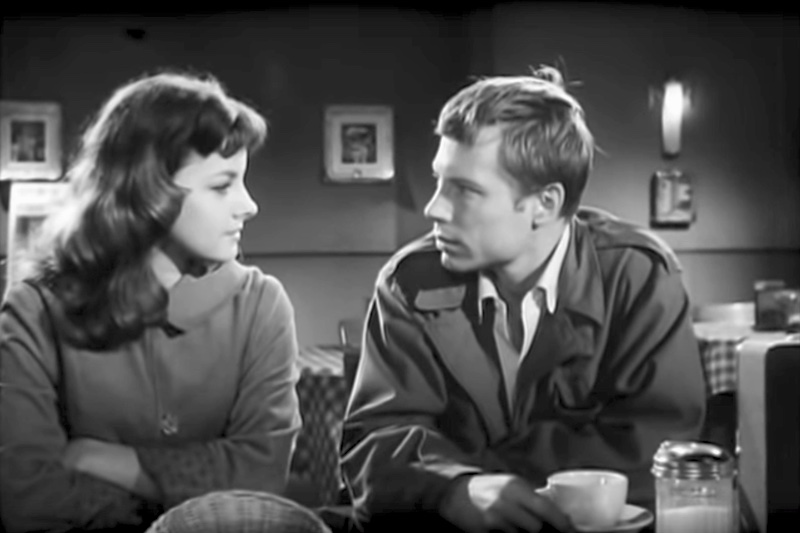
The actor Tom Pittman (below with Virginia Aldridge in his last film High School Big Shot) is regarded by fans of 1950s films as a kind of "second James Dean": blond, talented, rebellious, crashed in a Porsche 550 Spyder in his mid-20s and only appeared posthumously in his two greatest roles. So far so romantic – especially as Pittman is said to have worshipped Dean as his idol – but at most 85 percent accurate.
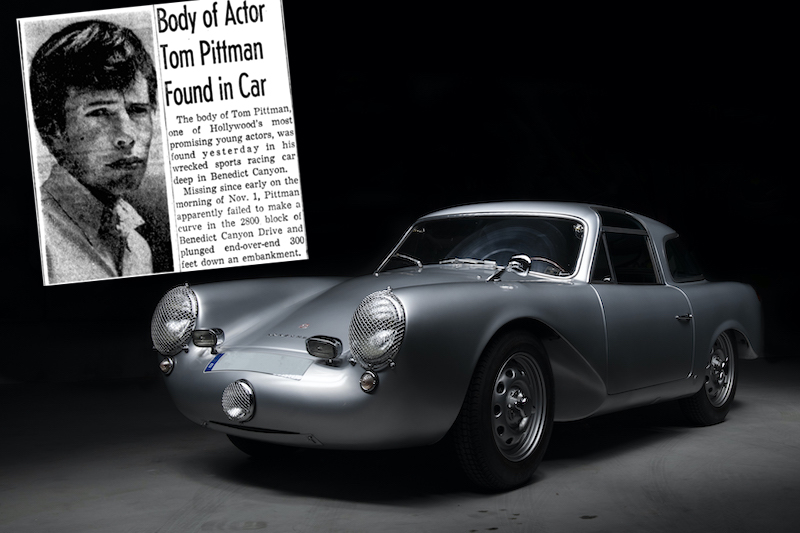
The circumstances of Pittman's death in a nutshell and at the same time in full length: After a party in the San Fernando Valley, on the evening of October 31, 1958, he made his way home towards West Hollywood at his usual speed. In the northern Benedict Canyon, he leaves the road, breaks through the crash barrier and plunges a good 90 meters into a ravine with his car. It was not until three weeks later that a police officer wondered about the hole in the guardrail and found the dead Pittman and the Porsche lying on its side, with the two-and-a-half-metre-long piece of guardrail still stuck in the windscreen. The next day, the newspapers report the accidental death of the young actor and name a "Porsche Spyder" as the car involved in the accident.
This naturally arouses the curiosity of the film-interested old-car journalist. But while the chassis number of James Dean's fatal 550 Spyder has at least been handed down and even the gearbox has recently turned up, there is still no trace of Pittman's Porsche. However, a second fate like that of 550-0055 is not known for any other Spyder, even if the documentation from the heyday of amateur racing in the USA is often very patchy. To add to the confusion, the Los Angeles Times wrote in its one-column article that the car had a special body from Switzerland. Nobody knows anything about such a 550 Spyder either.
The solution to the riddle can be found in the form of a photo of Pittman, which shows him next to a Porsche-like coupé with the Californian car number "NBZ 633" and which was kindly made available to us by "35 Millimeter Retro-Filmmagazin" from Saarbrücken. One thing is clear at first glance: this is no 550 Spyder, the engine is too far back for that. But it does indeed appear to be a special body – with the rear lights of the Opel Kapitän. But my own expertise ends here.
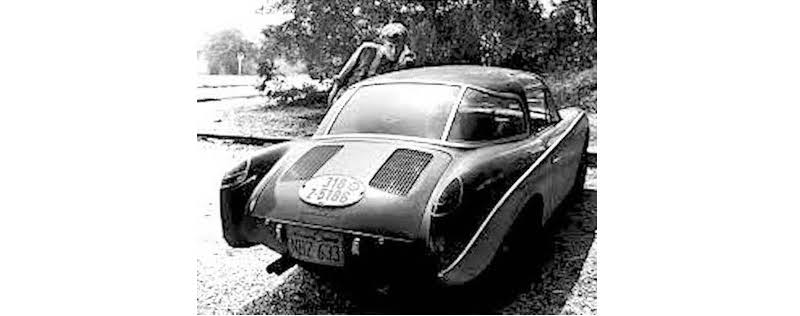
A friend who is much better read on Porsche matters identifies the mysterious car at first glance. The slanted trim, the side windows that extend into the roof, the three-part panoramic rear window – it's quite clear that this is the 1954 Glöckler Coupé, which was sold to America after its brief racing career in Europe, crashed there and then eked out a sad existence in Rudi Klein's famous high-end scrapyard in Los Angeles until it was rediscovered at the end of the 1980s.
However, many articles about the Glöckler-Carrera today (if at all) mention a certain Tom Shipman as the first owner in the USA. But no one mentions exactly who he was and what he did for living to be able to afford such a car. It's a bold thesis: at some point in pre-internet times, someone didn't listen properly or didn't look closely, and so Pittman became Shipman, which everyone has been copying from everyone else ever since. Daring, certainly, but entirely plausible, as the car is a one-off, the accident story fits and it would be a pretty big coincidence if two men with such similar names had owned the unique Porsche one after the other. However, Pittman's acting career only slowly began in 1956 with supporting roles in television series. So perhaps he really was the second Glöckler owner in the USA – or perhaps the coupé came across the ocean later than expected. After all, the "customs egg", the oval German export license plate, is still fitted in the picture above.
However, the photo of him leaning casually against the Glöckler coupé is a strong indication that Tom Pittman was the unknown accident driver and that the two individual fates of the actor and the sports car are thus linked into one. Moreover, a second thing can be deduced from Pittman's Porsche pose: the Glöckler Porsche did not go to Rudi Klein immediately after the accident, as is sometimes reported. This cannot be the case, as Klein only began collecting fine wrecks in 1968. At the time of the accident, the Coupé bore a yellow license plate of the type issued in California from 1956, which can also be seen in the picture with Pittman. However, photos showing the Coupé in Klein's scrapyard show a black plate (with the number "JRR 584") at the rear, of the type that was not issued until 1963.

That leaves the matter of the Swiss bodywork. Here, too, the Americans were logically mistaken. As with his roadster creations, Walter Glöckler had the aluminum shell for Porsche chassis number 12213 denged by Frankfurt coachbuilder C. H. Weidenhausen.
Addendum of November 21: It has now emerged that the Porsche photo was taken in 1957 by a friend of Pittman's, the jazz photographer William Claxton (1927–2008), and is reproduced in large format in his illustrated book "Photographic Memory" (Powerhouse Books, 2002). In addition to the registration seal for 1958, it shows that the Porsche – like James Dean's – had already suffered a few minor blemishes before the final accident.