Virtual expert panel - is the H license plate a curse or a blessing?

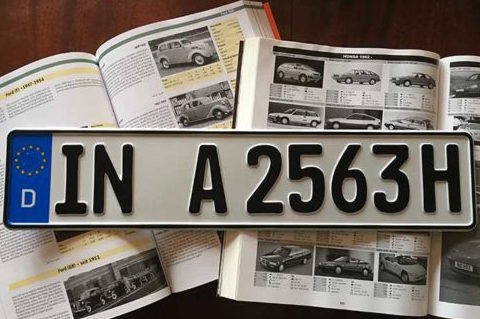
The insurer Hiscox recently organized a virtual expert panel ("webinar") on the subject of H-plates. Martin Stromberg (Classic Data), Norbert Schroeder (representing TÜV und Co) and Rainer Peukert (Hiscox) discussed the advantages and disadvantages of the H license plate.

To anticipate, the three experts all saw the H license plate as a blessing. The audience even voted 96% in favor of the advantages of the H license plate. Only Peukert added that the H license plate was somewhat less relevant from an insurance perspective because, after all, hot rods or tuning vehicles, i.e. modified classics, are also insured as long as they are roadworthy.
The H license plate was introduced in 1997, making the classic car an automotive cultural asset. This is regulated by paragraph 23, which defines the catalog of requirements, which states that a car must have been put on the road at least 30 years ago, be largely original and in a good contemporary state of preservation.
The usual "period of use" for a car was defined as 10 to 12 years; modifications that were possible during this time may still be visible on the old car today.
Of course, paragraph 23 offers a lot of room for interpretation. This can also be seen in appraisals, which primarily assess the condition and originality, and then secondarily determine a value, which must of course be in line with the market.
Modifications to classic cars gave rise to some discussion. For example, the conversion of a Jaguar XK 150 to classic disc brakes of a contemporary type is acceptable, but not the conversion to modern 6-piston carbon brakes. Not everything that serves safety is acceptable either. For example, seat belts are okay, but a Recaro bucket seat with electric seat adjustment and headrests in a 60-year-old car could be judged negatively. And a modern ABS system has no place in a classic car.
Another aspect that came up was the choice of materials. For example, a plastic hood or GRP mudguards may look okay, but what is relevant for the H license plate is what fits the period in terms of craftsmanship.
You are largely free to choose the color, but there are limits here too. For example, matt paint on an old car could well be a reason for refusing an H license plate.
From an insurer's point of view, all this is only marginally interesting: What is insured is what is technically safe and, if necessary, also registered.
Incidentally, an H license plate does not protect against obligations such as the registration of a larger engine.
It was also interesting to hear that deviations from originality can increase or decrease the value of a vehicle, depending on what it is.
Repairs following accidents were also discussed: Professional repairs have no influence on the H license plate. In addition, professional repairs have little influence on the valuation, but uncorrected damage can lead to a reduction in value. However, if a large number of parts have to be replaced during a repair, a loss of originality is possible, which can result in a reduced value.
The topic of "replicas" also came up, but was immediately "parked" as a subject for another panel of experts. Nevertheless, it should be said that a replica can also be given an H license plate if it itself is 30 years old.
Summary: One hour is not long enough to discuss complex topics. Nevertheless, the experts were able to pass on a lot of knowledge and the discussions were interesting.
Future webinars will certainly be announced on the Hiscox Classic Car blog .