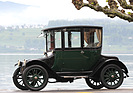
Electrifying a classic car will not save the world, on the contrary


We are basically of the opinion that everyone can do what they want with their own vehicle. If someone wants to "improve" their classic with modern aluminum rims or modern technology, there is nothing wrong with that if the result is not to be considered a classic and original vehicle. Of course, some historical cultural assets are lost with such modifications, but these are usually not one-offs that mutate into old-new hybrids, but (hopefully) mass products, many of which have survived (more or less) in their original form to this day.

Where we start to prick up our ears, however, is when we see an electrified Chevrolet Corvette C1 on the cover of a magazine with 1.55 million printed copies (certified) with the title "A second spring". The three-and-a-half-page article suggests that an environmentally friendly (and quiet) classic car has been resurrected. As is well known, the car is backed by the Marton manufactory, which is certainly enjoying this large-scale advertisement for its small company. We also reported briefly on the Corvette C1 some time ago.
After all, the article also documents that the electric Corvette has not only met with positive reactions. But apparently other cars are already in the conversion process, such as a Jaguar from the XK series or a Citroën DS. The high conversion costs will prevent thousands of classic cars from losing their combustion powertrains, but it doesn't really feel good to see more and more of these "Teslas" being built in old gear.
But now something should be said about the topic of "environmentally friendly classic cars", because installing a large battery and one or more electric motors does not make an old car environmentally friendly, on the contrary. For the electrified old car to be as CO2-friendly as an unmodified model, it would probably have to drive tens of thousands of kilometers, if not over 100,000 km, until the emissions that were necessary for the production of the battery and drive were offset again, even if the electricity could be produced completely CO2-neutral (which is of course impossible, because even solar power is based on energy-intensive and not completely cleanly produced solar cells, wind power as well, etc.).
But even with an electric drive, an old Corvette is of course still a car with technology from the 1960s and hardly anyone will cover such long distances with it over a long period of time. Let's leave aside the problem that many rare raw materials had to be mined to produce the batteries.
For us, the matter is clear. An old car needs a drivetrain from the period, otherwise it is no longer a classic and certainly no longer a historic cultural asset. And in addition to its beautiful shape, an old car also needs to make a good noise and perhaps even emit unwanted emissions in some places today. But if you consider that most old cars are cherished and rarely moved, then closeness to originality should be given higher priority than a zeitgeist drivetrain.