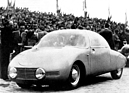
Juan Manuel's irregular victory in Argentina in 1955
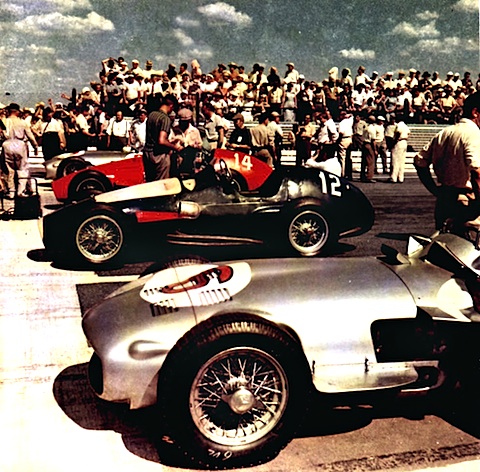
There had not been a race like this for a long time, and it was to remain unique for many years.
Buenos Aires, January 16, 1955, midsummer on the Río de La Plata. Almost 35 degrees of latitude below the equator, roughly at the same altitude as Cairo.
The Gran Premio de la República Argentina marks the start of the season. The best drivers with the fastest cars start at 2 p.m. sharp: Fangio, Ascari, José Froilán González, Farina, Moss, Behra, Villoresi. Mercedes-Benz, Ferrari, Maserati, Lancia, Gordini. A strong field: 21 participants.
Cloudless weather and almost unbearable heat. To be measured in the shade (30º C), on the track (60º C) and in the racing car (over 70º C).
Technology and mechanics are at their finest - the debuting Lancia with V8 engines and side-mounted central tanks, Mercedes with desmodromic valve control and many other technical delicacies.
The race is then extremely varied, with pile-ups, spins, changing leads and two to three-mile alternation between the drivers at the wheel of some of the cars. Only two drivers were able to endure the three-hour race: Fangio and Roberto Mieres (Maserati), Moss even fainted and was beaten up by Neubauer because he had allegedly not slept through the previous night.
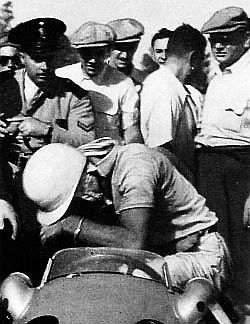
Finally Fangio's victory, champagne in the stands ...
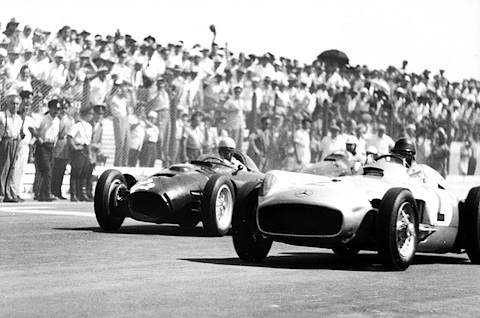
... and in the pits the engineers' turn to verify the regulations. Héctor Zampini and engineer Ricardo Polledo take over the measurement.
There is, of course, a trick behind this: the two are less interested in catching a glimpse of the forced-valve control system of the
W 196 R than the total displacement.

After all, the Mercedes mechanics in white manage to remove the cylinder heads without unauthorized eyes being able to take a look.
Measurement. Each cylinder should have a diameter of 76 millimeters and a stroke of 68.8 millimeters. This results in 2496.867 cubic centimeters, close to the limit of the 2.5 liter formula.
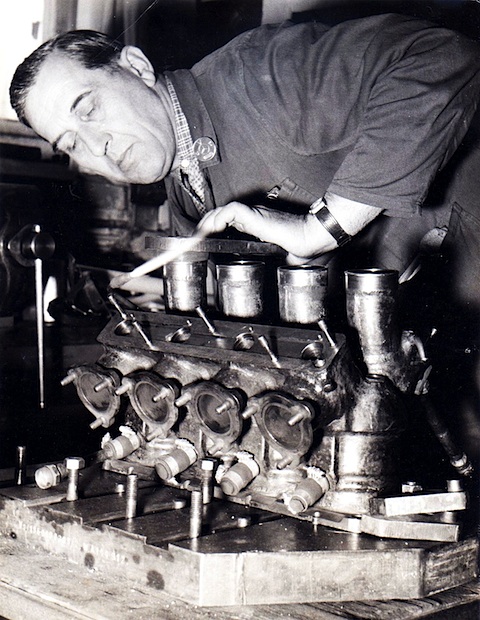
Surprisingly, the result for the middle cylinders, four and five, is slightly more than 76 mm. In other words, just over 2,500 cubic centimeters!
Speculation began immediately. That the middle cylinders were getting hotter than the rest and the walls were wearing down more. Or because the track dust had caused an emery effect or a mechanic had gambled when re-sharpening, because the W 196 R did not have replaceable cylinder liners but steel liners that could not be replaced but were a fixed part of the engine block welded together from sheet steel and only allowed extremely delicate honing.
Zampini and Polledo, not only compatriots but also personal friends of winner Fangio, did not want to be spoilsports and executioners of the deserving hero of the day and left it at that. Mercedes went on to win ahead of Ferrari, albeit with only a wafer-thin mechanical advantage, but at least beyond the regulations.
Forty-four years later, unaware of this anecdote, Ferrari was to take revenge at the 1999 Malaysian Grand Prix, depriving Mercedes driver Mika Hakkinen of victory.