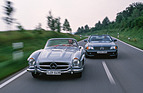
A new form of badge engineering?


We remember that in the 1950s, the British discovered the value of "badge engineering". To enable many brands to offer a wider range of products, the same basic vehicle type was slightly adapted and given a different brand name. This was the case with the Mini, for example, which came out as Austin or Morris, or the Austin 1100, which could even be bought as Morris, MG, Riley or Vanden Plas.
The various VAG brands have also been riding the same wave for some years now, even if the differences between a Volkswagen, a Seat or a Skoda are somewhat greater.
Of course, there was also private badge engineering on a small scale. For example, a VW Golf LS was upgraded to a GTI by fitting the corresponding GTI badge to the front. Or a Mercedes-Benz 200 D became a 400 E thanks to a badge swap.
Of course, this concept also worked in the other direction, when a Mercedes-Benz 500 E became a 200 E because its owner didn't want to show off or because it made more sense from a business point of view to go low.
And now Paris wants to introduce higher parking fees for cars over 1.6 tons. How the people who want to check that the correct fee has been paid will be able to tell from the car (perhaps not registered in France) whether it weighs over or under 1.6 tons remains their secret (for the time being). In any case, in view of the exorbitantly high parking fees, it might be worthwhile (again) turning a Mercedes-Benz C400 into a C200 or leaving the plate off straight away, which is even possible as a free option ex works. In case of doubt, the car would then be "lighter". And perhaps a Skoda Superb 4x4 could be turned into a Skoda Fabia by swapping the badge?
Admittedly, this French innovation is less of an issue for classic and vintage car drivers, as they are not welcome in Paris anyway, at least not in some cases. Otherwise, however, hardly any of these cars are likely to make it to 1.6 tons, because after all, the vehicles used to be much lighter ...