Automobile stories from the Vienna Central Cemetery


A visit to the Central Cemetery is a must for the author during his not-so-rare visits to the Austrian capital. There is always a lot to discover at Europe's second largest cemetery, not least the graves of famous deceased people. This is why many tourists are drawn to the resting places of celebrities such as van Beethoven, Curd Jürgens, Helmut Qualtinger and Falco.
But visitors interested in automotive history can also find what they are looking for here. Let's take two examples that not only have automotive history in common, but also show some other parallels.
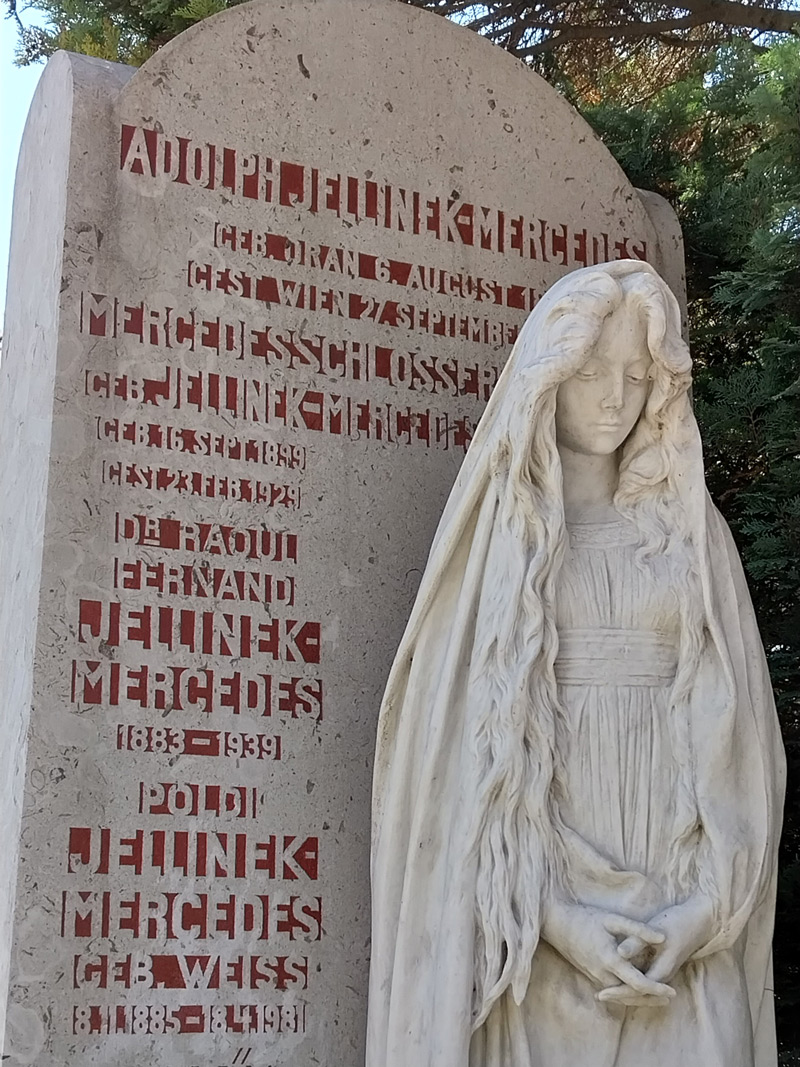
First, let's visit the private burial site of the Jellinek and Jellinek-Mercedes families, although the last name already makes you wonder. Rabbi Adolph Jellinek had five children, including his son Emil (1853 to 1917). He worked in the diplomatic service and was later quite successful as a businessman. Emil Jellinek was already interested in automobiles in their early days, particularly the Daimler brand. Thanks to his social contacts, he sold their cars professionally to a wealthy clientele from 1898 onwards. He also raced successfully using the name of his daughter Mercédès (1889 to 1929).
From 1902, Daimler cars were called "Mercedes", and Jellinek himself had his surname changed to "Jellinek-Mercedes". The daughter's first name had thus become a car brand. Incidentally, Mercédès Jellinek never owned a car herself. She was married twice and died at the age of 39. Incidentally, the date of birth on the gravestone is incorrect: she was not born in 1899, but in 1889.
If you would like to find out more about all this, we recommend a website worth reading.

Our second visit takes us to a grave of honor and even further back in time, namely to the time of the invention of the automobile. It is about the inventor Siegfried Marcus (1831 to 1898) and here, too, the gravestone is incorrect, as the name is misspelled ("Markus"). Marcus was the son of a Jewish merchant and came from the small Mecklenburg town of Malchin, which also has a small "Marcus Museum". After an apprenticeship as a mechanic, he moved to Vienna at a young age, where he lived and worked until his death. Among other things, he worked on ignition systems and carburetors and applied for patents for numerous inventions. However, he did not patent the automobile.
At this point, we don't want to go into the final question of "Who invented it?". The fact is that there were two so-called "Marcus carriages", the first was a wooden cart with a petrol-powered engine on top and was built around 1870. The second carriage, equipped with a steering wheel and seats, was built in 1888/89. Due to its incorrect pre-dating, Marcus was regarded for a time as the inventor of the automobile. In any case, it is undisputed that Siegfried Marcus was an important pioneer of automobile construction.
Incidentally, such visits to graves in Vienna need not be limited to the Central Cemetery. For example, the grave of Carlo Abarth (1908 to 1979) can be found in the cemetery in Grinzing...