Back to the future (from a German perspective)

Our hobby means that we like to sit in an older car and immediately transport ourselves back to the time when the vehicle in question was built.
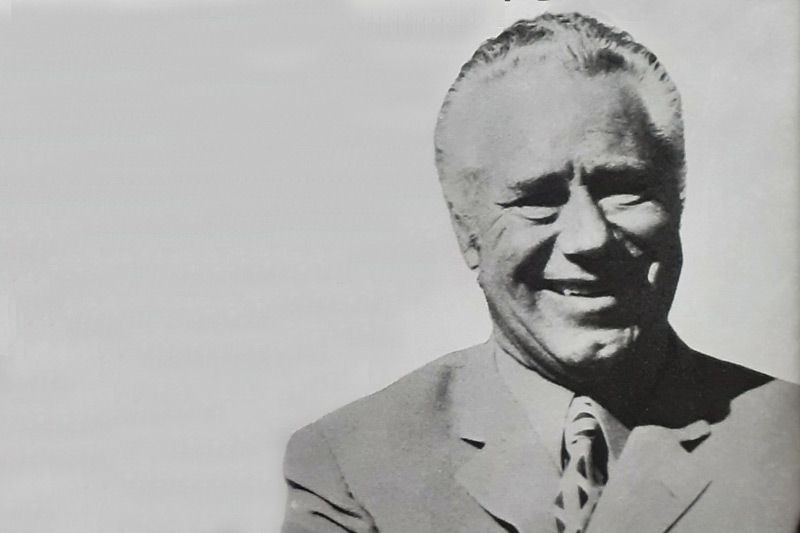
Recently, the author of these lines bought the book "Der Mann mit dem Vorname Auto", first published in 1973, at an antiquarian bookshop and immediately embarked on a journey back in time. It took him back to the early seventies. Perhaps one or the other still remembers Auto Becker, the trademarked term "2nd hand", etc.
Wilhelm "Auto" Becker, the author of the book, was an institution on the car market at the time and the fate of his company - including its less than glorious end - would be well worth making into a movie. At least for the author of these lines, there is a little nostalgia when reading the book, as he bought his first car from Becker in Düsseldorf when he was still very young. It was a peculiar mixture - a 1968 Morris Mini with a veritable Ferrari tailpipe. Really! Only the neighbors didn't like the sound, but I don't want to digress...
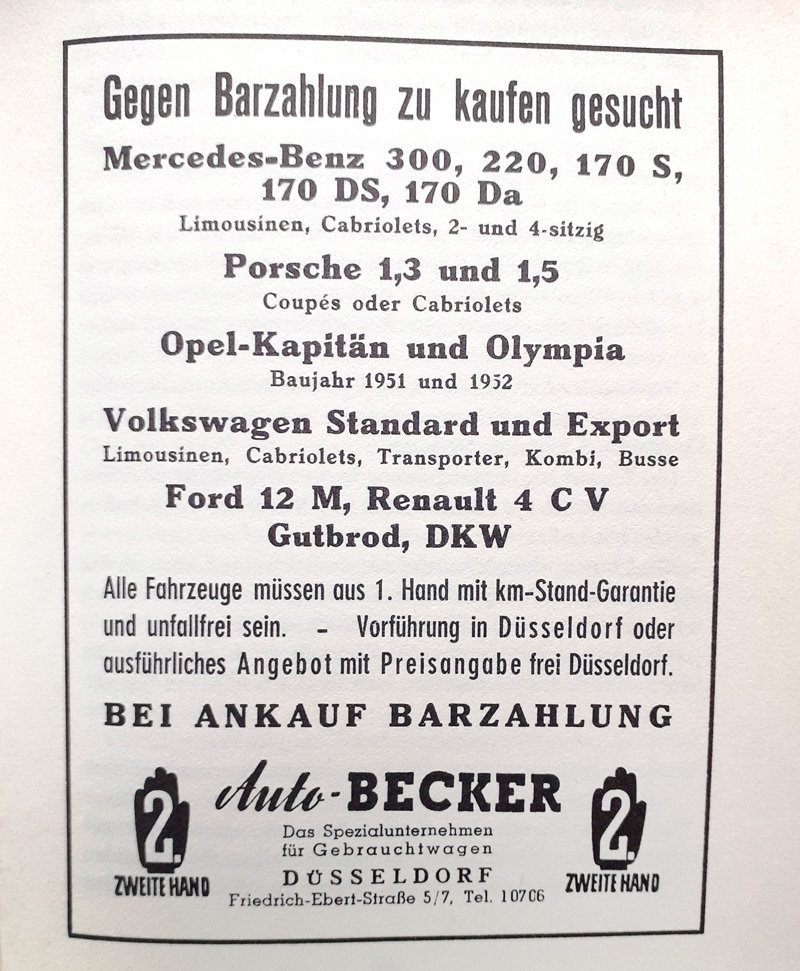
In the book in question, Becker describes his career from the son of a farmer in the poor Hunsrück region to a successful entrepreneur and has many an anecdote to share alongside practical advice. For example, the amusing story of the "Wendax" ("caricature of a car"), which had no chance of being included in Becker's sales program after a test on the Nürburgring. He also makes no secret of mistakes, such as his temporary representation of the Borgward sub-brand "Goliath", in which he had probably also inadvertently undertaken to sell three-wheeled carts and milking vehicles. Which, incidentally, he succeeded in doing.
And Becker was certainly not an easy business partner either, if you believe his comments on the disputes with Lancia or Rolls Royce.
However, there is another reason why the factory is mentioned here. It is interesting to see how Becker saw the automotive future around 50 years ago, i.e. at the time of the "oil crisis" with its Sunday driving bans in the Federal Republic of Germany, and what came true and what did not. In two (!) prefaces, the author leaves no doubt that he is a "car guy". He writes: "Abolishing the car, as is already being called for in some places, does not seem to me to be a solution...Because...those who distort their criticism to the point of heresy tend to underestimate the positive aspects of the car."
It seems to me that these are still sometimes overlooked in everyday discussions. There is no doubt that his comments on the time of the crisis are still relevant today: "Simply reducing the temperature in rooms by two degrees saves around ten percent of heating oil consumption". Phrases such as: "Fear reigned" or "Sports cars and large limousines, for some people the Beelzebub turned into sheet metal" are fitting, as SUVs did not yet exist back then.
In the last third of the book, Becker reflects on the mobility of the future. Based on his thesis that "the car... is more than just a means of transportation. It allows us to realize a degree of personal freedom", he concludes: "the environment must be redesigned, not people regressed". For him, "a world without cars is a dream world".
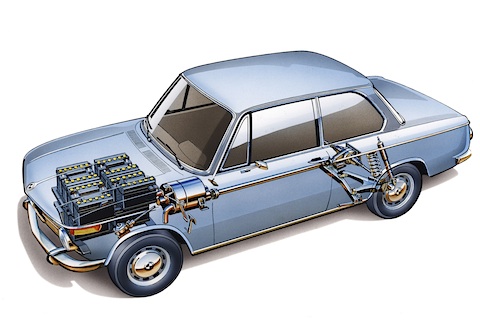
Based on the famous study by the Club of Rome (The Limits to Growth, 1972), which emphasized the finite nature of raw materials, Becker reflects on the alternative energies for engines (ethanol, steam, LPG, solar energy, but also turbine drives) that lay in the future at that time. On the (probably battery-electric) electric vehicle, he states: "As things stand, the handicap of the electric vehicle has become much smaller, but it is still far from being overcome...The possible future of the electric vehicle has so far been in the short range, because every discussion about this type of drive begins and ends with the range. Storage capacity and recharging speed therefore by no means predestine electric cars for long-distance journeys. Assuming that a third of the vehicle fleet is used exclusively for local journeys, this could gradually mean more than six million electric vehicles on the roads of the Federal Republic of Germany. If this solution is desired, then work must begin immediately on creating the necessary supply and operating infrastructure".
It should be noted that these statements are half a century old. And Becker is also more specific about the car of the future and was right in many respects. Let me give you an example: "I would like to predict a great future for the turbocharger... The combination of the turbocharger with the diesel engine promises to be particularly economical".
The author, on the other hand, gives the "long-term car" no chance and was right about that too. Likewise with the design: "The shapes of later generations of cars will be round, the windows curved". Becker also predicts that the airbag will become a matter of course and would like to see "a second exterior mirror, rear fog light, reversing lights, headrests and a heated rear window as standard....." Welcome to the present!
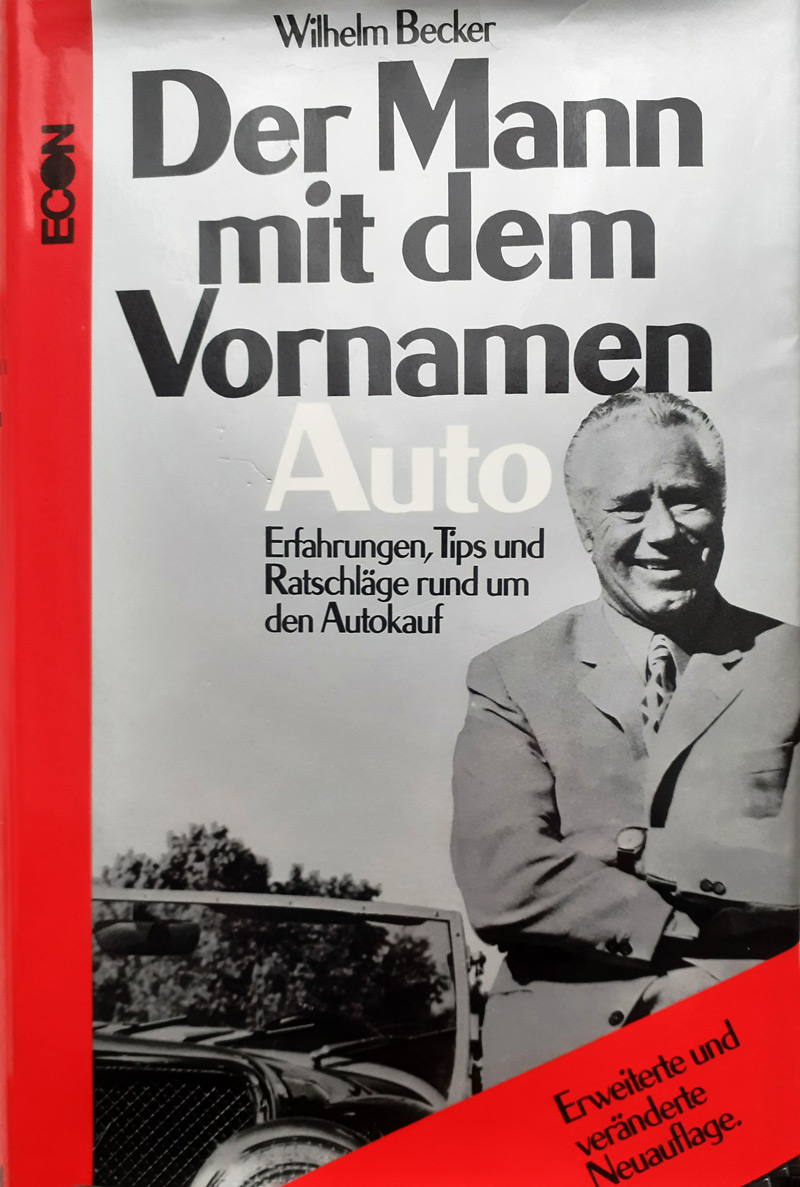
P.S. Here is the bibliographical information on the book:
Wilhelm Becker: der Mann mit dem Vornamen Auto
2. Auflage1979
Econ Verlag, Düsseldorf/Wien
ISBN 3 430 11245 1
(first edition 1973)