The operating competence

No, the term was not coined by me, but by the German transportation historian and author Kurt Möser. He brings it into play in his book "The History of the Automobile". Many years ago, I had the pleasure of meeting Möser at a conference of the International Association of Transport Historians T2M (Transport, Traffic and Mobility) at the Swiss Museum of Transport in Lucerne. At the time, I was in the middle of preparing a book about the Swiss electric car pioneer Johann Albert Tribelhorn. Yes, electromobility, I have to admit that the explosive nature of the topic was hardly really recognizable back then, in 2009, when I started the work. The future was still a long way off and most of the e-cars available at the time were rather crudely modified small cars with large lead batteries in the rear, only two seats and ranges that could barely exceed 100 kilometers.
I well remember how we went to an e-car meeting on the occasion of the vernissage of the book "Johann Albert Tribelhorn and his legacy at EFAG and NEFAG: Pioneering history of the electric automobile" Zurich: Verein für wirtschaftshistorische Studien 2011, in the same year were amazed to welcome an early owner of a Tesla Roadster to the Swiss Museum of Transport who had made the journey from southern Switzerland over the Gotthard to Lucerne without recharging - a true pioneer, indeed a hero in the eyes of the other guests present whose main topic was how long they were able to keep a battery pack alive or how far they had already driven without recharging. It goes without saying that there was hardly a charging station to be found anywhere at the time. In order to guarantee a carefree journey home for those present, a normal power distributor, such as those found on building sites, supplied the necessary "juice".
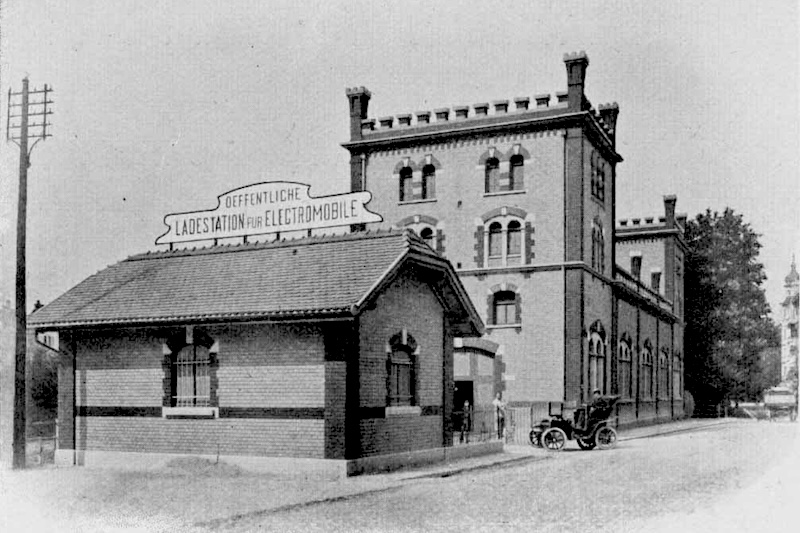
The first public charging station in Switzerland around 1912 in Zurich's Selnau district
The stay of most of those who arrived was somewhat longer. What they all had in common was that, as experts, insiders and "knowledgeable" people, they were able to answer pretty much every question from the public and knew how to operate their charging installation inside out. The people demonstrated operating competence. Kurt Möser uses the term in connection with the first, early automobiles, in which men wanted to compete with each other in the traditional way and used to show off their knowledge of how to control the machine. According to him, the car was not used to perform a necessary task, but as a means of fighting out archaic hierarchical battles in a more cultivated manner. However, the early electric car was able to contribute very little to this.
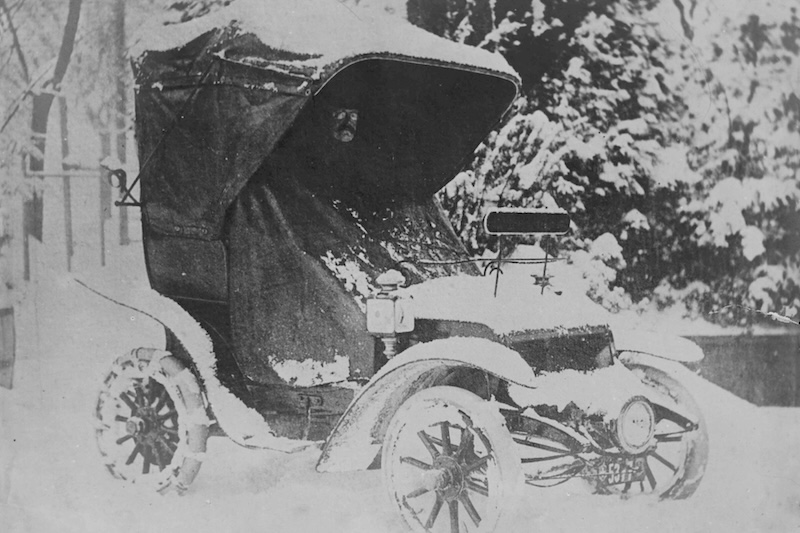
After all, apart from handling the hand controller, the steering system and the brakes, an "Electro" hardly needed any in-depth knowledge. As the picture of the snow-covered Tribelhorn from around 1908 (above) shows, an electric car started immediately when the toggle handle on the main switch was turned, even in the bitter cold. Tribelhorn had already fully automated the charging process at that time, with a drop switch that released a magnet when the charging current dropped below a certain level, which ended the charging process. Charging was carried out using an alternating current machine that drove a direct current generator; the charging rectifier was not yet commonly used to generate the necessary direct current from mains power. Such a Tribelhorn simply drove as long as it was charged, in wind and weather, sun or cold, not fast, without spectacle and therefore without any great social status. The early membership lists of the Automobile Club of Switzerland contain hardly any electric car drivers. However, the silent cars were soon said to be "suitable for women". And in industry and commerce, the magazine operator in Feldbach was trained as a driver of a Tribelhorn truck in a two-day course, which was considerably cheaper than hiring an expensive and better unionized mechanic, as is usual for combustion engines - operating skills!
But let's be honest, it is precisely this pride that still drives us to drive old technology, to bring the carburetor engine to life in wet and cold conditions by skillfully using the choke, to shift gears without scratching, to make some smoke and noise and spectacle instead of leaving the scene unnoticed. Yes, operating competence really does play a role in cars. Whether this is particularly masculine, or even archaic, remains to be seen. But what we do know is that the combustion engine has prevailed, despite numerous disadvantages compared to the electric car, which were still real problems at the time - sensitivity to frost, unwillingness to start, recoiling cranks, oily fingers. For us, that's a good thing and we want to maintain this legacy for as long as possible, just like our operating expertise! There will still be time enough to drive an electric car...
Image © Swiss Museum of Transport VA-50468 and VA-49627 from: " Johann Albert Tribelhorn and his legacy at EFAG and NEFAG: Pioneering history of the electric automobile". Zurich: Association for Studies in Economic History 2011