The photos from back then

Have you ever noticed that in old cityscapes from the late 19th and early 20th centuries, entire streets are often deserted? There are hardly any crowds of people or convoys of vehicles to be seen at important junctions, just a few carts, a waiting streetcar or isolated, scattered figures? That the few people who can be made out in the photograph all seem static, standing or sitting? Well, I suspect this has to do with the photographic technology of the time, or rather with the exposure time. Because a snapshot was often not even possible.
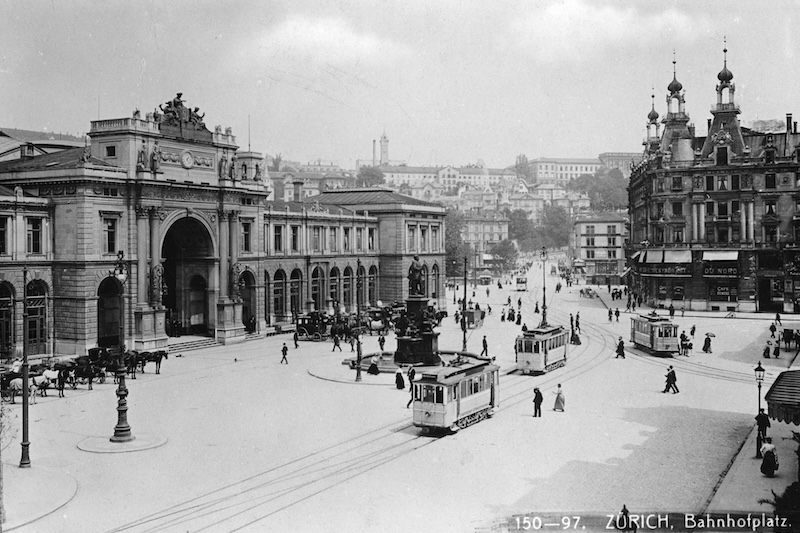
Zurich station square, end of the 19th century © ETH e-pics
A lot of light and a long exposure were needed to take a good photograph. This means that everything that moved away at a certain speed is barely visible or not visible at all in the picture, or only as a semi-transparent ghostly apparition. So those carts, handcarts and people in motion in the streets have been lost to the chronicler, according to my theory.
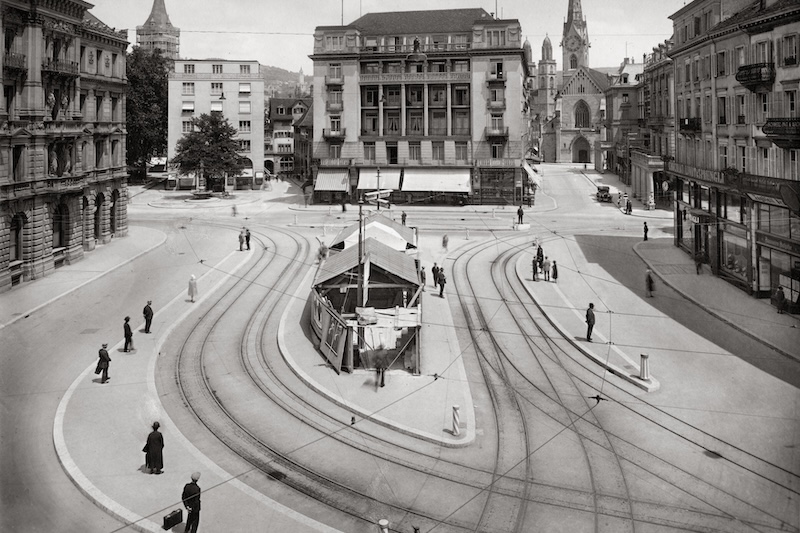
Only the passers-by at rest are visible in this picture, anyone in motion becomes a ghostly apparition © ETH e-pics
I suspected that this has led to a shift in perception today and suggests that in the cities of the past, those "without cars", people lived in almost ideal conditions. Large, wide, deserted squares and open streets dominated, and one wonders where all the inhabitants of the new housing estates of that time have gone, now that history teaches us that at the end of the 19th century there was a great deal of pressure on the cities due to the population explosion.
My answer was that they were not able to survive the lengthy development process of early photographs due to a lack of time to pause.
Although, the traffic of earlier days was slower and therefore easier for a pedestrian to assess. They had a certain amount of time before the approaching object actually reached them. The car shortened this time between its perception and the moment it actually posed a danger considerably. That's why the rush increased. But the photographic technique also improved considerably!
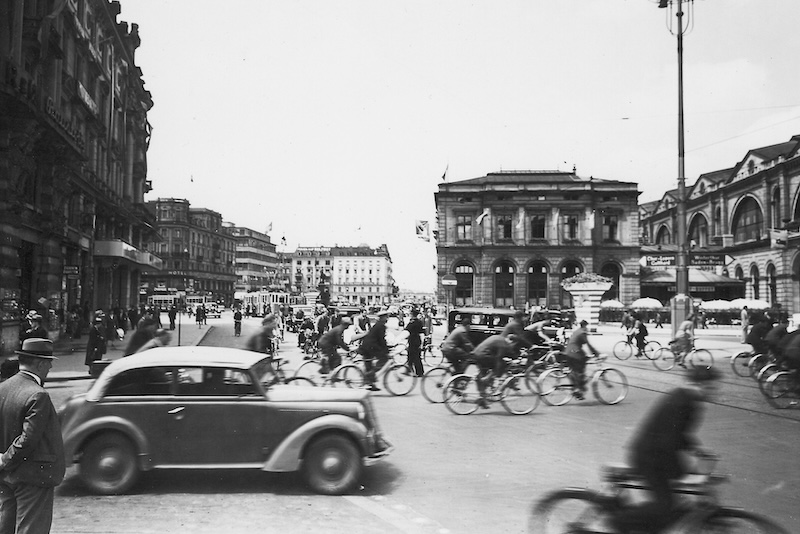
More cars - and many more bicycles around 1939, again in front of Zurich main station © ETH e-pics
Certainly, the masses of cars took up more and more space on the roads - in some cases probably too much. On the other hand, they played a huge part in the comprehensive renewal and expansion of this infrastructure, or at least encouraged it to be done. Switzerland's road network had previously remained more or less the same for centuries. It was only thanks to the automobile that it underwent an incredible expansion in the second half of the 20th century, connecting cities and towns that - despite the almost deserted look of the photographs - were certainly not deserted and traffic-free. On the contrary, chaos, as the last picture shows, already prevailed more than 80 years ago...