Just for decoration? What to do after the discontinuation of FM stations in Switzerland?

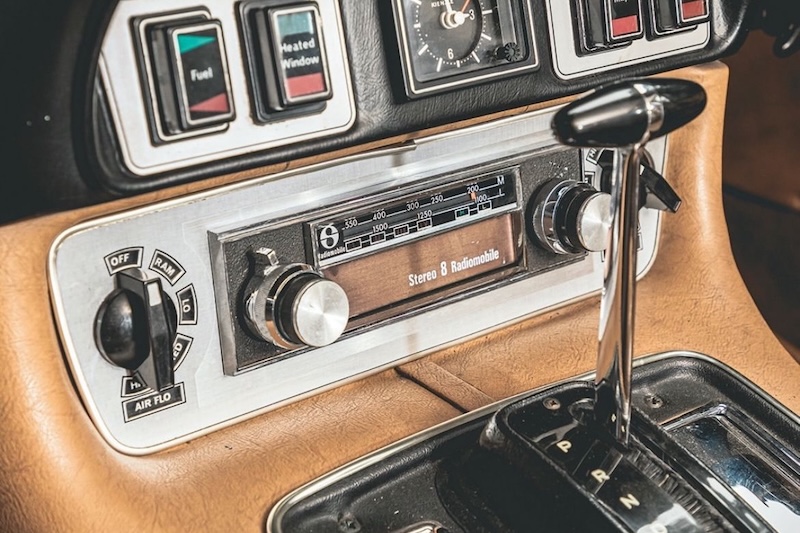
Replace it or make do with something else? The radio mobile in the Jaguar XJ was an original accessory, but as a LW and MW device and with an 8-track deck, it has long been obsolete. However, a modern radio could be installed in the slot.
As of January 1, 2025, the state radio stations in Switzerland have said goodbye to ultra-short wave FM. We have already reported on the impending end for some time. This means that the programs of SRF 1, 2 and 3 can only be received via DAB + (Digital Audio Broadcasting) or streamed over the airwaves. The private broadcasters will be granted a certain period of time before analog broadcasting ends there too. Of course, this does not necessarily mean the end of the car radio. The good old Becker Mexico or Blaupunkt Frankfurt can even be converted to DAB +. Incidentally, this has been necessary for the Americans for some time, as medium wave radio was already definitively phased out of Switzerland in December 2008. But many old radios will probably become obsolete without FM transmitters. This is not only a pity, we will also lose a certain everyday culture. However, despite my annoyance, I'm trying to take it in my stride and make the best of it. In any case, it will be exciting, even if most of the alternatives currently seem more like a tinkering than a reliable solution.
Well, if I want to listen to music in the car in the future, I can continue to do so: I'll get a boombox, for example, and stream straight in from my cell phone and keep the old car radio in the dashboard as decoration - and to plug the hole passably. In my American car, for example, the radio was an original option and therefore fits perfectly with the rest of the dashboard, including its buttons and the design of the dial. However, the Motorola 821 never worked in my possession. It was already silent when I bought the car over 10 years ago. And a hopeful expert in the restoration of old radios once even told me that I could save myself the effort of having it repaired, it sounded "sh...se" even in perfect condition. Well then.
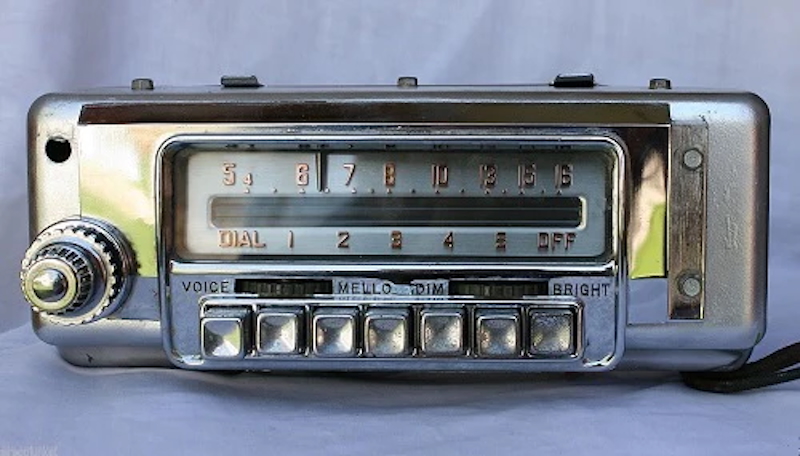
The Motorola 821 - an original accessory for DeSoto models from 1952 and 1953 - never played FM, so it had been obsolete in Switzerland since 2008. However, it could be converted to the latest technology.
Another solution would be to buy an adapter which - fed from all kinds of sources, including a DAB radio - sends an FM signal directly into the antenna socket of the built-in radio. I even have a "RediRad" from an American inventor lying around somewhere in my stash. He had configured this device exactly to the requirements of my Motorola 821 from the DeSoto: For 6-volt operating voltage and with the ground connected to positive. But right, the old tube receiver doesn't work at all...! So a conversion of the same would be recommended, but then the full program with built-in DAB and new loudspeaker! But then the old tube technology would be gone - and that puts me off! The only valid solution would probably be to get another faulty Motorola 821 and then have it rebuilt so that I could put the original set to one side. However, I don't want to incur the costs for the time being, although Timo Gschwendtner from the "Wunderbar Custom Radio Shop", for example, does an excellent job here. He retains all the features of a historic radio. For example, do you have an old US radio with a foot-operated station search? He can save it, even if the device also plays DAB and connects via Bluetooth after its conversion.
If the on-board electrical system works with 12 volts, I see far fewer problems. Because there are all kinds of little helpers and devices that can emit sounds, even a cell phone can be charged here, as can a boombox. After some research, I discovered that this can also work with 6 volts. All you need is a plug that transforms the 6 volt input voltage into the required 5 volt charging voltage. After consulting the relevant forums, almost any normal adapter plug for the 12 or even 24 volt cigarette lighter can do this; only an i-Phone requires an original adapter from Apple. So that would be excellent news! I will try it out one day and share my experiences here! This way, both cell phone and speakers can be operated for an unlimited time without having to rely on their battery capacity.
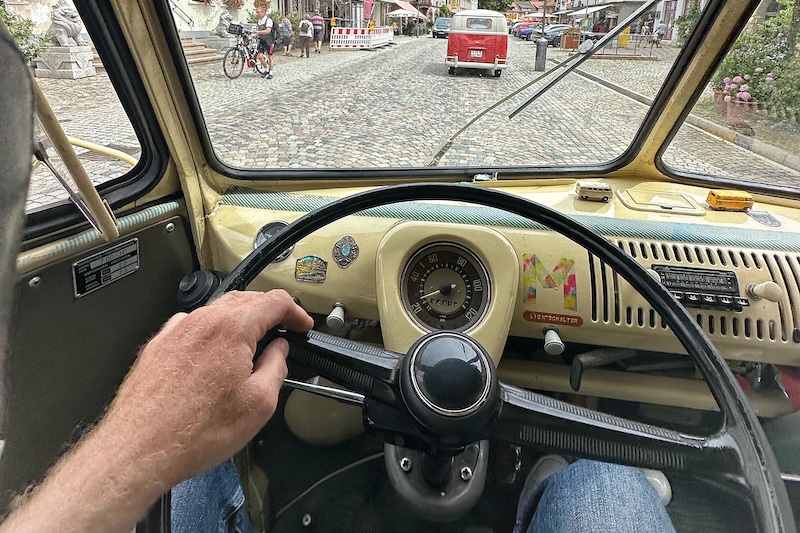
In my VW van, the not very powerful 6-volt tube radio has long been used primarily to fill the hole in the dashboard. At least it managed FM reception. As it's not original, I'm now going to remove it. This will give me more space on the dashboard shelf. The corresponding cover panel is even available again. It remains to be seen what will follow.
Radio reception, on the other hand, is a little more difficult - or more precisely: the comfortable radio reception I was used to. Basically, I just wanted to continue the previous ritual. This means: start the engine, drive off, warm up the engine and if nothing sounds unusual, switch on the radio and tune in to the station. For me, this is preferably the Swiss culture station SRF 2, whose chatter is usually the least annoying. And classical music calms me down when I'm driving. Driving through a city like Zurich at rush hour accompanied by Camille Saint-Saëns' Symphony No. 3, the "Organ Symphony", is a reasonably bearable experience this way. But this also works for other cities, although the works can of course be adapted. Bach, by the way, has a similar, perhaps even more universal effect. But I don't even want to get into the many different musical tastes here. And it's also true that I enjoy this form of acoustic accompaniment anyway. My sore point is therefore the spoken radio program. On the one hand, I want to hear the news, but on the other, I'm usually also interested in traffic reports. So I simply WANT radio in the car, I like it. In addition to all my enthusiasm for old technology and the associated noises and acoustic impressions while driving, I also want a suitable soundtrack. The only exception is an open-top car or a sports car. Nobody needs a radio in a Caterham.
My 12-volt cars will therefore probably get a new radio, which means that the original factory-fitted unit will lose its regular place. Thanks to the DIN slot, however, it's easy to get over, and there's also a whole range of radios that look very similar to the options that were available in the mid-1980s, but now with Bluetooth connectivity for cell phones, DAB and so on, making them state of the art. The same applies here: you should definitely keep the old radio. However, I don't think the FM switch-off is a real pity for my car radios in the first place. I have just described possible solutions. What I will miss most is my favorite station from my old "Blaupunkt Ideal Capri Deluxe" tube radio, the indoor unit that serves me in the workshop. The huge, heavy box has been working tirelessly since 1958. At first it was my grandparents' kitchen radio. Sometimes shrouded in coffee vapor and surrounded by a wall of haze, it has never stopped working - until now. Of course, I could feed in the DAB radio signal with a small transmitter via the aerial and retain the original sound. But it's no longer the same! Turning the wheel to get the magic eye to make the two green light bars in the tube touch, indicating that the transmitter is perfectly tuned in, is tempi passati!
In the end, however, it is fundamentally questionable whether DAB + will still be around in 20 years' time and whether we will not once again find ourselves in a race to replace the corresponding receivers at regular intervals as a result of technological change. One thing is certain: the switch-off is certainly not sustainable.