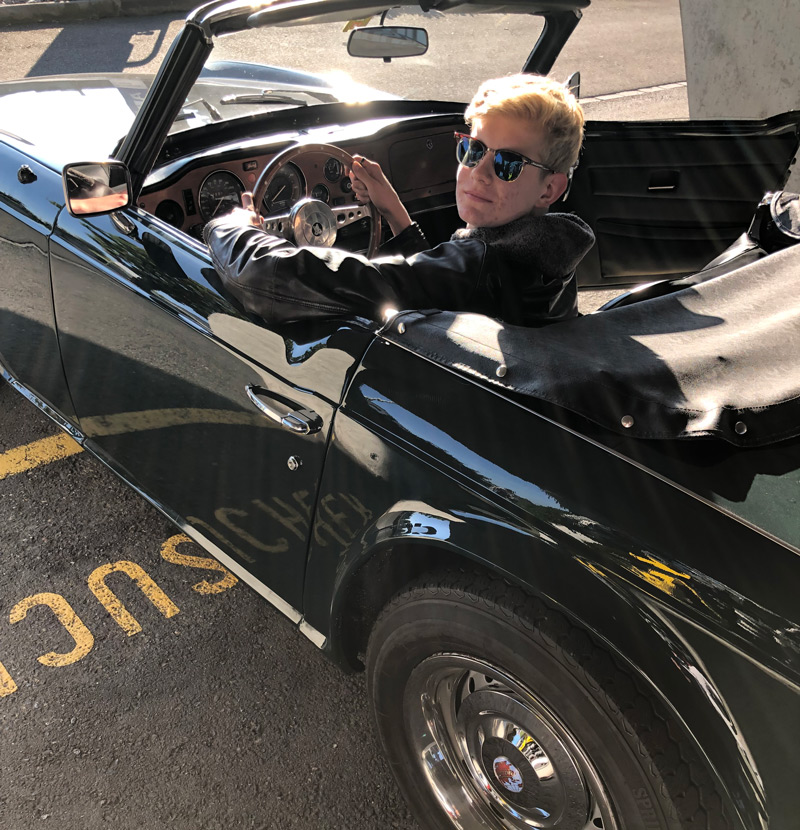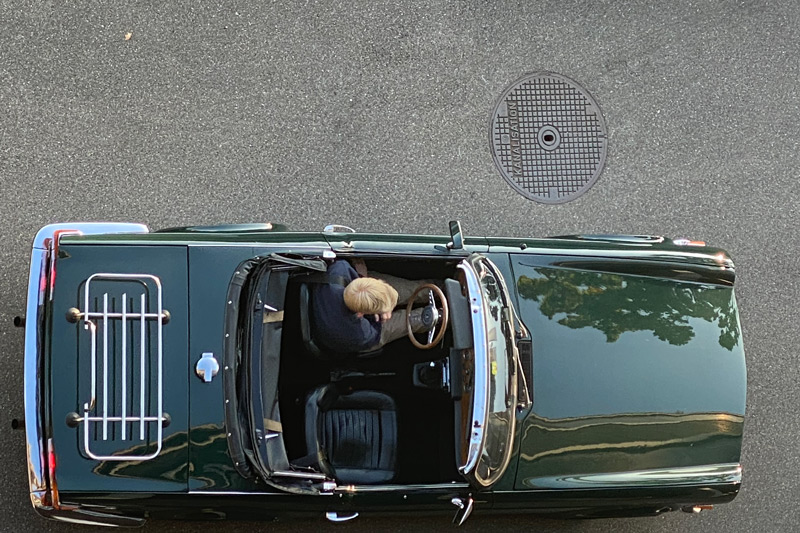
The fall sun was shining from the sky and a relaxed Sunday afternoon provided the perfect setting for a short drive with my 18-year-old son Bruno. He was allowed to drive my 1974 TR6 (for the first time); and surprising things happened - to him, as well as to me...
Bruno had obtained his driver's license in Berlin just a few weeks before, mind you in one of those unpretentious, trendy, high-legged family trucks of modern times, a Seat Azteca. So he learned to drive with parking sensors and camera, electronic handbrake, hill start assist and - I really had to laugh - automatic parking. Yes, you only need to accelerate briefly to successfully reverse into a parking space; the driving school car takes over the steering. Fortunately, this only served to relieve the driving instructor during the repetitive "best practice" demonstration in front of his students.
But such well-equipped cars may explain why the cost of obtaining a driver's license has already decoupled somewhat from the general price trend. Fine, but shouldn't you be able to get by with half the driving lessons? There are now many more hours than before. Even driving instructors know that your first car as a pupil, learner or student will not be a new Mercedes with all the assistance systems - even though the brand's marketing strategists originally targeted buyers under the age of 30 with the popular A- and B-Class models for senior citizens. But because that didn't work out, they later offered more leasing bargains - in other words, AMG posing in installments for young drivers who still had to live with mom to finance them.
At least Bruno was still allowed to learn how to shift gears and use the clutch. In some places, unwilling drivers can even opt out of this with their "automatic driver's license". Perhaps the next step will be the annoying learning of weather-related peculiarities when driving? "The autopilot does all that anyway," young smartphone-fixated drivers might object. "Well, if you buy a Tesla like that". But perhaps only in 15 years' time, when all the legal disputes surrounding the many upcoming Tesla accidents have been resolved in the incipient "trial and error" phase. "Do you want to drive a bus until then?" I ask.
![Fahranfänger Bruno im Triumph TR6 (© Marcel Pelletier)]()
Before the first little classic car trip as a new driver's license holder, I quickly had to learn a few special features that a SEAT Azteca can't offer: Disconnecting the battery charger, "what is a choke and what do you do with it" and "which accelerator pedal position do you use to start a carburetor engine? How does a car brake without ABS and what does that mean for a healthy distance to the car ahead? Why was there still such stiff steering in 1974 and only these dangling seat belts, but neither a distance radar nor a keyless-go?" Sure, I was joking, but the answer was on the tip of my tongue: "Because back then, something like that was only conceivable in Star Trek, just like your iPhone.
"So, big guy, here's the key, let's go!" He: "And where?".
Me: "Oh dear! Would you rather I drive?" Turning the key then worked. Even until the engine had been running for a long time, only to stop again as soon as the starting process was complete. Questioning look from a teenager. "Well, how was it with the accelerator pedal at the start? Must be different from the Seat, right?"
It's good to see that even sporty, fit and young people still have to put in a bit of effort when parking and maneuvering. Thanks to the use of the choke, he even managed to do this without the engine stalling.
And finally we drove from Seestrasse up to Pfannenstiel, at least initially in first gear. "Dad, second gear won't go in!" I had been waiting for this. "Yes, it does, with feeling. And a bit of intermediate throttle because it's still cold."
"Eh? What's a bit of throttle?" Fortunately, he was still on the clutch and answered some questions himself, by thinking and combining. Just as you would expect from a high school graduate. And with feeling, we continued in second gear - and that sound that put a big grin on Bruno's face.
As the road slowly climbed and we occasionally had to stop at junctions, I could feel his concentration and his efforts to do everything right and to protect the equipment. He didn't succeed immediately, so I smelled the clutch of this car for the first time. This was new territory for him and after an honest "oh oh" he didn't say: "Yes dad, it doesn't have hill start assist", but asked me about the correct dosage and the perfect duration of the clutch release - so the problem was recognized.
Which pleased me as a father: He had respect and obviously felt the speed far more than in any modern car. He drove much more consciously, more attentive to the course of the road, anticipating the optimum braking point and gear change and the traffic situation than with our everyday BMW. And that's a good thing when the material is less forgiving of driving errors and accidents can end painfully.
In the end, his exclamation, which came from the heart as he accelerated out of a wooded area into the evening sun, reflecting orange on Lake Zurich, was important: "It's awesome!"
So a one-hour short trip seemed to be much more "driving", more adventure and emotion, more feeling for technology and more enjoyment of it than in the 15 driving lessons before the test. Or, than in all the modern cars he has been able to get to know since then in his young driving life thanks to their courageous owners. A new building block in the effort to inspire my children Julia (at 15) and Bruno with the magic of old cars seemed to have worked well. Previously, there had been little taster trips to Mille Miglia departures at 6 a.m. in Bologna or in Parma.
Today, shortly before leaving school, Bruno is working at a petrol station in Berlin and wants to find a BMW 5 Series from the turn of the millennium (E39) - after all, a very solid, veritable youngtimer and a good and affordable basis for discovering Europe with friends. Incidentally, this is much freer and more impressive than by train and - depending on the occupants - even far less ecologically questionable than Greta Thunberg tries to convey to this generation. So you don't even have to be a member of the rural population to find driving and owning your own car attractive and desirable at the age of 18.
My conclusion: individual transportation is here to stay. Perhaps redefined in the future, but always with the occasional movement of vehicles that make driving an eternal experience. It doesn't matter how simple or valuable they are: Even 18-year-olds sense this immediately and the next generation is (hopefully) assured.