Adriano Cimarosti remembers Jo Siffert
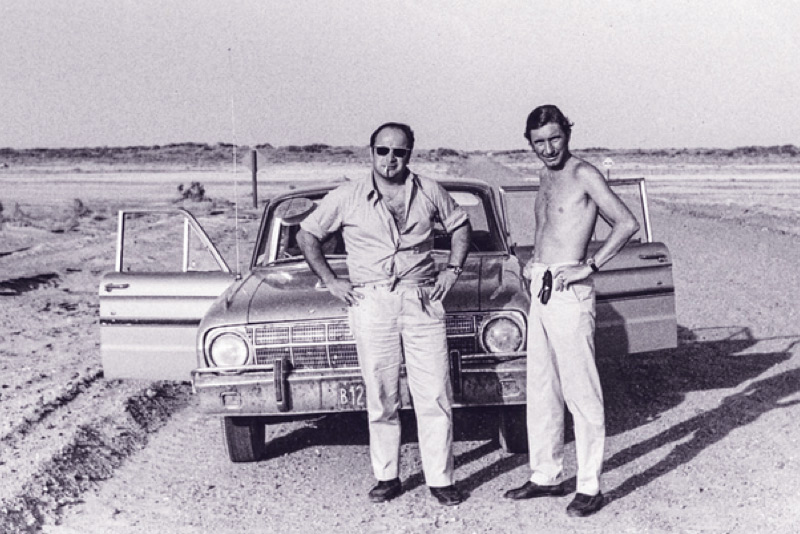
There are events when time stands still. And everyone can still remember the exact moment later. October 24, 1971 was such a date. The (Swiss) racing world held its breath and fell silent: on Sunday afternoon, Jo "Seppi" Siffert died in a fatal accident in a non-championship Formula 1 race at Brands Hatch - on the very circuit where he had celebrated his first major victory three years earlier.
Several reports on Jo Siffert have already been published on zwischengas.com, shedding light on his life and achievements:
- Jo Siffert, the exceptional Swiss talent
- Jo Siffert - Death at the peak of his career
- Mario Illien, Prof. Dr. Ferdinand Piëch, Klaus Bischof, Jacques Deschenaux and Paul Blancpain on Jo Siffert
The paths of Jo Siffert and Adriano Cimarosti first crossed at the Monaco Grand Prix in 1961. No, not in Formula 1 - Siffert drove a Lotus 18 in the Formula Junior race. "Siffert and his two mechanics had set up their small workshop in a garage. They also slept there, makeshift, on mattresses they had brought with them! No sign of a hotel. Food was prepared on a small gas stove," the doyen of Swiss racing journalists recalls his first encounter. Over the years, a friendly relationship developed between the racing driver and the journalist. "A few times we traveled together on the same plane to Zurich after a Grand Prix, and most of the passengers were delighted when he boarded. On the car ride to Bern, we talked and laughed a lot together," continues Cima, as good friends call him.

"At all the races I attended, we always talked to each other, of course. He had incredible charisma and was always nice. But you had to wait for the right moment. If there were technical problems with his racing cars, he didn't allow himself to be disturbed, but it goes without saying that you didn't intervene," says Cimarosti. Cimarosti illustrates the fact that things were still quite tranquil back then with the following episode: "In 1964, Dan Gurney drove his Brabham behind Siffert's Brabham for a lap and observed how the Swiss driver's car was behaving. At the next pit stop, he went to Siffert's mechanic, Heini Mader, and explained to him how he needed to set up the Fribourger's Brabham differently - unthinkable today".
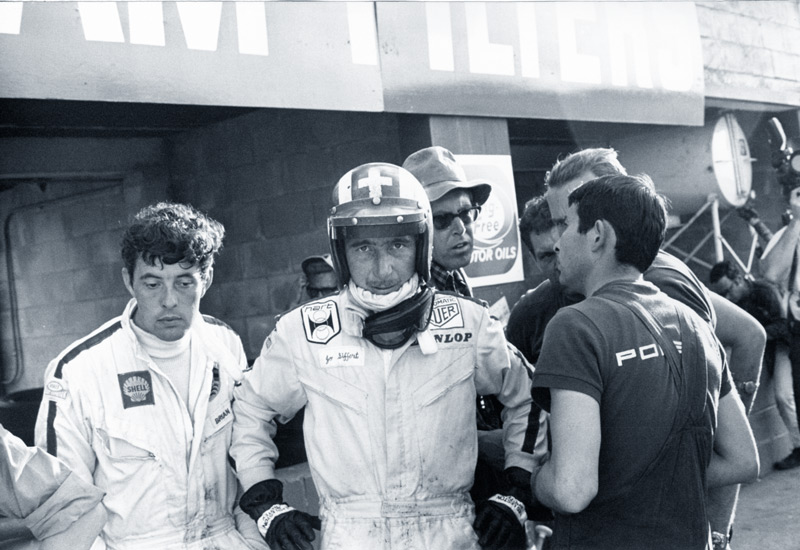
Cimarosti attests to Siffert's great business acumen and explains this using the example of the race car procurement for Steve McQueen's Le Mans film. "Siffert organized a countless number of racing cars for the film production company, which he rented out for good money," he says and continues: "Siffert had a particularly good nose for such opportunities. However, the content of contracts, including those with sponsors or racing car companies, was never discussed. Absolute discretion! His mother always commented with pride that he was a good businessman and 'he learned that from me'," smiles the journalist. He also attributes this to the fact that "Siffert came from a district of Fribourg where less well-off people lived. His father ran a dairy business and his mother earned some extra money as a cleaner. The family had to be careful with money". Cimarosti also remembers a deal Siffert made with the watch company Heuer. "Siffert got Heuer as a personal sponsor and wore the company logo prominently on his racing overalls. He was granted the right by company boss Jack Heuer to purchase Heuer watches at a preferential purchase price. The enterprising racing driver immediately took action - within a very short time, countless people in the paddocks were wearing a Heuer watch. Presumably they were not resold at cost price...!".

Adriano Cimarosti looks back at the beginnings of Siffert's automotive racing career (he previously competed in motorcycle races): "In the beginning, he financed his first racing cars with a second-hand dealership. This was very successful. And over the years, this developed into the company 'Jo Siffert Automobiles' with an official Alfa Romeo and Porsche dealership". When Siffert and his team members were short of money, which was not only occasionally but often the case, they sometimes resorted to unorthodox means, as Cimarosti recounts with a grin: "On the journey to the Syracusa Grand Prix in Sicily in 1963, they had to put the towing vehicle and trailer with the Lotus-BRM on it on the ferry to Messina in Reggio Calabria. Assuming that they would be able to avoid buying tickets, they disappeared into the ship in a flash to wait for the ship to depart. Suddenly, however, the loudspeaker announced: "The owner of the car with Swiss license plates is requested to come to the ticket office...".
Another reminiscence from Cimarosti's box of memories goes like this: Jo Siffert drove up to Swiss customs in Basel early in the morning on March 19, 1961 with a new Lotus 18 that he had just picked up in England. As it was Sunday, no cars were cleared through customs. However, Siffert was due to take part in the hill climb in Mont-sur-Rolle on the same day. Siffert, from Fribourg, remembered that Federal Councillor Jean Bourgknecht, head of the Department of Finance and Customs, was also from Fribourg. Various phone calls (there were no cell phones yet!!!) were made to the Federal Councillor, whereupon Bourgknecht arranged for Siffert to enter Switzerland. In Mont-sur-Rolle he then set the fastest time in his category...!
He was always correct with his mechanics, team members and journalists. "He was careful with personalities such as team bosses Rob Walker, Ferdinand Piech or John Wyer. He knew that you had to be friendly with such personalities," says Cimarosti and also recalls meetings between Siffert and Enzo Ferrari: "But it never came to a conclusion, because Porsche had intervened.
Cimarosti assesses the situation of the two Porsche works drivers Jo Siffert and Pedro Rodriguez in John Wyer's team as follows: "Both were hotheads in this relationship during the race. Both wanted to win - neither wanted to give in. This resulted in many a heated duel for the lead and victory. I wasn't there at Spa in 1970 and at the 1971 1000km race, but these are fitting examples to illustrate this.
Siffert had a friendly relationship with his immediate companions such as Jacques Deschenaux, Paul Blancpain or his sister Marguerite, who ran the secretariat, and of course with his racing mechanics Jean-Pierre Oberson and Heini Mader. He was a close friend of the artist Jean Tinguely, a great motorsport fan. He often accompanied Siffert to the races. "Tinguely once bought a disused Formula 1 Lotus 24-Climax and had it mounted on the wall of his bedroom...", smiles Cimarosti. And there was also a relationship with Jack Heuer, the watch manufacturer from Biel, that went beyond purely business matters.
On October 24, 1971, Adrian Cimarosti was at home and not in England at the Brands Hatch race track. "It was terrible when I heard about Jo Siffert's death. I made my way to the editorial office of Automobil Revue in Bern on Monday. As I walked past a newsstand, a newspaper poster read in large letters: "This is how Jo Siffert died". It hit me like a hammer blow, I felt like I'd been hit over the head - I didn't want to and couldn't even comprehend that this had actually happened," says the journalist, describing the moment. But - it was the end.
Profile of Adriano Cimarosti
Adriano Cimarosti is the grand seigneur of Swiss motorsport journalists. He became known to a large audience thanks to the TV program "eifach, dopplet oder nüt" by Mäni Weber at the end of the 1950s. This appearance as a quiz candidate was followed by a commitment to Automobil Revue, which was thus able to competently fill the post of racing editor for 40 years from 1961 until his retirement in 2001. Cimarosti is the author of numerous (racing) books, a walking racing encyclopaedia, a classic car enthusiast with models of exclusively Italian provenance (as befits a native Italian!) and, of course, still deeply attached to his home country. Cimarosti was not awarded the title of "Commentatore" like Enzo Ferrari, another famous Italian, but "it was still enough to become a Cavaliere", as Cima remarks with a grin. Born in 1937 in Friuli in Italy, he has lived in Switzerland since 1941, now lives in a suburb of Bern, is married and has a grown-up son.