Downsizing over 30 years ago

Downsizing is the order of the day, even Jaguar has recently installed a four-cylinder engine in the F-Type in order to comply with increasingly draconian emissions regulations and fleet fuel consumption targets.
However, the problem is not entirely new. As early as the 1970s, American car manufacturers felt compelled to reduce the thirst and, above all, the exhaust emissions of their road cruisers. And they did exactly what is still "en vogue" today: they replaced a large engine with a smaller one and gave it a turbo.
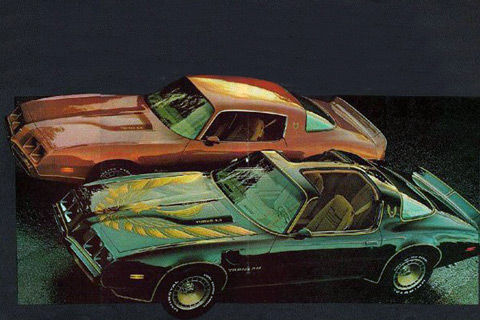
It quickly becomes clear that this cure is a lot more American than modern downsizing, in which some eight-cylinder engines are replaced by six-cylinder engines and six-cylinder engines by four-cylinder engines, when you look at the Pontiac Firebird Turbo of 1980. As is well known, the Pontiac was a brother of the Chevrolet Camaro and although it was available with a six-cylinder engine, it was only suitable as a cheap entry-level variant. The majority of cars, such as the Pontiac Firebird Trans Am, had an eight-cylinder engine.
At the beginning, when the second generation was introduced in 1970, these engines had a displacement of over six liters and more than 300 hp. Over the years, they lost more and more horsepower due to lower compression ratios, until even a 6.6-liter only produced 188 hp.
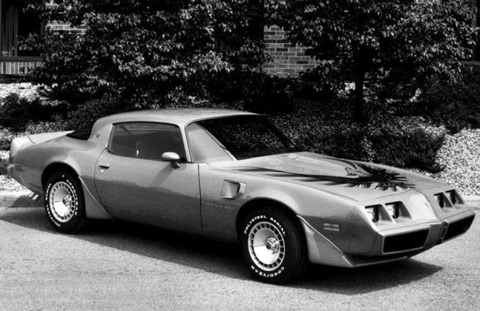
With the Pontiac Firebird Turbo, GM engineers took the plunge. They fitted a turbo to the smaller 4942 cm3 V8 and coaxed 213 hp from it at 4000 rpm, without reducing the compression ratio. The ESC (Electronic Spark Control System) was supposed to prevent knocking at full acceleration, but in a test conducted by Automobil Revue in August 1980 , it was not quite up to the task.
The "downsized" Pontiac accelerated from 0 to 100 km/h in 9.4 seconds, and the forward thrust only ceased at 191 km/h. These were good figures, which did not quite come close to the Pontiac Firebird F 400 with 6.6 liters displacement and 253 hp tested in 1972 , which had only taken 8 seconds for the standard sprint and had reached 217 km/h, but were still more reminiscent of an old-school "muscle car" than the weak V8s of the time without turbochargers.
However, the Americans proved something else that nobody wants to admit today, even back then. A required turbocharged engine, even if it has to make do with a significantly smaller displacement, can consume considerably more fuel at the same speed than a less required larger engine. At a constant 160 km/h, the five-liter turbo of 1980 consumed 28.2 liters per 100 km, while the 6.6-liter of 1972 had consumed a much more modest 19.2 liters. At 180 km/h it was 38.8 versus 23.3 liters. Up to around 110 km/h, however, the turbo was able to show fuel consumption advantages, and as is well known, the Americans were not allowed to drive much faster even then.
We have now dedicated a driving report to the second-generation Pontiac Firebird's brother, the Chevrolet Camaro, which reveals why Europeans also loved it.