Better to buy an Alvis than a VW Golf GTI? (Question of the week)

We have already become accustomed to classic car prices growing year on year, and recently price records for youngtimers have also been reported time and again. However, cars with annual double-digit growth figures are the exception. Most old vehicles tend to rise at a more leisurely pace and there are also many vintage and classic cars that are said to have already passed their peak in value and are already on the decline again. In this context, representatives of the pre-war era as well as gnarled British sports cars from the post-war period are often cited as examples.
Instead of puzzling ourselves, we asked our readers which cars are most likely to be affected by a decline in value. We chose five very different classic cars and, in our " Question of the Week " , we wanted to know explicitly which of these is most at risk of a falling market price over the next two years.
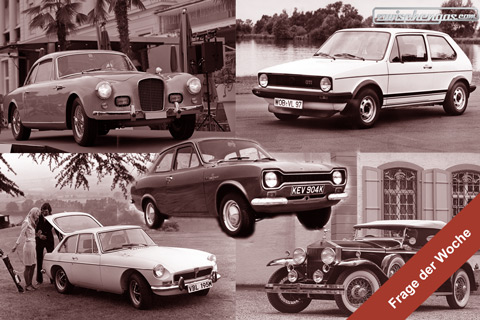
The cars to choose from were a Rolls-Royce Phantom I from 1928, an Alvis 3 Litre TC 108/Graber from 1957, an MG B GT from 1973, a Ford Escort 1100 from 1968 and a VW Golf GTI from 1981.
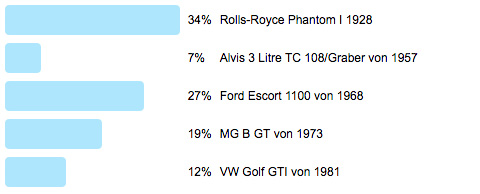
Of the 520 readers who cast their votes, around a third (34%) believe that the Rolls-Royce Phantom I is most likely to lose out in terms of value. This comes as little surprise, as this particular vehicle category celebrated its price triumphs in the 1980s, when these majestic luxury vehicles were auctioned off at top prices. Since then, however, their prices have come under pressure and buyers have turned to other cars.
However, 27% of readers believe that a 1968 Ford Escort 1100 is at the highest risk of depreciation. This is somewhat surprising because, on the one hand, the "dog bone" is very popular, and on the other hand, former bread-and-butter cars are among the vehicles that have increased in value particularly significantly in recent years.
19% of the respondents said that the MG B GT from 1973 was the most likely to lose value. As a representative of the British post-war sports car generation, especially as a coupé, it was to be expected that values would not skyrocket in the future.
Almost a seventh (12%) named the 1981 VW Golf GTI as a candidate with a potential loss of value. This is surprising, as the sporty hatchback compact saloons rank highly in the favor of classic car and, above all, classic car enthusiasts.
In the end, a rather unexpected candidate was chosen as the "winner" of the value development lottery. Only 7% of readers assume that an Alvis 3 Litre TR108 with Graber bodywork from 1957 is at high risk of depreciation. Yet it is precisely this vehicle category that has been battered by severe losses in value at auctions in recent years. Special bodies and cars from the 1950s, many of which still featured pre-war technology, were not actually popular. However, these were usually built in very small numbers and, as special bodies, they were often even one-offs. Whether this, or the fact that these vehicles in particular are no longer known to many of today's classic car and youngtimer enthusiasts, was the reason for the low rate cannot be conclusively determined.
In any case, the overall result is surprising and could hardly have been predicted. The graphical results are shown here:
In two years' time, we will be able to check whether the predictions were correct. Because then we will compare the 2019 ratings with those from April 2017, which according to Classic Data (state 2) were recorded as follows:
- Rolls-Royce Phantom I 1928: EUR 120,000 *
- Alvis 3 Litre TC 108/Graber from 1957: EUR 59,800 *
- Ford Escort 1100 from 1968: EUR 10'600
- MG B GT from 1973: EUR 14'700
- VW Golf GTI from 1981: EUR 13,900
The next question of the week is already underway. This time we are interested in how original tire patterns and tire sizes should be for classic car and youngtimer drivers.
And of course you can still read all the previous results of the "Questions of the Week " in the corresponding topic channel.