Yes, they do exist, the good opportunities in life. For example, anyone who has been dreaming of a classic car for a long time and likes to have their hair in the wind when driving should perhaps consider buying a Mercedes Benz 300/500 SL, Alfa Romeo Spider, Audi convertible, BMW 3-series convertible or Mazda MX-5 now.
All of these cars are "on the market" in sufficient numbers and offer a lot of driving pleasure for the equivalent value of an entry-level Smart. In this context, we are talking about 5000 to 15000 francs (or 4000 to 12000 euros). So a tight wallet isn't enough, but you don't have to be a Rockefeller to enjoy carefree summer convertible pleasures with four/five/six or eight cylinders.
Convertibles often have low mileage even in their second and third age and in most cases have been treated with care and perhaps even protected from salt water as collector's items. The state of preservation is often correspondingly good, which reduces the risks for the buyer.
High-tech noblesse - Mercedes Benz 300/500 SL R129
![Mercedes Benz 500 SL 1992]()
The Mercedes Benz 300 SL / 500 SL of the R129 series was the convertible of superlatives in the nineties. The innovative feature was the roof, which opened and closed without any effort with the help of many motors and an elaborate mechanism, and of course disappeared under a fixed flap. Bruno Sacco had drawn sleek and mostly straight lines, and the engine builders provided six to twelve-cylinder units from 180 to almost 400 hp. Integral seats and a surcharge list that easily allowed the base price of just under six figures to be increased by several tens of thousands were also part of the package, as was the standard hardtop, which also made the car suitable for winter driving.
No wonder the R129 was popular, no wonder over 200,000 were sold. And so there is also a large supply on the used car market. And you can get a lot of technology for surprisingly little money. However, you shouldn't expect cheap workshop bills if something does go wrong.
Italian classics - Alfa Romeo Spider
![Alfa Romeo Spider Serie 4 1998]()
In 1966, Alfa Romeo presented the Duetto Spider in Geneva; in 1970, the rear end was cut off and it became a fastback Spider. Another 13 years later, the Milanese company fitted a front scoop and rubber spoiler lip at the rear and named it the Aerodinamico, before finally giving it a more classic front and a rounder rear again from 1989 as the Series 4 version.
The Alfa Romeo Spider was always popular, so there was no need for the movie "The Graduate". With its Italian temperament, the famous twin-camshaft four-cylinder engine - although the catalytic converter and noise regulations took some of the edge off - and Mediterranean flair in the interior, it drove its way into people's hearts.
There is no shortage of youngtimer-age vehicles on offer, but good Spiders have never been cheap.
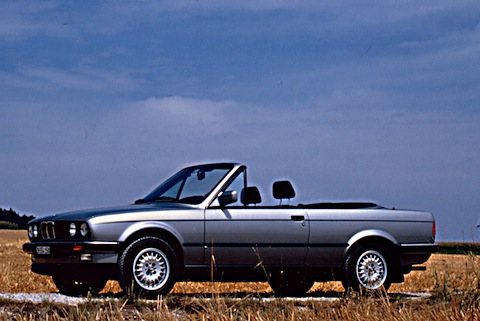
Pioneering BMW 3 Series Convertible E30
![BMW 325i Cabriolet 1990]()
While the Milanese were always present in the full convertible market thanks to the Spider and were one of the few car manufacturers to do so, you had to look back many years before you came across the ancestor of the BMW 325i convertible presented in 1985. For many years, Baur had provided fresh air in BMW saloons with targa-like designs, then BMW presented a truly open E30 on its own, which promptly hit the market like a bomb. The lines were just right and with the over-center kinematics, the roof could also be fitted without much effort if it had not disappeared under a flap. There was plenty of room for four people and the famous in-line six-cylinder engine hummed its beautiful song in the front if the buyer had not opted for the cheaper four-cylinder.
The popularity of the time is still evident today, and prices for well-preserved 3-series convertibles are comparatively high.
The beginning of a new generation - Mazda MX-5
![Mazda MX-5 1991]()
If the Mazda MX-5 ( also known as the Miata) had not existed, perhaps the great convertible renaissance that began in the 1990s would not have happened. The Japanese (together with their American design center) had the right instinct and amalgamated the English sports car legend Lotus Elan with modern and everyday Japanese technology. The result was a beautiful convertible for two that exceeded all sales expectations. Between 1989 and 1998, several hundred thousand of the almost 1000 kg folding headlight roadsters left the factory and made convertible fans around the world happy. And because the Japanese car was almost flawless, many have survived. Examples with few kilometers are comparatively expensive.
Fast Follower Audi Cabriolet
![Audi 2.3 E Cabriolet 1992]()
Audi was certainly not a pioneer with the Audi 2.3 E Cabriolet based on the Type 89 coupé in 1991 . After all, BMW had already presented a model half a decade earlier and Audi was able to observe and adopt what had proved successful.
The company launched a convertible with a 2.3-liter inline five-cylinder engine and an easy-to-install soft top, and then increasingly expanded the drive side. Visually, the open-top Audi was only subtly refreshed during its nine-year production period.
With front-wheel drive, it was well equipped in summer and winter, and the lined soft top made a hard top unnecessary. Even four people could travel open-top as long as there was no wind deflector on board. Gears were changed manually or automatically.
The car does not yet have cult status, which is why the prices are relatively low, even for vehicles with low mileage. And there were also some iconic colors such as broom yellow or Gomera pearl effect.
Spoilt for choice
Whether Mercedes, BMW, Audi, Alfa or Mazda - all these cars are a joy to drive. They all fit into roughly the same budget, which is surprising, as the most expensive (Mercedes) cost around five times more than the cheapest (Mazda) in 1990. The decision criteria will be the number of seats, the expected performance and, of course, the maintenance costs to be factored in. And probably above all aesthetic criteria. The good thing is that there is a wide and varied range on offer.
Are there alternatives? Of course, always. If you want to go less "mainstream", you can also opt for a Jaguar XJS Cabriolet, a Chevrolet Corvette, a Toyota MR2, a Mazda RX-7 Turbo Cabriolet, a Citroën Mehari or a Maserati Biturbo Spyder. Just to name a few examples. Smaller numbers and, depending on the case, more capricious technology could, however, lead to headaches later on and higher follow-up costs. But that doesn't have to be the case, of course.