Rare sports cars and convertibles are in the favor of classic car collectors. Saloons and many more commercial and utility vehicles rarely command high prices at auctions, if they appear there at all. The first-generation VW Bus is an exception.
Everyone knows it and can categorize it immediately. The first VW Bus, also known as the T1, has a striking face with two googly eyes and a truly huge Volkswagen logo. The lines basically resemble a box, and the maximization of available space was understandably a priority during development.
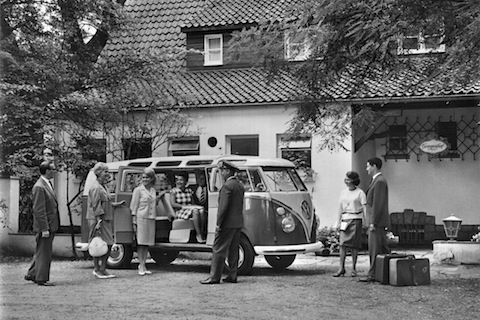
The history of the VW Bus began with the internally named Type 2 (alongside the Beetle, i.e. Type 1), which was produced in Germany from 1950. The first series was built 1.8 million times by 1967 and was then finally replaced by the T2, which was technically comparable but visually refreshed. The first prototypes of the "Transporter" were developed as early as 1949 under the then VW boss Heinrich Nordhoff.
![VW Bus und VW 1200 im Jahr 1960]()
From March 1950, the VW Transporter could be purchased for DM 5850, which was only slightly more than the price of a fully equipped Beetle. The Wolfsburg-based company did not experiment with technology and fitted the bus with an air-cooled rear engine that drove the rear wheels suspended from a swing axle. At some point, the T1 was nicknamed the "Bulli", a term that could have come from the combination of the first letters of bus and van.
Successful
As was usual for Volkswagen, the VW Bus underwent constant improvements. It was also available in ever new versions, whether as a platform van, camper van (Westfalia), hunting version, police van, fire engine or hearse.
![VW T1 Samba von 1962]()
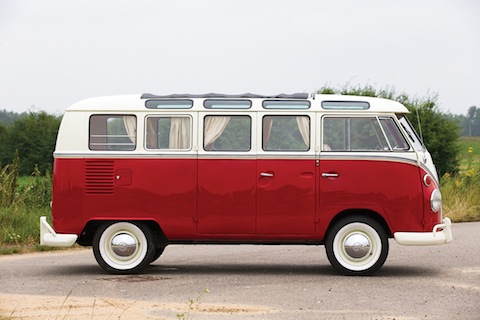
One of the most popular versions, known as the "Samba" or "Deluxe Microbus", had 23 windows, two-tone paintwork and a sliding folding roof. The Samba was designed to transport eight people and featured a more luxurious interior, which even included a radio. The Samba cost DM 8,475 in 1955, and even in Switzerland the price was less than CHF 10,000.
![VW T1 Samba von 1963]()
Now expensive
Today, the affordable transporter of yesteryear has become a luxury classic car. At auctions, the more luxurious Samba versions in particular reach top prices of CHF/Euro 100,000 and more. RM, for example, is offering a red Deluxe Microbus from 1965 (pictured above) at the London auction on September 8, 2014 for an estimated price of £ 60,000 to 80,000, the equivalent of around € 75,000 to 100,000 or CHF 91,000 to 112,000.
The amazing thing is that over 110,000 of these models were built between 1951 and 1966 - rare is different. As a quasi-utility vehicle, only a few of these likeable people carriers have survived, of course, but the price level (10 times the new price) is still surprising. In fact, the prices are so high that you can even consider buying a dilapidated example and still remain in the marketable range despite the restoration costs. There is hardly any other vehicle in this category that offers similar value. A week ago, the blue example pictured below achieved a six-figure selling price in Monterey.
![VW Deluxe Micro Bus von 1966 (© Darin Schnabel - Courtesy RM Auctions)]()
The compact VW buses have of course remained practical and reliable to this day, perhaps one of the reasons for their popularity alongside their hippie past.
We have brought together a selection of VW bus models in a picture magic series .








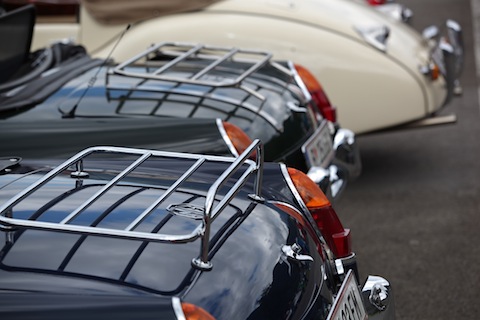
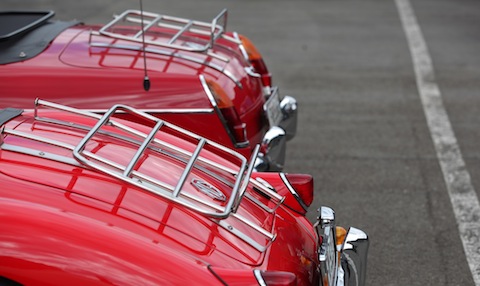

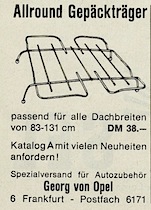 Of course, there was also the variant for the car roof, which was even more popular. Millions of Beetles were fitted with such a device and sometimes transported heavy loads above the passengers.