BMW's first electric car

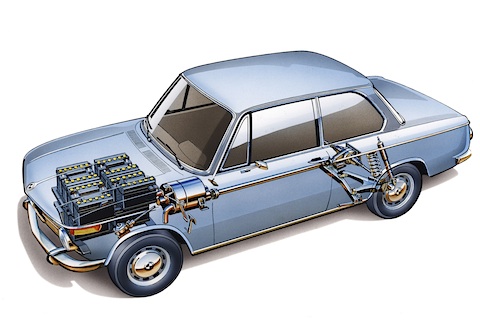
Today, everyone is talking about the BMW I3 and I8 and praising the vehicles as pioneering achievements. But BMW already launched two electric vehicles over 40 years ago. At that time, the basis was the BMW 1600-2, the compact, sporty two-door model. Developed jointly with Bosch and Varta, the vehicles were intended to showcase BMW's innovative spirit to the public on the occasion of the 1972 Olympic Games in Munich.

The two otherwise largely standard 1600-2s were equipped with a powerful frame in the engine compartment, which carried twelve 12-volt vehicle batteries. These powered a direct current motor with around 32 kW (43.5 hp) weighing 85 kg, which was installed roughly where the gearbox was normally located. Due to the high temperatures, it was cooled by a fan. The power was directed to the rear axle via a reduction gear and the cardan shaft.
A Bosch thyristor control unit was located in the rear, which acted on the electronic accelerator pedal and controlled the engine speed.

The ready-to-drive car weighed 1331 kg and was capable of 100 km/h. There was even a range indicator in the largely standard cockpit. The electric BMW had a range of around 70 km, but only if the power was not fully drawn.
If the batteries were empty, you could either simply replace them or recharge them via a socket located behind the kidney grille at the front.
From the outside, the two cars looked almost like their petrol brothers, but lacked the exhaust and, of course, the characteristic sound.
In September 1972, the two BMWs entered the Munich Olympics as camera and support vehicles for the marathon and the 20 km walking competition. The two test vehicles then disappeared again, and further electric prototypes were built on a different basis in 1987 and 1991.

More details and information can be found in the book "Legende BMW 02" , which was recently republished.