Generational conflict - Lotus Esprit


When Lotus presented the Esprit in 1975, visitors to the Paris Motor Show were left open-mouthed with amazement. Giugiaro's shape, which consisted largely of a wedge and many straight lines, was impressive and made the car the magnet of the show. Everyone had actually been prepared for the Esprit, as a prototype had already been shown for the first time at the Geneva Motor Show in 1972.
It was not until 1976 that the first buyers were able to take delivery of their Esprit and a little later, in 1978, the S1 became the S2, which could do many things better without being fundamentally different. This was followed by the S 2.2 with the larger 2.2-liter engine and then the S3, which was also available with a turbocharger. Finally, in 1987, the Giugiaro creation was replaced by the Stevens-Esprit and then continued to be built into the new century in a wide variety of configurations with four and eight-cylinder engines. Then it came to an end and nothing has come of the new Esprit announced some time ago (so far).
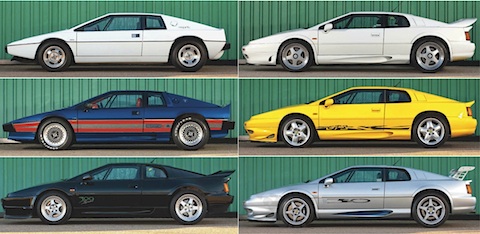
About a year ago, EVO magazine compared the various Esprit models and drove a (James Bond white) S1 and an S3 (Essex) Turbo (on the racetrack). Not entirely unexpectedly, the EVO people preferred some of the modern (and more powerful) Esprit variants, but the S1 came off surprisingly well, not least thanks to its low weight of just over 1000 kg and because none of its successors came close to it in terms of honesty and straightforwardness.
Esprit S1 models have cult status today, and not just because of the almost psychedelic interior, which is so hard to come by.
We devoted an extensive report to its direct successor, the S2, some time ago.