The Chevrolet Corvair and the crosswind

Crosswinds became the natural enemy of the automobile in the post-war years. The faster the cars drove, the more dangerous the gusts. In order to observe the effects of sideways gusts of wind, car manufacturers in the 1960s initially made do with airplane propellers mounted on the side of the road. Mercedes, for example, had such a system in Stuttgart-Untertürkheim.
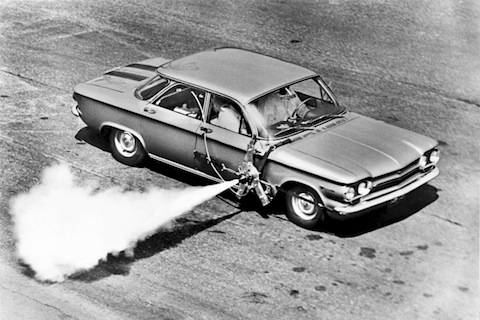
The disadvantage of these stationary systems was the short test track on which the effects of crosswinds could be observed. General Motors therefore developed a test arrangement in which the crosswind could be generated on the vehicle itself, as Automobil Revue described in issue 43/1963: "The research laboratories of General Motors Corporation therefore developed a new type of device which makes it possible to generate any desired lateral flow. It is a jet engine that can be mounted on the vehicle itself and exactly imitates the effect of natural wind currents.
This new test method enables technicians to test the stability of a vehicle under the influence of side winds with the utmost precision. As the nozzle motor can be mounted at different points on the car, it also allows wind currents to be tested on different body shapes and their strength to be precisely controlled."
However, this variant did not quite catch on, as later on stationary systems with propellers were mostly used again ...