Is "Ferrari", the movie by Michael Mann, a car movie?

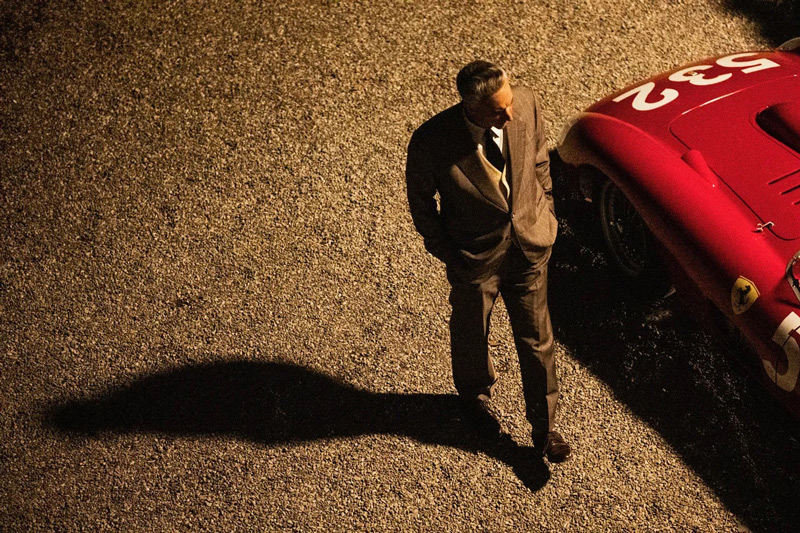
It almost feels like being in an unfamiliar restaurant. You get something completely different from what you would have expected from the name. The "Wall Street Journal" praises Michael Mann's Ferrari film with the slogan: "Ferrari is the best car movie of all time". In my opinion, however, this is simply not true because the incredible driving dynamics in Steve McQueen's film "Le Mans", which is over 50 years older, simply remain more impressive than the fast cuts and artificial digital speed of today. The enormous possibilities offered by digitalization should actually be able to achieve much more. The Mille Miglia was lined with crowds for its entire 1600 kilometers, but in the film the cars always drive at unreal close intervals through deserted landscapes, with only the town crossings being lively.
In 1957, the Italian car manufacturer and former racing driver Enzo Ferrari, portrayed in the film by Adam Driver, found himself in the biggest crisis in the company's history. The company that Enzo Ferrari and his wife Laura, played by Penélope Cruz in the film, had built up from nothing ten years earlier was on the verge of insolvency. In order to save his company, Enzo Ferrari put all his energy into a single race, the most famous road race at the time, the Mille Miglia.
Of Enzo's 90 years of life, only a third of a single year is recorded. However, these three months of the certainly difficult year 1957 are excellently realized and sensationally played by the two leading actors Adam Driver and Penélope Cruz.
In order not to wake up his second wife Lina Lardi (Shailene Woodley) with their illegitimate son Piero, Enzo pushes his Peugeot 403!!! to the hillside early in the morning, then jumps into the car and starts the French car. Thus begins the story, with its unexpected intimate scenes, but also with the expected racing scenes.
Death makes its brutal presence felt from beginning to end, with Enzo visiting the grave of his son Dino, who died of muscular dystrophy on June 30, 1956, aged just 24, alone every morning. After a bit of company history, motorsport begins with the death of Eugenio Castellotti, who died in a fatal accident during test drives in Modena on March 14, 1957, while trying to beat Behra's time in the Maserati 250F with the Grand Prix Ferrari 801. The Mille Miglia on May 11 and 12 of the same year, which is central to the film, ended catastrophically with the death of the Spaniard Alfonso de Portago and his co-driver Edmond Nelson when the Ferrari 335 Sport hit a milestone at full speed on the five-kilometre straight to Guidizzolo, slammed into a telegraph pole and, after spinning, crashed with full force into an embankment. Unfortunately, local fans and their children are standing right there. Nine innocent locals, including five children, are swept to their deaths. The scene of the accident is portrayed in an absolutely uncompromising and taboo-free manner, comparable only to a war movie. Unfortunately, it was a time when death was omnipresent at all times due to a lack of security. Michael Mann wants to portray Enzo's absolutely uncompromising will to succeed.
Michael Mann, as English Motor Sport writes, is considered a director who rarely shies away from contextual violence and here too he chooses an unflinching approach, showing the horrific brutality of the tragedy that occurred just 50 kilometers from the finish line in Brescia. As a result, the film receives the full score of 15 in England. "It stays true to the events, out of respect for the significance of this accident," Mann emphasizes. His sources were police and investigation files - and, as he reveals, a very special eyewitness. "We visited the scene of the accident in Guidizzolo. While we were there, an elderly gentleman with a stick came up to us. He asked what we were doing here. When we explained, he said: 'I was there. We heard the first car drive through. My older brother, who was nine years old at the time, had run out of the house,' he told us. 'I was three. I ran after him, but I was slower and he got to the side of the road - where he was killed. I had to watch the whole accident,' the man told us."
This account inspired Mann to create the scene with the farming family and the two children.
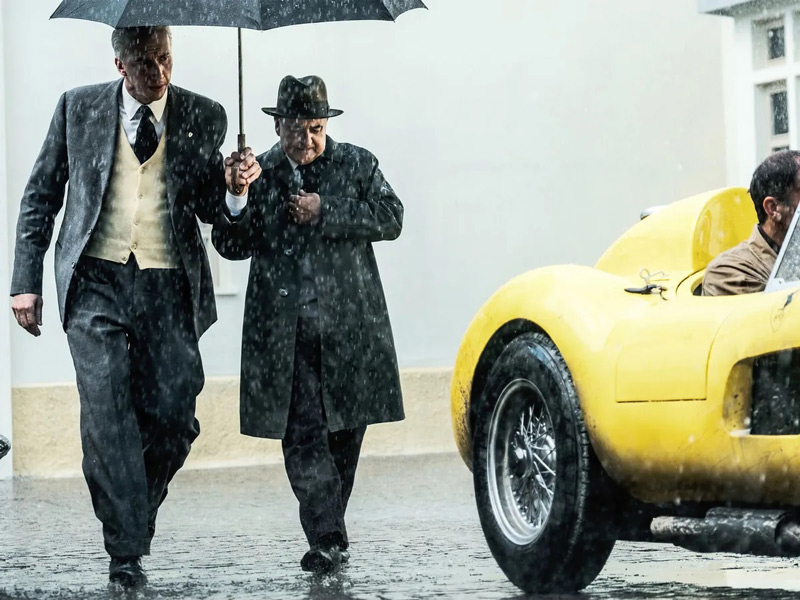
Enzo repeatedly encouraged his drivers to take more risks. It wasn't even enough for him when four plus the GT coupé of his cars were unrivaled in the lead, no, he also had to pointlessly urge the fourth-placed Portago to drive faster, which of course triggered an internal battle.
Denis Jenkinson journalist and contemporary witness: "At the inspection in Ravenna, the Ferrari team only received notification of the first three podium places, so they didn't know that the only real competitors from Maserati had already been eliminated. The reaction to this monopoly was actually incomprehensible, only von Trips took it a little easier, but Collins couldn't live with the fact that the German was in the lead at the first check, so he drove faster and Taruffi, as always, only really got into his stride on the fast stages on the Adriatic coast. Gendebien had no idea what was going on behind him and drove as fast as the car could go. By the time they reached Pescara, Collins and Taruffi had overtaken von Trips, and only before they turned inland did they realize that the Maserati threat no longer existed, as all the Ferraris occupied the first five places. In Rome, the order remained unchanged and the Ferraris drove in the order of Collins, Taruffi, Trips and Portago towards a sure-fire big win, which was to be underlined by Gendebien in fifth place and winner of the GT class."
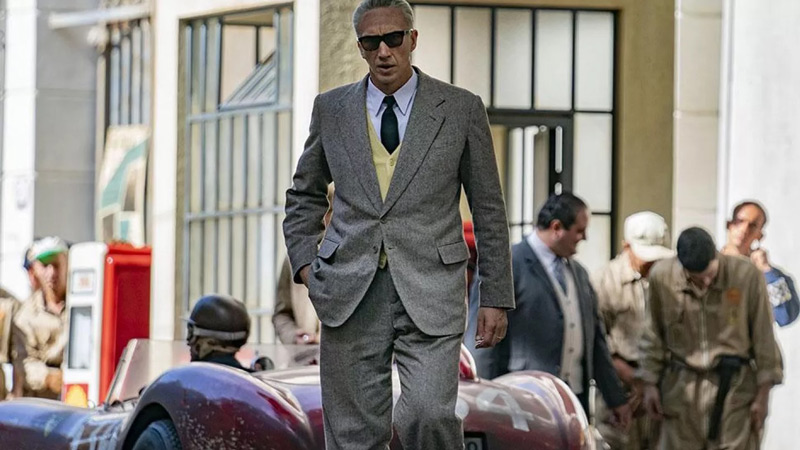
Enzo's private life was just as uncompromising as his management. In addition to a number of affairs, he kept switching back and forth between two women, so much so that his wife Laura even shot him once out of anger (seen in the movie).
Enzo's private life does end up taking the leading role in the movie, but shows us a rather unknown, surprisingly child-loving man.
The release of the film "Ferrari" is the culmination of a lengthy odyssey that spanned 30 years for director and Hollywood star Michael Mann. Mann was already in his fifties when he and his friend, fellow director Sydney Pollack, first began working with screenwriter Troy Kennedy Martin on a story based on Brock Yates' biography "Enzo Ferrari: The Man and the Machine". Pollack passed away in 2008, but Mann, now 80, has only now finally been able to realize the vision they defined together and bring his perspective on Enzo Ferrari to the big screen.
The illegitimate son Piero Lardi, born on May 22, 1945, who has worked in his father's company since 1965 and has been Vice President of Ferrari since 1988, has certainly brought back some memories from his childhood.
Making Of
Interesting note from our reader ra****** regarding the vehicles in the movie: