Are "Autlers" superhumans?

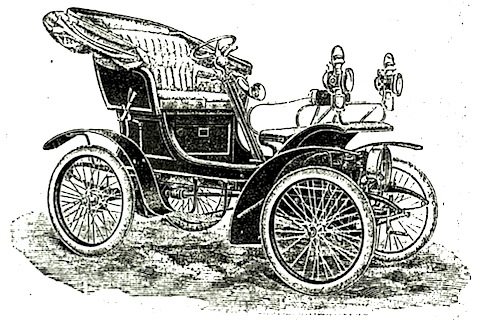
In 1906, the following article appeared in the magazine "Deutscher Motorradfahrer", which we would not like to withhold from our readers, not only because we like the term "Autler" very much, but also because it illustrates the problems of early motorists very nicely:
What the Imperial Court requires. The motorist who goes for a ride in bad weather would do well to get out of the car every five minutes and check whether a layer of road grime is covering his number, because if it is not clearly visible, the gendarme will write it down without the motorist noticing; strangely enough, the gendarme recognizes the number precisely when it is illegible "contrary to police regulations". Even in the clearest lane, driving in the middle of the road costs a few thousand dollars: the driver always has to keep to the right; our authorities don't want to know anything about the left.
If the driver sounds too quietly, he is liable to prosecution; but if he sounds too loudly, he is also liable to a police ticket. Every driver must have the police regulations in his head and observe them scrupulously. Of course, people who know a thing or two about this claim that it is impossible for the most conscientious driver to live his life without any conflict with the strict authorities.
But the Reichsgericht thinks differently: what the police regulations require can only give an indication of the care that a driver has to observe; they certainly determine the minimum degree of care required, but they do not constitute an exhaustive regulation. Thus, the Reichsgericht pronounced a judgment on September 20, which is reported in detail in the latest issue of the Juristische Wochenschrift.
On the state road leading from Landshut to Freising, which is frequently traveled by automobiles, a horse that was harnessed to a carriage carrying several people shied away from an automobile and ran off. Eventually it overturned the car. A woman was thrown onto the road and suffered a fractured skull, which resulted in her death. The husband of the victim and her two minor sons now sued the driver of the car for payment of 10,000 marks in compensation, possibly an annual pension of 1,000 marks and 100 marks in funeral costs.
As the court of first instance, the Munich Regional Court declared the claim to be justified on the merits. On the other hand, the Munich Higher Regional Court dismissed the claim on appeal. However, the Reichsgericht did not agree with this; it set aside the judgment of the lower court and referred the case back to another senate of the Higher Regional Court for a further hearing.
The Senate of the Higher Regional Court, which dismissed the action, was not allowed to deal with the case again, because it had not given the highest court enough weight to the degree of care required in traffic with motor vehicles. He had denied that the driver of the automobile could expect that the horses he encountered "would generally no longer behave with particular fear towards his automobile, since that road has lively automobile traffic. A gross error! Because - says the Reichsgericht - the defendant could not rely on the horses he encountered there being less sensitive to cars .
Opinion against opinion! But the Imperial Court is the higher authority, and therefore it is right.
The driver of the automobile sinned by driving past the horse, although it "immediately became restless when the automobile approached, raised its head and began to prance with its front legs". Then, according to the Reichsgericht, it must be assumed that the defendant had noticed or "with due attention" "should have noticed" how the coachman got off the carriage and led the restless horse against the side of the road. Furthermore, the coachman gave the driver a signal to stop. According to the Imperial Court, it was not only a question of whether the defendant had seen the sign, but also whether he should have noticed it if he had been paying due attention. The lower court must now re-examine whether the danger was recognizable and, if so, whether the defendant could have stopped at a reasonable distance from the vehicle, i.e. more than 5 meters away. If he could, he had to until the danger was eliminated.
The Reichsgericht therefore actually requires the driver of the automobile to look at each horse to see whether it is automobile-shy or not; because the mere restlessness does not suggest that the horse will immediately race away wildly when an automobile approaches. The driver should be able to recognize the horse's shyness even at a distance of more than 25 meters! Is it at all likely that a horse will shy away from a car at such a distance? But if that is the case, then it will shy away even more when the snarling monster, called an automobile, stops in front of it.
Will the engine driver be required to keep an eye on the road running alongside the tracks to see if there are any railroad-shy horses running around, and if he spots one, to bring the train to a halt? Is it not much more correct to demand that locomotive-shy horses are not brought onto such roads?
The Imperial Court trusts you drivers even more than the police. And be happy about that! Be proud of the high opinion that the highest German court has of you. The superhuman level of care that is expected of you cannot be achieved by any ordinary mortal: it requires supermen. Perhaps the Imperial Court will one day realize that you too are no worse and no more perfect than other people; perhaps it will realize this when all the Imperial Court judges drive automobiles themselves; then they will realize that they are asking more of you than human strength is capable of.
You can read more about automotive jurisdiction over the course of time in the various issues of Motorfahrer, Motorradfahrer and ADAC Motorwelt in the Zwischengas magazine archive .