The Hydrak gearbox and Fangio's last Formula 1 race
I had no intention of going out again after dark when, after dinner with his wife Beba at the Hotel Lion d'Or on Place Drouet d'Erlon in Reims, Fangio suggested to me (and I searched my memory to see who could have come up with the idea of dining [and paying] there - anyway, of the three of us, I could least afford it): "Let's go to the garage to see if (Guerrino) Bertocchi has found the 300 extra revs my Maserati was missing this afternoon".
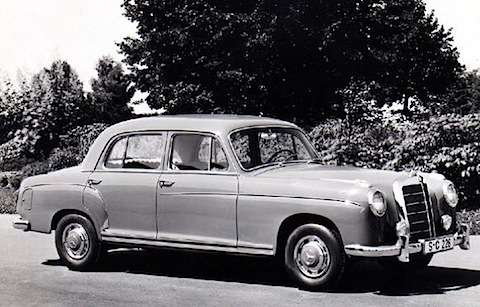
We both left the hotel while Beba withdrew. Outside was the car I had driven from Stuttgart to see this race. It was a Mercedes-Benz 220 Hydrak. I gave Juan the keys, he sat down and I began to explain to him how this vehicle - without a clutch pedal! - worked.
Juan got behind the wheel and saw that one pedal was the essential gas pedal and the other, wider one, was the brake, as in most North American cars. "Look here!" said 'El Chueco' (the crooked-legged one).
I explained to him that instead of a clutch pedal, you simply use your hand to operate the gearshift on the steering wheel. This lever seemed to be like the others, but it had some play, as if it had been badly adjusted or worn out.
"As soon as you touch the lever, the clutch plates separate," I told him. "You pull the lever and select the desired gear. But then you have to let go quickly so that the clutch engages".
Whereupon he asked me: "Did you know that we had developed such a system at Mercedes-Benz in 1955 in order to be able to install it in the racing cars of the following season (1956)? But this project was surprisingly withdrawn. So this is the first time I've driven a car with this mechanism."
Of course I didn't know that. Fangio set the car in motion in the direction of the Maserati workshop. He drove at a leisurely pace, not because it was already dark, but because he always drove slowly in traffic: "Imagine I was involved in a traffic accident..." he once said.
Fangio was already a five-time world champion, but the current season had started badly for him. With the car he was driving and the competitors he was up against - some 15 or 20 years younger than him - a sixth title would not be easy to achieve.
In the workshop where the mechanics were located, calm and optimism prevailed. Bertocchi, the heavyweight mechanic who held Pasta in the highest esteem, had already solved the engine problem.
We returned to the hotel within about half an hour and Fangio went to bed to get some rest. The following day's race, the Grand Prix de France, would put him to the test. And Juan was already 47 years old!
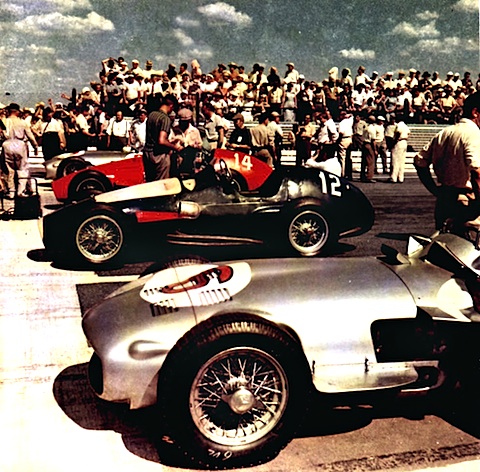
So it was July 5, 1958, the eve of the Grand Prix, which would be Fangio's last race. Hawthorn won in the Ferrari at 201 km/h, and Fangio finished fourth, two and a half minutes behind, and - that's right - driving without a clutch.

Sadly, the young Musso died in an accident. Poor Luigi. He had to ride as fast as he could to keep up with the murderous pace of his teammates Hawthorn (winner), Von Trips (third) and Collins (fifth).
I was very surprised when I read in the newspaper on Monday that Fangio had announced his retirement from active (Formula 1) racing.
And I had learned some news: That the 1956 Mercedes-Benz W 196 R should have been equipped with a semi-automatic gearshift. Or rather: with a hydraulic-electromagnetic clutch in combination with a normal gearbox. The production version was also an ingenious technical solution, but Mercedes decided to abandon it shortly after it went on sale. I don't know why it never met with much interest from the general public.
The fact that the racing department in Stuttgart Untertürkheim had developed this technology, which later became known in the trade as Hydrak (for hydraulic clutch), was due to the eternal quest for the last tenth of a second.
What modern computers calculate in a matter of seconds was done freehand or with a slide rule (who still knows how to use one today?), so a racing diagram was drawn up for each race, taking into account propulsion, power (for top speed), the mass of the vehicle in running order, air resistance, rolling resistance, chassis strength, traction and grip on the track.
A diagram was drawn up that made it possible to race with optimum power input and precisely calculated gear ratios.

They even took into account the fractions of a second that the driver lost by shifting up or down, estimating it at two tenths of a second between leaving one gear and engaging the next. This applied to all racing drivers except one: Juan Manuel Fangio. This was because the technicians had found out with their time measurement that this man from Balcarce shifted gears faster than his team-mates. And twenty faster gear shifts per lap corresponded to the small matter of - two seconds! These were not exact figures, but approximate.
And it was precisely to reduce these time losses that, in collaboration with Fichtel & Sachs, the racing Hydrak was developed, a gearshift without a clutch pedal, triggered only by manually tapping the gearshift. This was what Fangio had already seen at the end of 1955. But because Mercedes-Benz gave up participation in international races, the development was used in Mercedes road vehicles.