What super sports cars and their opponents felt like at top speed at the end of the 1980s ...

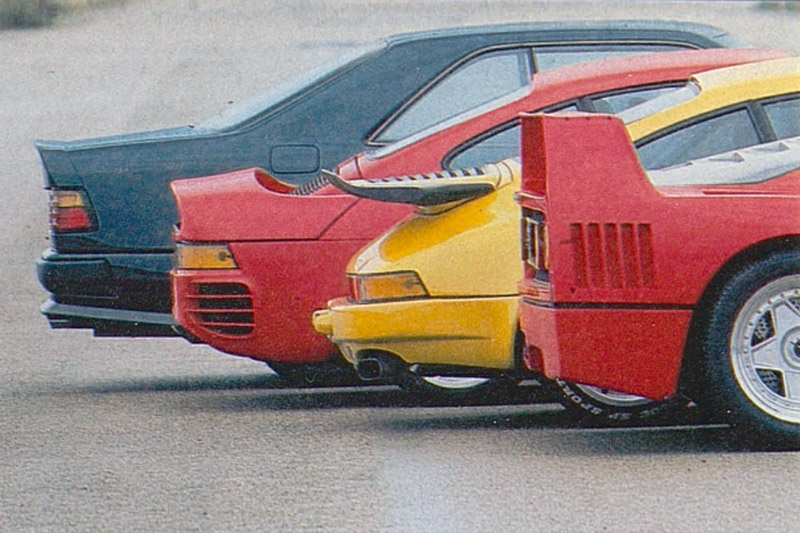
It was 1988 when the test crew from "auto motor und sport" set off for Italy with four super sports cars to pit the Ferrari F40, Mercedes-Benz AMG 6.0 32 V, Porsche 959 and Ruf-Porsche CTR against each other on the high-speed circuit in Nardo. Two Tunig cars battled against the super sports car elite of the time.
ams online editor Gregor Hebermehl recently summarized the article, but we would like to add a few things here. The original article in ams 25/1988 ( to be found in our magazine archive) ran under the title "In Reih und Speed".
In the article, Götz Leyrer and Bernd Ostmann commented on the fact that such a test drive is not without its problems: "Over 400 km/h have already been achieved in world record drives in Nardo, with special record cars, of course. But even in Nardo, 300 km/h with road sports cars is not entirely problem-free. The lateral acceleration 'g' is then, despite the superelevation, just under 0.2; the RUF-Porsche, for example, then weighs 1300 kg on the road - values that are good for nightmares among tire specialists. Porsche therefore recommended two slow coasting laps to cool down after each top speed attempt. Alois Ruf had reserved a separate set of tires especially for the measurements. Ferrari alone faced the test with all the nonchalance of many years of Formula 1 experience. Tire problems? None, if you just follow the instructions on the windshield of every F40: 3.0 bar tire pressure for speeds over 300 km/h."
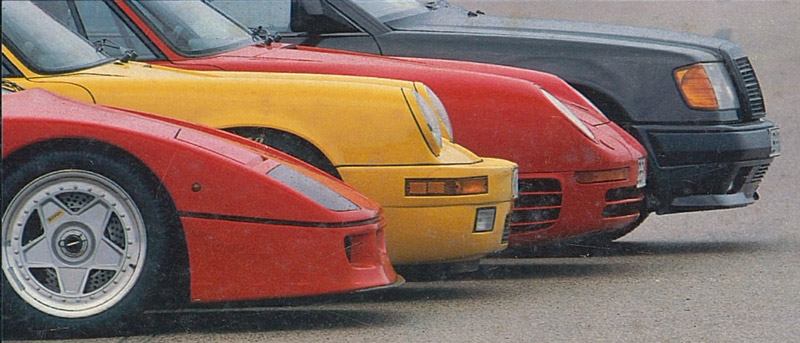
For the sake of completeness, it should be noted that the F40 reached 321 km/h in this way, but was even outperformed by the 959 with 339 km/h. Here, however, Porsche had done a lot of retrofitting; the test car was obviously the most powerful 959 ever to leave the development center in Weissach. Nevertheless, one of them was even faster, the RUF-CTR. It was able to reach a whopping 342 km/h and it was clear that it did not have to adhere to the official performance specifications. The AMG-Mercedes couldn't quite keep up, but it was certainly the most comfortable of the four test subjects.
When you read the description at the time, you can only wonder how today's hyper sports cars with 1000, 2000 and recently even 5200 hp want to convert their power into reliable and safe propulsion ...
P.S. It's worth reading the whole test again, or at least the summary by colleague Gregor Hebermehl.

_RM.jpg)