More space-related questions and an additional solution


It's time to address a truly important issue once again: Anyone who collects model cars will recognize this from the blog post about Depreux parking garages: The newly created space with a new shelf always runs out far too quickly; the collection—thanks to a complete loss of control over one's own desires—continues to grow unabated. The problem needs no further explanation...
But besides the parking garage, there's a second, equally ingenious solution to this perennial problem—the (model) car transporter! I'm always happy to welcome beautiful examples of these.

A model car transporter easily doubles the shelf space. It displays the models stacked on top of one another—on two loading decks, accommodating multiple vehicles, and occupying a single spot on the shelf. For a long time, I tried to stretch my shelf capacity with Plexiglas shelves, but now the solution is a car transporter. I was inspired by a gift I brought home from the owner of our Hongqi . The Japanese semi-truck—featured on the cover—now adds more color to the collection and, conveniently, also creates a little more space for die-cast cars from Japan and China.
The Husky transporter has also helped me solve some space issues. Husky was launched in 1964 by Mettoy Playcraft Ltd. in Swansea, Wales, and renamed Corgi Junior in 1970. The lineup included, for example, the Husky 2002 model, a Ford tractor unit with a Hoynor Mk II trailer—pictured above. The model featured well-thought-out details such as adjustable wheel chocks for vehicles of different sizes, a lowerable rear ramp, and a lowerable upper loading deck.

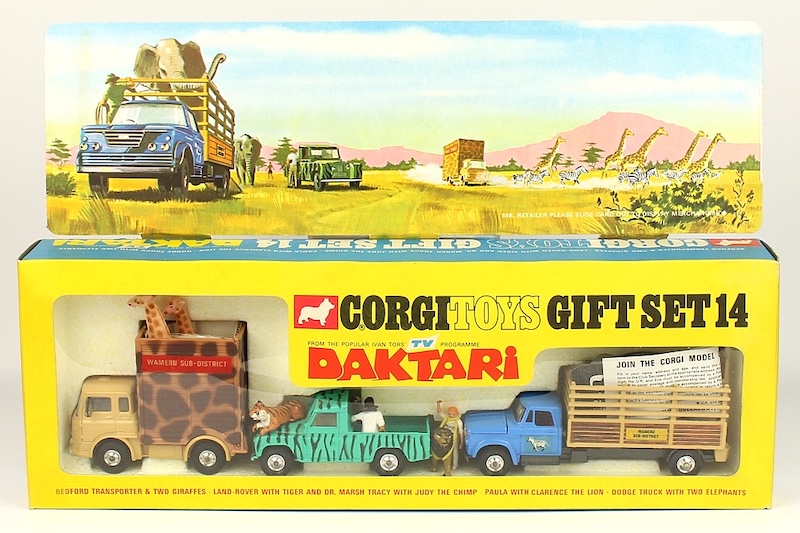
It was also sold as a gift set along with five matching vehicles. Mine aren't the ones from the original set, but they're Husky models nonetheless. With larger models—such as those for 1/43-scale cars, like the large Corgi Toys transporter in the top image—there's just one small problem: When fully loaded, the models are quite heavy. If they also have rubber tires, the tires will inevitably flatten against each other. For some of them, I've therefore placed PU foam pads underneath—essential solutions to pressing problems!