Spinning tops and hot chocolate


There are things along the roadside that I just miss. Things that left a lasting impression on me as a child, and things that—not surprisingly, given my life—are somehow connected to traffic, cars, and the road.
Just the other day, for example, there was talk in the newsroom about “Banago,” a chocolate drink that apparently tried to make a name for itself among boys in the 1970s by associating itself with racing. Well, in the Lucerne region, where I grew up, there was always another favorite in the milk glass: Heliomalt, which, as far as I know, was last produced in Hochdorf in the Seetal region of Lucerne.
An illustrated elephant on the packaging showed just how strong you'd become if you drank Heliomalt. Incidentally, in the 1960s, an uncle of mine had the pleasure of riding an elephant backward into a garage for a Heliomalt commercial. However, he claimed for the rest of his life that the poor animal had been traumatized by the experience. I don't know if that's true.
What's certain, though, is that on the way into town at Kreuzstutz, a Heliomalt elephant always greeted us kids from the wall. If we missed it—say, because we weren't paying attention—the bus ride had basically been for nothing. Because back then, kids still looked out the window. In the winter, you first had to wipe the fog off the window with your mittens. For us back then, the Heliomalt elephant was something like the gatekeeper to the city.
At some point, much later—after I'd driven across the intersection at Kreuzstutz countless times—the Heliomalt elephant disappeared. And with it, the product vanished from the shelves—thanks to Nestlé, Associated British Foods (Wander), or Mondelez (Suchard), whose multinational distribution networks left the small local players with hardly a chance. Heliomalt is reportedly back now, as is Banago, but the elephant at Kreuzstutz can barely be made out beneath a thick layer of paint on the building's wall. Perhaps he's still there beneath that layer.

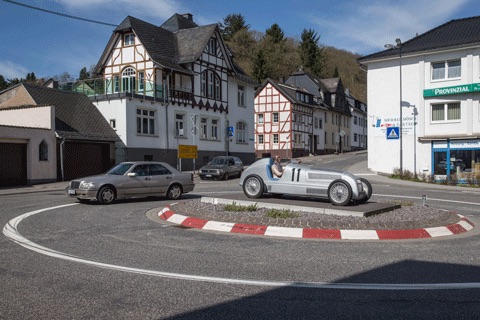
What's visible today, as in the photo, is a roundabout. This wasn't just any roundabout, but the first one in my hometown of Lucerne—and thus the first one I had the pleasure of experiencing. Back then, such a traffic infrastructure was still a big deal. At Kreuzstutz, it solved a major problem, because previously, the oncoming traffic shown in the picture could not turn left up the hill (on the right in the picture); instead, drivers had to take detours to pass under the railroad tracks and cross the road in question at a right angle. However, many guests at the Hotel Gütsch (to the right in the picture) weren't aware of this, and you constantly ran the risk of having your path blocked by an unsuspecting tourist.
The roundabout was really well-designed. Since then, many, many more roundabouts have been added—and some are far less successful. Incidentally, the statue of street sweeper Heinz Gilli has adorned the roundabout at Kreuzstutz for several years now. He hears, sees, and knows everything that happens in the neighborhood. Perhaps children today pay more attention to him than to the Heliomalt elephant.