Shakedown at Goodwood – Archie Scott Brown's Lister-Maserati and a Racing Debut


Friday is the most honest day of a race weekend. No one has won yet, and everyone still believes anything is possible. At Goodwood, it’s even more than that: Here, qualifying already counts, and if you sleep through Friday, you’ll start at the back of the pack.
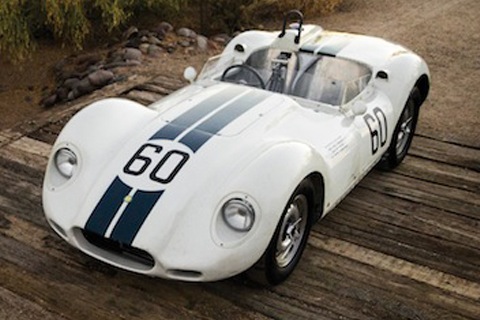
We’re on the road with the “Jaguar Sportscar Collection,” under the wing of Pendine Historic Cars, and I have the pleasure of being part of the team. Two cars, one day, and the usual ritual: tightening a bolt here, letting a little more air out there. In action were the XK 120 “Hansgen Special” and—the centerpiece—the Lister-Maserati.
Two Liters Against the Rest of the World
Let’s put it this way: the Lister is underpowered. Its two-liter six-cylinder engine from the Maserati A6GCS produces around 200 PS. Among the countless parts, we even found a letter from Brian Lister in which he certifies the engine’s output as 170 PS. Ours is a replica by Crostwaithe & Gardiner; it’s supposed to produce a bit more. 200 PS is a nice number—until you see what’s parked next to you in the pit lane. A Lister “Knobbly” with the 3.8-liter Jaguar XK engine produces around 330 PS. The Lister-Costin probably even more. So you do a quick calculation—the Costins or Knobblys are said to weigh only about 200 kilos more—then let it go and focus on driving.

Almost twice the power of the competition
That’s how it feels when you compete in the Sussex Trophy—a field that pays special homage to Brian Lister’s work and, incidentally, commemorates the driving skills of Archie Scott Brown. That’s right, there are also a few Lotus 15s and Cooper Monacos in the mix. Scott Brown, a Scot from Paisley, was born in 1927—his mother’s rubella left him with lasting effects: legs that didn’t support him until after 22 surgeries, and a right hand without fingers. It was with that very hand that he went on to steer race cars. And how! You can still see this today on our little “MER 303”—all the switches are located to the left of the steering wheel. That’s where Archie had fingers; on the right, he would brace his arm against the steering wheel while shifting gears.

Archie Scott Brown is still highly revered in the UK today: a wild one and, despite his disability, a winning driver
Here in England, in particular, you can tell just how popular this man was. His name comes up in the pits without anyone even having to bring him up. He was a hell of a guy, a master driver of the highest order—and, just like our driver Robin Dönni, apparently also talented at giving the team the right feedback. At Lister, this met with a designer who listened: Brian Lister built the cars, the Cambridge-based engine specialist Don Moore made the engines fast, and Archie Scott Brown drove them (the Maserati, unfortunately, mostly just) to the finish line. In April 1954, the three of them won their first race together at Snetterton. Then, in 1956, after using MG and Bristol engines, they decided on the delicate and expensive Maserati engine—at the time, a finicky, highly refined piece of machinery. Today, the engine is reliable. It’s just not exactly blessed with abundant power.

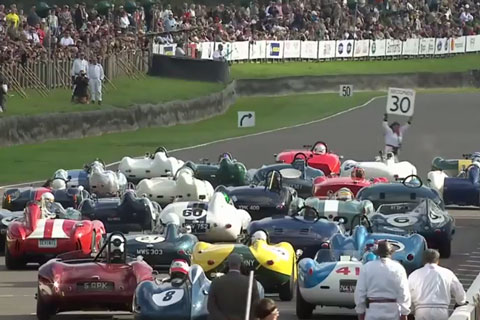
It stands no chance against the D-Types (right) or even the Lotus 15 (far left behind the Lister-Maserati)
A Swiss driver makes his debut
The day was nonetheless—or perhaps precisely because of that—insightful. The car performed well, as did the drivers. The shakedown is now complete and the first practice session in the bag; nothing is broken, and no one ended up in the gravel trap. And most importantly: Robin Dönni made his debut in front of an international audience. A complete success!

Yours truly, the owner Christian Jenny, and the driver: Robin Dönni
What’s remarkable about this driver is his versatility. From classic cars to modern supercars, he masters the entire spectrum—a combination that’s rare at his age. In a car that’s driven with the rear end rather than the tachometer, that becomes apparent very quickly. Well, we’ll know more later today—this Saturday—when the race takes place. Yesterday, Friday, we at least knew by the end of the day that it’s possible.