Yes, Switzerland - the country where milk and other things flow, such as cash flows. To give the clichés an extra boost, I have delved a little deeper into the model ranges that were once offered in this country. One thing is more than striking throughout the entire post-war history and has been confirmed to me time and again over the past decades, and not just as a motoring journalist: The Swiss despise the basic model! So if you want to boast about a really, really rare piece in this country, the best way to do it is with the basic model. These are hard to find in this country. I even suspect that some of them were only listed on the price list to serve as a decoy. Whether they were actually sold is questionable. The Citroën BX without any additional designation, for example, equipped with the 1.4-liter engine and 62 hp, was in the Swiss catalog in 1983, but never seems to have been homologated. In 1984, the BX range in Switzerland began with the 14E and 72 hp.
Another example was the Opel Kadett, the 1.1-liter bumper engine was not (or no longer) available at the beginning of 1984. Admittedly, the country's stricter exhaust and noise regulations had caused a number of engine variants to fall by the wayside the year before. But it is no coincidence that it was usually at the lower end of the model range that importers made the least effort to take suitable measures to type-approve the car after all.
![]()
Swiss version of the '48 Beetle with some chrome trim - even on the still external horn
Out of tradition
As already mentioned, Switzerland has a long tradition of being "particularly sophisticated". There were the first VW Beetles for Switzerland, for example. Unlike on the home market, the bumpers, lamp trim rings and hubcaps were already gleaming in chrome here in the spring of 1948, even before the export model had been presented in Wolfsburg. Or for the market launch of the Citroën 2CV, after initial trials with the mouse-grey models from Paris, which were decried as "ugly" even by the Swiss dealers, only Belgian models were imported, which offered such luxurious features as windshield washers, hubcaps, a sheet metal trunk lid or different body colors.
![]()
The Citroën 2CV for Switzerland came from Belgium, recognizable by extras such as the wider aluminium bumpers, the hubcaps or the attached rear lights on the fenders (brochure cover page 1955)
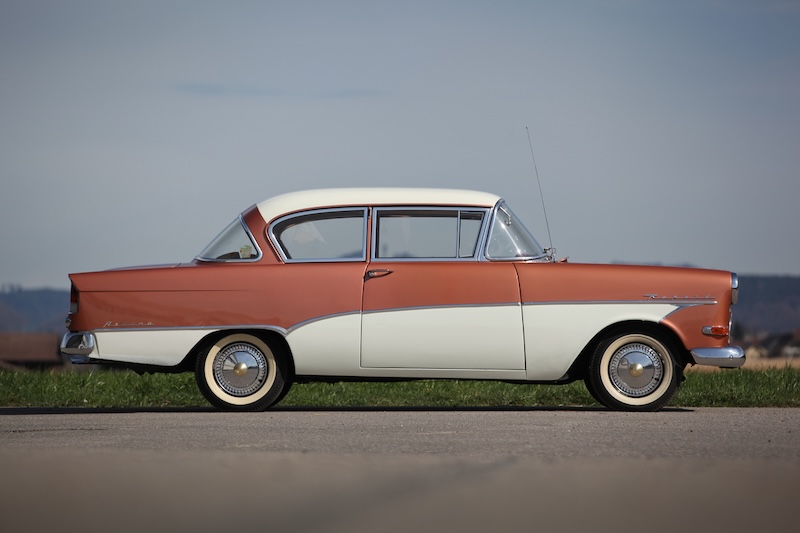
The first Opel Ascona - pictured on the cover - was also built for and especially in Switzerland. General Motors Suisse SA in Biel had specially designed a Rekord "Ascona" with even more equipment for the demanding Swiss clientele and assembled it in the watchmaking town of Biel in the country's largest assembly plant, not without a certain degree of success. However, an exception to the rule postulated here also came from here: at the beginning of the 1950s, the Chevrolet was also available with the 2.5-litre six-cylinder engine from the Opel Kapitän instead of the Stovebolt-Six especially for the domestic market, as a kind of downsizing.
![]()
The Lotus Europa Hemi 807 with over 100 hp instead of 86 hp was also only intended for the Swiss market
Even the smallest manufacturers such as Lotus went to the trouble of homologating a particularly attractive Swiss model. The Lotus Europa "Hemi 807" even has its own type certificate. The mid-engined car from Hethel was equipped with a tuned Renault 16 engine with over 100 hp for the Swiss importer, Garage Perrin in Geneva. Even a version with Kugelfischer petrol injection and around 130 hp was homologated, but was probably only built once among the 30 or so "Hemis". The popular "Seven", on the other hand, is nowhere to be found in the Swiss price lists. The first example was introduced by a Lucerne hairdresser in 1972 on a one-off basis.
And at the other end of the scale, the price list in Switzerland remained mostly empty. A standard Beetle was hard to find, the Ford Capri with a 1.3-liter engine? Not a chance! And it has remained that way to this day. During my time as a motoring journalist for new cars, there were also some embarrassing moments, such as when, at a press presentation of the Alfa Romeo Stelvio, they wanted to take the Q4 variants away from the Eastern European journalists and put them in the rear-wheel-drive diesels so that the Swiss "journos" wouldn't have to drive a model version that wasn't even intended for this market. For us Swiss, however, this was a very interesting or at least rare experience...