His first time, 100 years ago

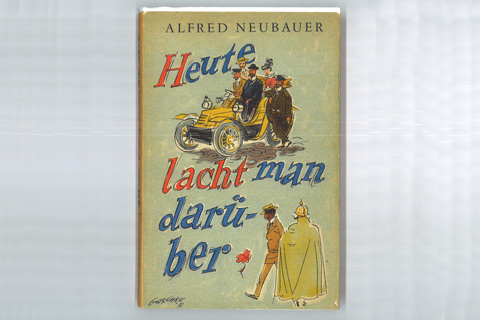
Racers, friends, rivals—they gave him many names: Fat Alfred, Don Alfredo, Friedl, or simply “The Fat One.” We're talking about Alfred Neubauer (1891–1980), born not far from the Nesselsdorf automobile works, known today as Tatra.
His career began as an automotive officer at Austro-Daimler during the Austro-Hungarian Empire, and he continued it there after World War I—as a race car driver. In 1923, he followed Ferdinand Porsche to the Daimler-Motoren-Gesellschaft, where he became head of the department for the so-called “test drivers,” who had to cover many kilometers in new vehicles as quality testers.

On September 12, 1926, Neubauer stood on the track for the first time as race director at the Solitude Race—100 years ago today. The organizers protested, but he simply said, “I am the race director for the Mercedes team. I have to stand here so I can give my people signals.” This scene marked the beginning of his unique career as the first race director at Daimler-Benz, a career that spanned three eras of motorsports.
First, he worked with the S-series supercharged touring cars, followed by his most successful period during the Silver Arrow era of the 1930s. Among his greatest achievements at that time was the development of a communication and signaling system between the pit and the drivers, first using flags and later using boards.

After the war, he led Mercedes-Benz back to the racetrack in 1952 and witnessed the tragic end in 1955: a 300 SLR veered off the track at Le Mans through no fault of its own, killing 84 people. However, the end of Mercedes' racing activities was unrelated to the accident; it had already been decided beforehand. Neubauer subsequently retired, and race car driver Karl Kling succeeded him.
In 1958–59, Neubauer published his memoirs in the widely cited books *Men, Women, and Engines* and *Master of 1,000 PS*. For a long time, there was debate over his claim that, to meet the 750-kilo racing formula, the white paint had to be scraped off the race cars to save weight. This, he said, is how the Silver Arrows came to be. Today, based on the discovery of old photographs, it is considered likely that this is exactly what must have happened, despite existing inconsistencies.

He was only indirectly involved in the development of the Silver Arrows, alongside racing director Rudolf Uhlenhaut. However, one commercial vehicle owes its existence largely to his suggestion—the “Blue Wonder.” This unusual and almost sculptural front-wheel-drive vehicle is based on the chassis of a 300 S and is powered by a 220 PS inline-six engine from the 300 SL.
Racing DNA with practical value: independent suspension, a race-car-style cockpit, and integrated aluminum loading ramps make this race transporter unique. Even when fully loaded, it reached a top speed of more than 170 km/h, enabling it to quickly transport a vehicle back and forth between the factory and the racetrack over the course of a weekend. The one-of-a-kind vehicle was scrapped in 1967; a faithful replica has been on display at the Mercedes Museum since 2001.