Big optimization steps on a small scale

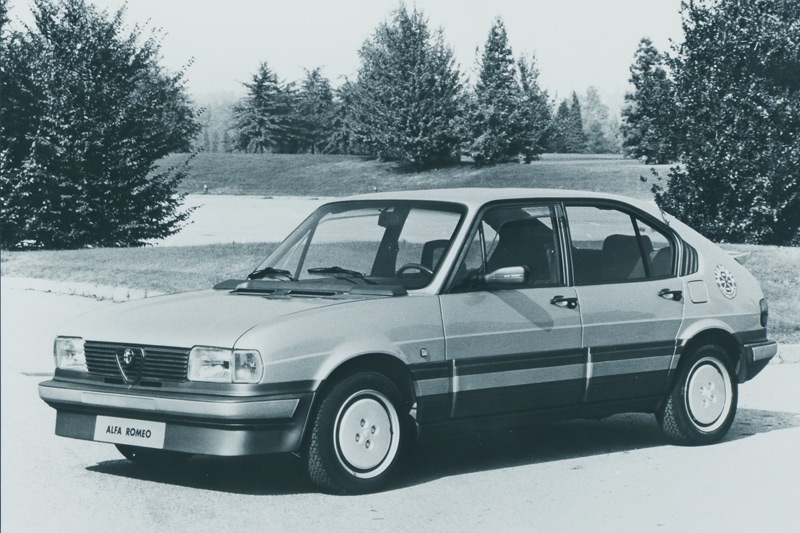
Fifty years ago, concept and research vehicles did not look like UFOs, but were more like cars you could drive in everyday life. At least this was the case with the Alfa Romeo SVAR , which was presented in December 1982.
SVAR stood for "Synthesis Vehicle Alfa Romeo" and was actually the second step in the development and was presented in Kyoto.
In a first step, Alfa Romeo had optimized the Alfasud into the ESVAR ("Energy Saving Vehicle Alfa Romeo ") and achieved impressive results.
The car had been aerodynamically optimized (Cd 0.423 to 0.328) and at the same time lightened by 77 kg. At the same time, the rolling resistance was reduced (Pirelli P8) and the engine was optimized by increasing the compression ratio from 9.5:1 to 10.2:1 and replacing the carburetor with a microprocessor-controlled injection system. The engine was also trimmed for economy with thrust and cylinder deactivation, while at the same time the gear ratio was increased. Despite this, the ESVAR was faster than the standard Alfasud.
The top speed was increased from 174 to 185 km/h and the acceleration time from 0 to 100 km/h was reduced from 10.7 to 9.8 seconds. This was possible while at the same time improving fuel consumption by 20.9 to 26.4 percent (according to ECE standards). At 120 km/h, for example, the SVAR consumed only 6.3 instead of 8.1 liters per 100 km.
Stage two (SVAR) then included improvements in terms of accident safety. The front and rear sections of the chassis were reinforced, side impact protection devices were integrated into the doors and a roll bar was added. This added another 54 kg, which meant that economy and dynamics suffered somewhat. Nevertheless, the SVAR was still 185 km/h fast and only marginally less economical than the SVAR, but in any case clearly superior to its series counterpart. Finally, the SVAR performed convincingly in the crash tests.
The press release concluded with the words: "SVAR is ultimately just one stage - albeit an important one - in Alfa Romeo's extensive development efforts to continually perfect its vehicles."
And why is all this still interesting today? Alfa Romeo showed back then that good aerodyamics are possible without compromising the face and characteristics of the bodywork. Improved safety equipment can be realized with a good 50 kg, so the increase in weight of modern automobiles has only a small part to do with this. However, Alfa Romeo had little of this to offer, at least not in the Alfasud. The successor, the Alfa Romeo 33, is likely to have benefited considerably more from this research ....