What remains of the Triumph Spitfire Mk IV
It must have been around March 1974 when my car at the time, a Fiat 124 Familiale (estate), was so eaten away by rust that it could no longer be lifted onto the jack (under the B-pillar) without it giving way in the middle with a groan. I'd had to tape the windows to the top edge for a while and the headlights were so loose they gave a bedroom view. Item, the nightmare of every motor vehicle inspector. So a new car was needed. A convertible was of course very desirable, but as a young married self-employed engineer it had to be something affordable.
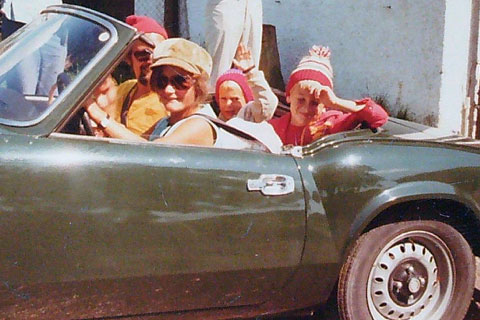
Then I saw an advertisement for a Triumph Spitfire Mk IV 1300 cc in "british racing green", second-hand, probably built around 1971, for sale at the Seefeld garage in Zurich for a price that was just within financial reach. On a first viewing in Zurich, the car looked sensational in the showroom, the bodywork, drawn by Michelotti with a light feather, shone like new. It also came with a hardtop, which made it look reasonably suitable for everyday use and winter driving. Convinced that I was buying a bargain, I signed the purchase contract.
Once the papers were in order and a new SG number was emblazoned on the car, I went to collect my new car. Unfortunately, there was about 10 cm of snow on the road, but that didn't discourage me. So I drove freshly but carefully to Wil. But I didn't get there.
Not because of the snow. But at the highway exit Münchwilen there was a terrible rattling noise and then the engine didn't really want to work anymore. No wonder, as the mechanic who was called out found that a valve spring was broken. At least the seller was kind enough to arrange for an external company to repair it. That was the last breakdown that I didn't have to pay for myself.
The joy of the beautiful little car was soon spoiled by this and that event. The spare wheel in the not exactly ample trunk had to make way for a toolbox and a can of Finilec, because the likelihood of a flat tire was dwarfed by all sorts of other breakdowns. Neither before nor since have I ever had a car like this. And the fatal thing was that the punctures always occurred at the most inopportune moment.
Once I was called out to an urgent maintenance job in the Welschland. At about Spreitenbach, the left rear wheel bearing seized up. After about 2-3 hours, the car was finally in a workshop, another one rented and all the computer junk reloaded. The retrieval operation took another half day.
When is the right time for a distributor axle bearing to break? Shortly before midnight on the highway during a cloudburst, of course. At least I made it home with a couple of broken tongue depressors as a makeshift and in creep speed.
When is the right moment to burst a water hose? When you call an expectant father from a customer visit to say that his wife is in labor. When I arrived at the hospital, I was immediately enveloped in a cloud of steam and could no longer see the tip of my nose.
While the valves on many cars are self-adjusting, they were self-adjusting on the Spitfire. To keep the rattling under control to some extent, I always had a distance gauge in my toolbox.
Anyone who believes that a hardtop protects against the rigors of winter is not familiar with the Spitfire. The gap between the windshield and the hardtop provided good ventilation and a few snowflakes on my face. The fabric roof was much tighter.
Speaking of winter: The oil dampers of the two SU carburetors had to be filled with hydraulic oil in frosty temperatures because the single-grade oils of the time were too solid when the engine was cold. And while we're on the subject of these funny carburetors: In the morning on the drive to work, I often got a carburetor icing up, which only allowed me to continue driving after a long wait.
After a crankshaft bearing got stuck for the second time, I gave the car to an apprentice mechanic for a few francs. The battle with the supposedly cheap car became too expensive for me. But anyone who wonders why "British Leyland" was renamed "British misery" may never have owned one of these English cars of the early seventies.
Our dog, however, loved the convertible rides (as does mine today). When we overtook another car, he would proudly turn his head to the right after the "boring car". However, if we were overtaken ourselves, he would turn his head bashfully to the right.
But it was one of the most beautiful cars I have ever owned. Pretty, attractive, curvaceously styled, agile, light-footed if rather bitchy. Any comparisons with living creatures are conditional. And even in later years, I still dreamed of the Michelotti bodies. So much so that one day I couldn't help but visit a Triumph Stag that was being advertised in the German Palatinate.
And because I didn't want to forget the Spitfire despite the mishap, I kept the owner's manualand the sales brochureto this day.
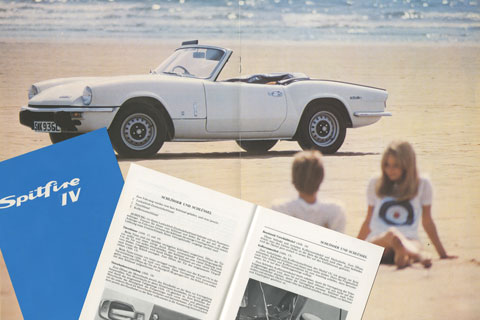
Both documents can now be found in the Zwischengas archive.