What also influences the market value of a classic car/youngtimer

Actually, the market valuations for cars of the same type, which are also in a similarly good condition, should settle at a similar level. They used to do this in the past, but no longer do. You can quickly see this when you analyze auction results for a vehicle type.
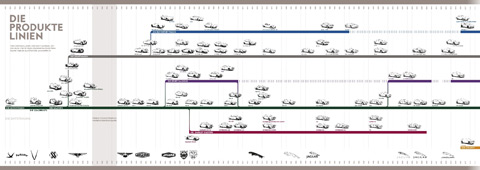
There are indeed characteristics such as a thoroughly documented history, originality, authenticity, owner recognition, success in racing and concours, as well as restoration quality, which have a significant influence on the value. But there is at least one more criterion, as Christian Jenny explained at the Jaguar information evening organized by the Jaguar Drivers Club at the Emil Frey Classics Center in Safenwil. In his view, the position on the product line (in particular the proximity to branches) is also an important factor influencing market value.
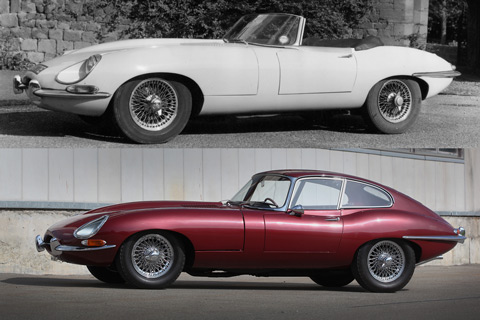
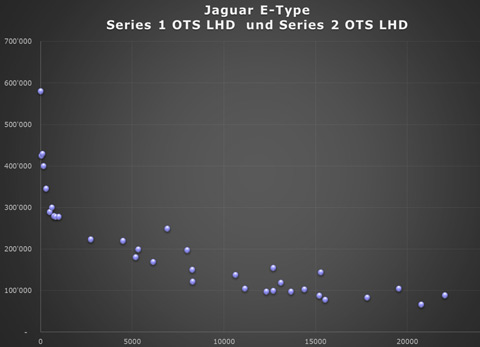
This was illustrated by Jenny using the Jaguar E-Type as an example. Jenny explained that the very early examples achieve significantly higher prices, while later Series 1, Series 2 and Series 3 are traded visibly lower (shown in the picture by the increasing production volume on the horizontal axis).
This consideration is certainly worth investigating, but the additional criterion could also be interpreted more openly: How rare or distinguishable is an automobile based on its manufacturing or historical constellation compared to others from the same product line?
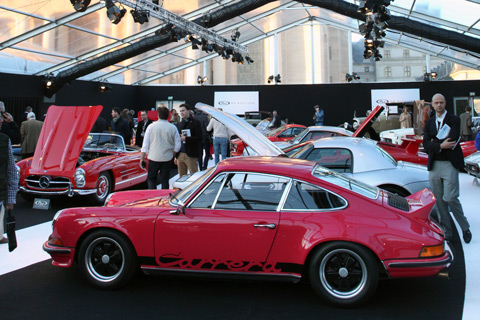
A Porsche 901 is technically and conceptually almost indistinguishable from an early 911, but is nevertheless sold at a significantly higher price, simply because there were only a few 901s before the designation was changed. And the early Jaguar E-Types are also valuable because they differ significantly from later models in terms of construction (keyword "flat floor").
Special models within a series/product line also often give rise to higher prices, because they were produced in small numbers and can be authenticated cleanly.
However, it is not only difficult to separate the value-determining factors, but also to obtain a truly statistically stable database, because unfortunately (or thankfully) we are not dealing with a completely transparent market in the classic car trade ...