The ideal winter car?

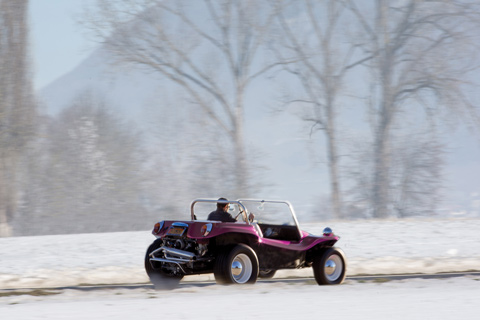
In the 1960s and one or two decades later, anyone who did not want to expose their hard-earned "modern" car to the side effects of winter (snow, ice, cold, salt, etc.) bought a "winter car".
A good winter car had to be robust, start reliably even at low temperatures and, above all, offer good traction. Narrow wheels, perhaps even equipped with studded tires, and sufficient ground clearance were also an advantage.
The VW Beetle was one of the favorites when it came to determining the ideal winter car. It was robust, had the engine mounted on the drive axle and, with its large wheels (diameter), was also convincing on snow and ice.
Even better, however, would have been a Beetle after its metamorphosis into a buggy, because the advantageous Beetle characteristics were retained. An additional advantage was that the buggy was significantly lighter and the short wheelbase made the car more agile. Of course, the buggy would also have needed narrow winter tires, but the early examples of this type still had comparatively narrow tires, because the same characteristics were also important on sand.
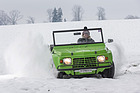
Why didn't the idea catch on back then? Well, there were also disadvantages. For example, heating a buggy was a problem and hardly any of them had a really tight and heat-insulating hood. But the buggy would certainly have been a lot of fun to drive in winter. Unfortunately, we haven't really been able to verify this yet, the picture above is a photomontage. However, if anyone would like to provide us with a buggy with winter tires, we would be happy to test its suitability for winter use. Gloves and hats are ready.
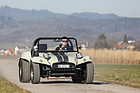
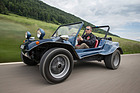
We have just published a comprehensive report on the Meyers Manx buggy, which can be seen in the picture.
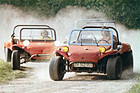
You can also find more buggy pictures in our picture magic series" Buggymania".