Self-driving cars 50 years ago

Future-oriented magazines such as "hobby" or "Popular Mechanics" were already describing self-driving cars in the 1950s, but serious research also took up the subject early on and with some meticulousness.
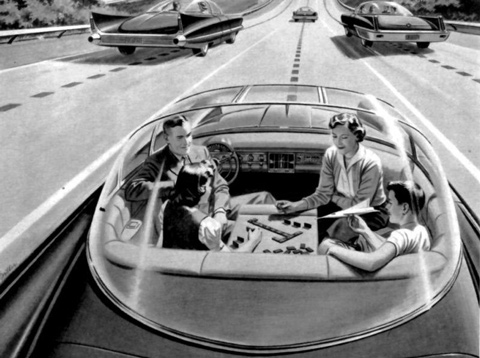
K. Behrendt reported on the state of research in the first issue of Automobil Revue in 1967:
"At Ohio State University in Columbus, Ohio, engineers under the direction of Dr. Robert L.Cosgriff are working on the design of a "driverless car" This is a remote-controlled automobile in which all steering functions are taken over by an electronic system that responds to appropriate electromagnetic signals. Two receiver coils on the car transmit the signals to a small analog computer, which immediately records and corrects deviations from the course and the intended speed .
Joystick as brake and gas pedal pedal
In the "driverless car", the driver does not need to do anything; his car drives along a road, turns, brakes or accelerates without the need for a driver. To be on the safe side, the Ohio State University test car also has a driver with a brake pedal in case of an emergency. There is also a button on the handlebar (in the form of a joystick) that can be used to switch from "automatic" to "manual" mode. The steering rack is reminiscent of the General Motors Unicontrol system; there is no actual steering wheel. To decelerate or brake, the steering stick, which serves as an accelerator pedal, is pulled backwards .
According to the research team, the shortcomings of the steering stick can be eliminated without much effort. The electronic steering should also be easy to manage. This requires two current-carrying cables under the top road surface, while an induction loop must be attached to the front of the "driverless car" in the middle and on the underside of the vehicle on one of the two sides. "Detectors" should indicate if the front loop is too far away from the two side cables, i.e. the car tends to "break away" to one side or the side loop does not have the correct angle to the road axis. If this is the case, signals from the detectors cause the necessary steering corrections to be made with the help of a small analog computer.
The "longitudinal control", which ensures the correct distance to the vehicle in front, still poses greater problems at present. Detectors are provided on the road for this purpose. If a car passes such a "sensor", it signals this to the next detector, which in turn transmits a signal to the next car. In this way, the computer in the second car can calculate how fast the "car in front" is driving and how far away it is. The signals sent by the computer to the joystick cause the car to maintain its speed or to accelerate or decelerate, depending on the circumstances .
According to Dr. Cosgriff, "driverless driving" should be possible in around 15 years on a series of suitably modified roads. The electronic devices in the car itself should only cost a few hundred dollars, while the signaling system in the pavement will increase road construction costs by around 10%. Driverless cars that travel at 100 km/h are to be tested at the university's Transportation Research Center from 1969."
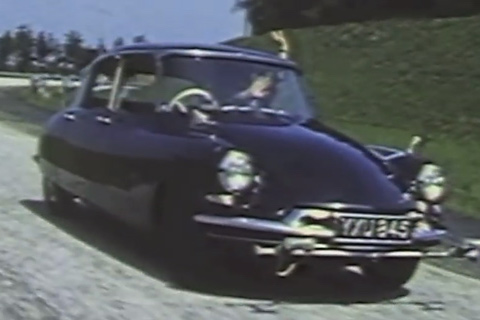
And the Americans were not the only ones working on such a system. In the UK, a Citroën DS also did its laps autonomously on a test track, following similar technical concepts (see pictures above and below).
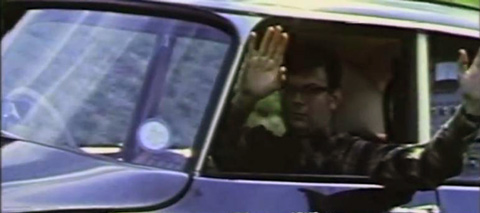
However, neither the technical approach nor the self-driving car prevailed 50 years ago. The demands of today's developers are much higher, as the controls in modern autonomous cars are intended to replace the human driver without any external assistance ...