Zwischengas wishes you all the best for the new year!

12/31/2010
We wish all zwischengas friends and members a HAPPY NEW YEAR!
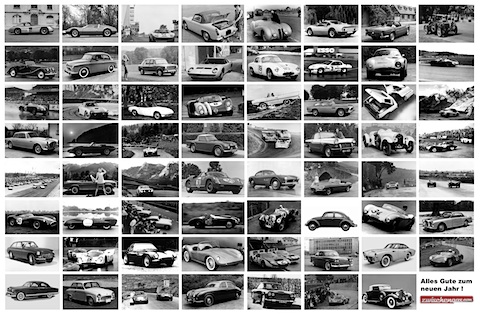
A larger or higher resolution version of the "New Year's card" can be downloaded here .

We wish all zwischengas friends and members a HAPPY NEW YEAR!
A larger or higher resolution version of the "New Year's card" can be downloaded here .
The end of the year invites you to make good resolutions for the new year, to make plans. We at zwischengas.com have a lot of ideas that we want to implement and the good resolution is to implement the things that are most important to our readers and members.

Our list of plans includes
The list is much longer, so we are all the more interested in what our readers have on their minds.
And in addition to functional enhancements, we also want to digitize more archives, make valuable documents available and link content even better.
So what should we aim to do in 2011? Ideally everything, right?
The nice thing about large-scale classic car meetings (such as the Oldtimer Sunday Morning Meeting in Zug/Switzerland) is that there are also real rarities to be found among the many frequently seen classics.
A Beutler Porsche surpasses the much-vaunted Mercedes-Benz 300 SL in terms of rarity and even a Ferrari 250 GTO was produced more often than the rarities produced by the Beutler brothers at the end of the 1950s.

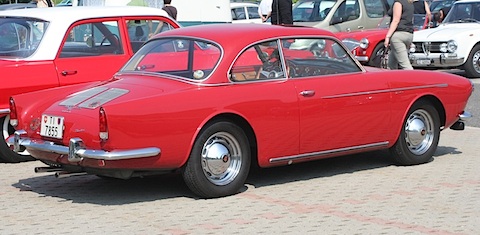
On August 27, 1959, under the title "A four-seater Porsche" , AR presented the Beutler, which was built on a chassis that was 25 cm longer than the 356 and, with an overall length of 450 cm, offered space for four people and also had an enlarged luggage compartment. The body variant was built with the consent of Porsche - after extensive testing of the prototype.
The Beutler brothers (from Thun) also built other special bodies, using Lancia, Maico, Bristol and especially Volkswagen chassis as a basis. The designs appealed for their elegance, good use of space and practicality.
The Beutler coupés were praised in an article in the AR on March 20, 1957 on the occasion of the Geneva Motor Show tour:
"Beutler has reached a new peak in the clothing of the VW chassis, which this year will be equipped with the engine and brakes of the Porsche 1600. This year's version achieves the impression of length by the simplest means, namely by enlarging the front and rear overhangs and making both sections as flat as possible. These bodies, which have gained in purity of form thanks to numerous individual improvements, also feature very tightly dimensioned windshield pillars and a significant window area."
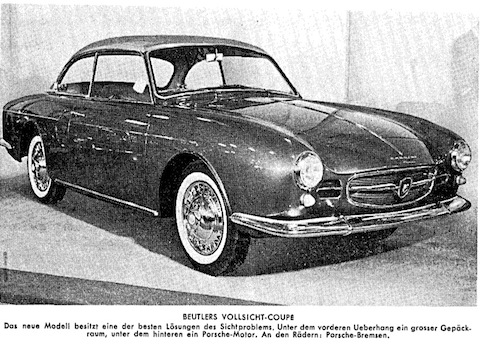
The collaboration with Porsche also resulted in a special 356 version, which is advertised in the following advertisement from 1960.

Pictures of roads and traffic routes from the past are always interesting to look at. So much has changed and yet you can probably recognize some streets even after 50 years.
Tiefenaustrasse in Bern will probably look familiar to every local even after 50 years, even if the cars and road signs, but even more so the advertisements, have changed considerably. The VW Beetle is present in almost every picture of a street during this period.

This elevated road in Tokyo, taken in 1959, was innovative 50 years ago. The road runs over the roofs of houses, so to speak.
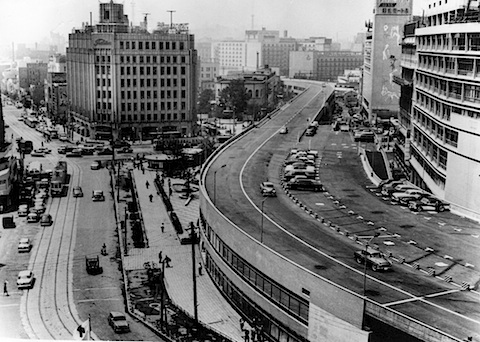
It is not surprising that there are no Beetles visible here (in Tokyo), but many vehicles with pontoon bodies.
We would be delighted to receive impressive street photographs from the past from our zwischengas readers, which we would then be happy to publish.
In Motor-Rundschau 10 of 1961, doctors clearly demanded the return of hand throttle! The reason for this was also given immediately:
"Many unspecified complaints, such as general lassitude, rapid fatigability, headaches, dizziness, pressure-sensitive tension in the neck and shoulder girdle down to the gluteal muscles are involved. Many patients spontaneously state that these and similar complaints occur to a particularly unpleasant extent on long car journeys. This is attributed to the fact that the driver's movements are restricted, especially because he has to constantly fix his right leg on the accelerator pedal."
The recommended solution is to install a hand throttle to give the right foot more freedom of movement.
Many cars built up to the 1960s had hand throttles as standard, such as the 1954 Alfa-Romeo 1900 Super shown here.
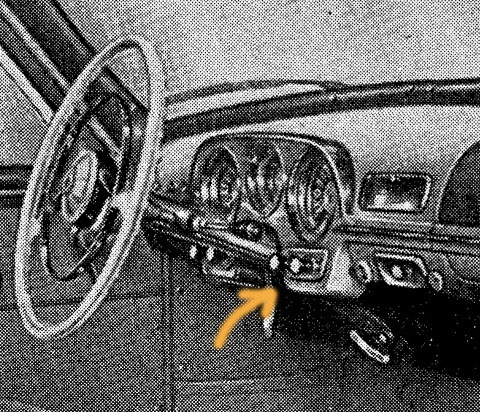
Later, the hand throttle disappeared and only exotic models such as the Haflinger offered this special feature. The need for it also diminished with the advent of cruise control and similar devices.
However, the question remains as to how quickly the foot, freed by the hand throttle, found its way to the brake pedal in an emergency ....
Driving a car used to be much more demanding in many areas than it is today. Things that are self-evident and automatic in modern vehicles used to have to be controlled and monitored by the driver. For example, a report in Motorrundschau 23 from 1961 warned against driving with an "undercooled engine":
"Nothing is as damaging to an engine as driving in a supercooled state. Cooling water temperatures below -70 degrees Celsius damage the lubricating oil by preventing it from reaching the low viscosity required for circulation in the engine. The consequences of chemical wear are even worse. When the engine is undercooled, the lubricating film on the cylinder walls is washed away by fuel condensation, resulting in the risk of short-term dry friction from metal to metal. Above all, however, acidic combustion residues are formed which attack the cylinder liners, pistons, piston rings and bearings. A single cold start is equivalent to the wear that occurs in around 10 hours of operation at full throttle."
Those were strong words. Even back then, many "modern" vehicles already had a thermostat that supported rapid heating from a cold start, but the problem of keeping the operating temperature at the desired level even at low outside temperatures remained unsolved. Car and accessory manufacturers therefore offered various solutions.
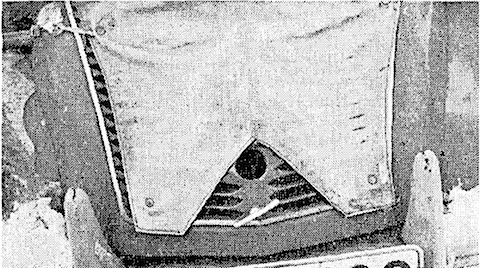
There were "semi-official skirts", as shown here on a Citroën 2CV:
And there were so-called "radiator shutters", which could (in some cases) be adjusted via Bowden cable from inside the car, or even automatically regulated the cooling air supply.
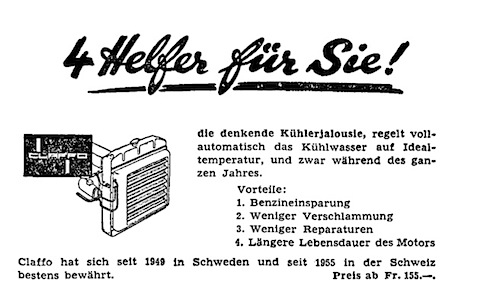
However, some of these solutions had the disadvantage that the opposite could also be achieved if they were not carefully monitored and operated - the engine could overheat. If you also consider that many vehicles at that time did not have a coolant thermometer, then you can imagine that operating errors could not be ruled out.
When developing the zwischengas platform, care was taken to ensure that it can also be used well in the iPad browser. For example, the selected screen width fits perfectly in the iPad's landscape orientation. All functionalities are available. However, the absence of a keyboard that is available at all times has some minor limitations, e.g. to scroll forward in galleries you have to tap twice on the right-hand side of the image, the first time activating the area, the second time scrolling forward. On a computer, this can also be done using the arrow keys on the keyboard or by clicking once on the image with the mouse.
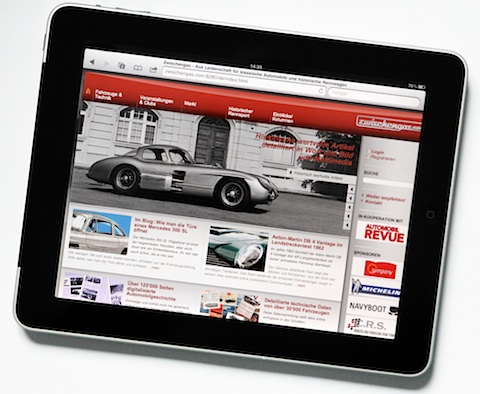
The application can also be used well on the iPhone, although the small screen is not ideal for reading archive articles and other high-resolution content.
It is practical to place Zwischengas on the "home screen" of the iPad or iPhone. This can be done very easily in four steps, as illustrated below.
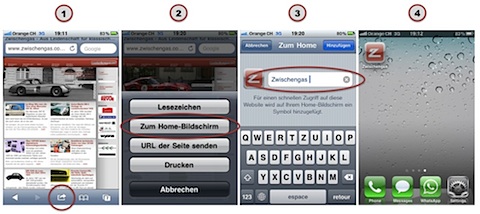
First, when you are on zwischengas.com, click on the arrow symbol in the rectangle (bottom on the iPhone, top on the iPad), then select "Add to home screen", you can then assign a name and have already placed the beautiful zwischengas button with "Add".
From today's perspective, we can hardly imagine that seats are not adjustable, blinker levers are not automatically reset or that cars are operated with 6-volt systems. In the early 1960s, however, things were still different, at least to some extent.
The magazine Motor-Rundschau repeatedly asked its readers about their preferences, for example in January 1962, whether they were in favor of blinker operation with automatic resetting: 77% voted for automatic resetting, 23% against. The arguments of the opponents are interesting: the blinker goes out during steering corrections, the automatic reset does not work as desired in city traffic, manual actuation gives you better control over the actuation, unnecessary costs and source of interference, double caution and attention required, etc. were the reasons given by the opponents.
The following surveys and results from the years 1960-1962 are also interesting:
In March 1962, 90.4% of MR readers were in favor of front hinged windows , as they provided low-draft ventilation, increased the supply of fresh air even in rainy weather, enabled quick opening and were simply practical. The reasons given by opponents were that they favored theft, whistling noises, visibility disadvantages and the preference for other ventilation options.
The result of the April 1962 survey was also exciting, as only 64% preferred a 12-volt system to a 6-volt system. The reasons given by the 6-volt fans included the wide availability of 6-volt components in Europe, the lower costs, the lower weight, the faster testing, the longer service life of the bulbs and the fact that spare parts were always available.
The survey in June 1962 seems almost funny, when 81% were in favor of a brightly painted engine compartment, while the 19% opponents mainly mentioned the increased cleaning effort and more expensive painting costs.
Yes, from today's perspective, some of these surveys may seem strange, but it shows thatdrivers of the past were much more concerned with the technology and design of their cars than modern car owners tend to be.

For zwischengas, Christmas was almost here on December 22 when we went live to the public.

We wish all our readers and members a Merry Christmas, a peaceful and reflective holiday season and plenty of time to find the treasures you've been looking for in the wealth of information on zwischengas.com.
Exactly 50 years ago, this Corvette advertisement appeared on December 22, 1960, drawing attention to the 1961 model .
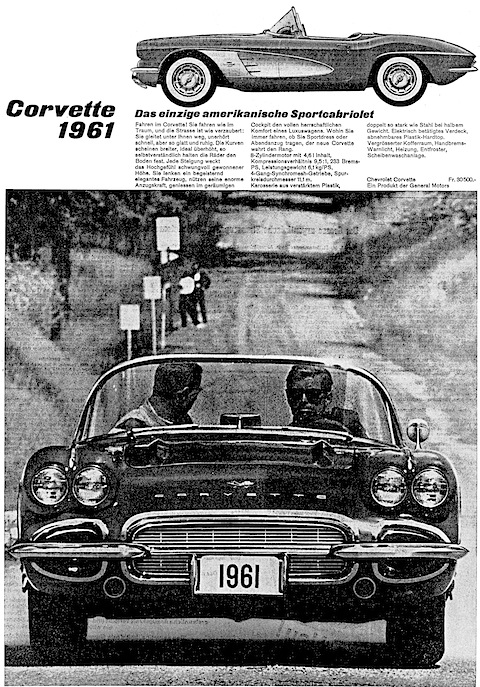
"The only American sports convertible" was the slogan.
And the advertising copywriters drew on the full potential: "Drive the Corvette! You drive as if in a dream, and the road is enchanted: it glides away beneath you, incredibly fast, but so smooth and quiet. The bends seem wider, ideally banked, the wheels grip the ground so naturally. Every incline awakens the exhilaration of having gained height. You steer a thrillingly elegant vehicle, make use of its enormous pulling power, enjoy the full stately comfort of a luxury car in the spacious cockpit. Wherever you drive, whether you're wearing a sports outfit or an evening suit, the new Corvette holds its own.
At SFr. 30,500, the Corvette - which, incidentally, was referred to as the Corvette in this Swiss advertisement - was not cheap, but the equivalent value was equivalent to around 4 Volkswagen Beetles.
But the following statement is certainly also interesting:
"Body made of reinforced plastic, twice as strong as steel at half the weight."
And an interesting question is whether the passenger in the picture is simply looking back to the old year or is happy that he doesn't have to wait for the bus ...
Zwischengas has been publishing a daily blog post here since 2010
For more entries, please use the navigation by year and month.