
Arosa ClassicCar 2010 - the Nürburgring of hill climbs

The Langwies-Arosa hill climb circuit is exceptionally selective. If you look at the results of the historic hill climb that took place last weekend, you can quickly see the limits of the cars and drivers in the results.
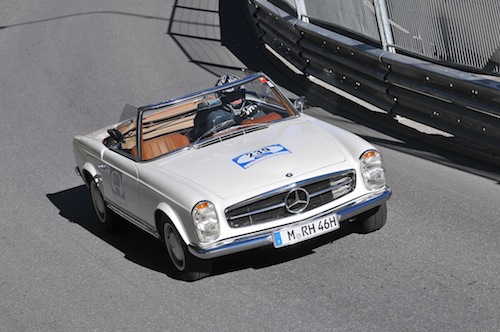
In the regularity classification, the actual running time was secondary, which gave a Mercedes 250 SL victory on Saturday thanks to a difference of just 1 hundredth of a second. However, if attention is paid to the running time, the critical success factors for fast hill climb times become apparent: High power-to-weight ratio, plenty of mechanical grip, well-balanced suspension and, above all, a skilled driver. The latter actually has an enormous influence, as you would expect. Otherwise, the super-fast Fiat 124 CSA Abarth with times comparable to a Lotus 23 would be inconceivable. Similar vehicles with a difference of 30 seconds or more per hill climb can also be explained primarily by the driver. The fastest times around 4:30 were only achieved by a few modern cab vehicles (Seat Super Coppa, Porsche 911 GT3 RS, Porsche Carrera GT) and by well-known fast classics such as the Chevron Formula 3, the Porsche Carrera 6 and the rally Ford Escort RS (1980). Most of the other participants can be found in the 5 to 7 minute time window. Under 5:30 already means mastering the hillclimb course, which is characterized by 76 bends, at around 90 km/h. Even on Sunday evening, many of the drivers were unable to keep the course completely in their heads and therefore (partially) drove on sight.
The Langwies-Arosa circuit has it all: hairpin bends, downhill sections, fast serpentine bends, straights and tight 90-degree bends. It's almost like a mini Nürburgring - the only thing missing is the carousel!