How does a synchronized gearbox actually work?

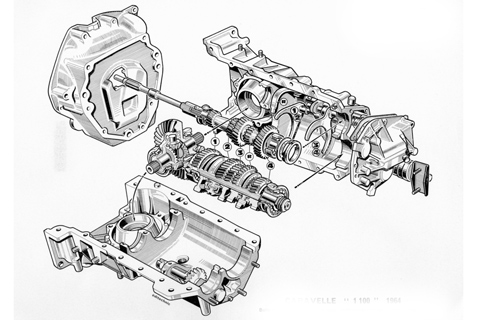
Nowadays, hardly anyone knows what a simple four-speed gearbox feels like, what with all the torque converter automatics and eight-speed DSGs. However, even back then, not everyone was aware of how a synchronized gearbox really worked. That's why "auto motor und sport" made an attempt in 1952 to explain how the transmission works in an understandable way. It sounded something like this:
"You're driving in some lower gear, you've revved the engine and want to go into the next gear. So disengage the clutch, release the accelerator at the same time, pull the gearshift over and it starts to screech. This is because your rear axle and the transmission parts connected to it are still turning at the same speed. However, in order to be able to engage the new gear immediately, the engine speed must have already dropped - and you have shifted too quickly! The art of noiseless and smooth upshifting is based on giving the engine, which has just been cheering loudly, enough time to calm down to the speed corresponding to the new, higher gear after the low gear has been pulled out. This primarily requires time. You can try this out - pull out a low gear, consciously force yourself to wait, engage a higher gear. You will then quickly find out how long you have to wait between gears until you can engage them smoothly. Make things easy for yourself: keep the clutch disengaged! Of course, it is an advantage to let go of the clutch while waiting between gears and only depress it again to engage the gear - don't do that at the beginning, try waiting a little between gears, that will help a lot. And when your hand has mastered this without thinking, then teach your left leg to double-clutch, i.e. to temporarily release the clutch until you depress the clutch again to engage the new gear. By the way: There are people who like to set a fairly fast idle, me too - you have to take a little longer breaks when changing gear, the engine then takes longer to drop down with the revs.
So, and now the other way round: you're in high gear and want to go into a lower gear. The transmission parts connected to the rear axle continue to run unchanged, and the lower gear cannot be engaged because the engine would have to rev higher than before. To be able to pull out the big gear, you have disengaged the clutch and taken your foot off the accelerator - someone once told you that you have to take your foot off the accelerator to engage the clutch. Your engine doesn't think about revving higher than before!
I do this by disengaging the clutch - but not very low, just low enough so that the big gear can be pulled out. I also take the throttle off - but not all of it. When the big gear is out, the engine cheers all by itself and the smaller gear can be pushed in. . .."
Of course, this did not explain how the gearbox works, but you could read on for a while. And there was also an illustration to enjoy in the article in issue 3/1952 of auto motor und sport .